European Oak Slab Buying Guide
How to assess the size, drying, movement, grain, finish and price of a European oak slab before buying online.
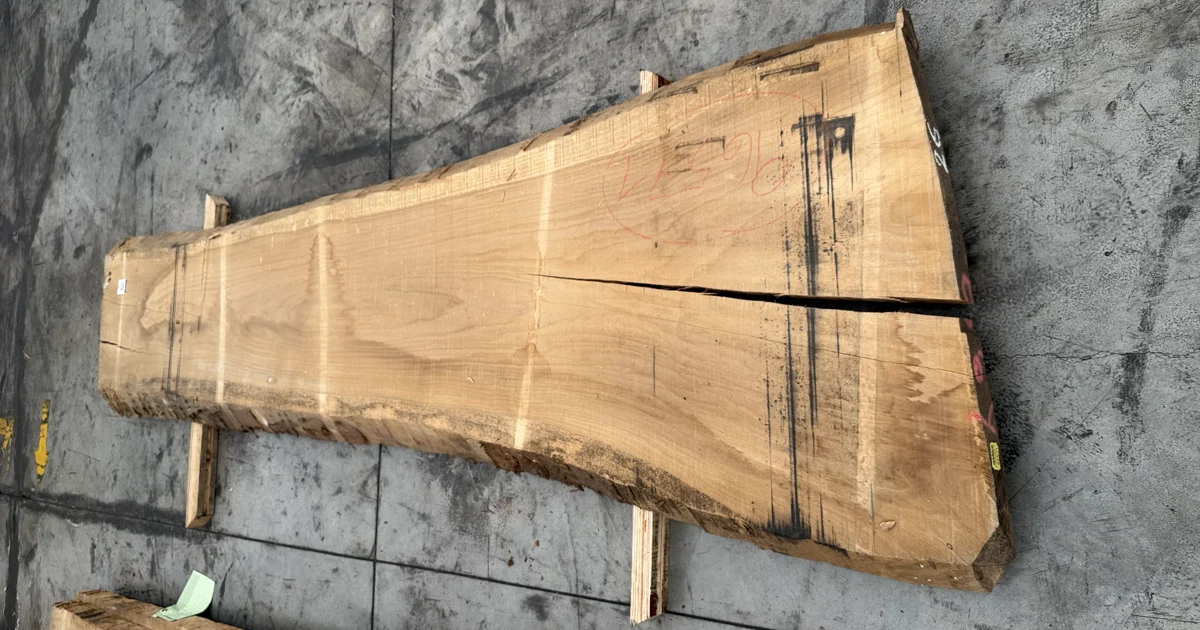
European oak is a practical choice when you need a large table top with visible grain and enough thickness for substantial joinery. It is hard, familiar to most makers and available in one-piece widths that can reduce the need for a bookmatched pair.
The important question is whether a particular oak slab suits the drawing, workshop and final room. Start with the measured outline, then check width, thickness, moisture and defects. This guide explains what to look for. For the broader ordering process, read How to buy a hardwood slab in Europe.
Why makers choose European oak#
European oak usually refers to Quercus robur and Quercus petraea. Both have a long history in European furniture, interiors and structural work. The timber combines high hardness with workable machining characteristics, although interlocked or changing grain can still tear out under a planer.
Its pale straw to warm honey colour works with many interiors. The grain remains visible under clear oil, soap-style finishes, stains and darker treatments. Oak can therefore support a quiet contemporary top or a heavier, more architectural table.
Weight is part of the decision. A wide slab at 70–90 mm thick is demanding to carry, flatten and support. Confirm access to the workshop and final room before ordering. A removable base is usually sensible for a large dining table. See the European oak species guide for further species detail.
What an oak slab looks like#
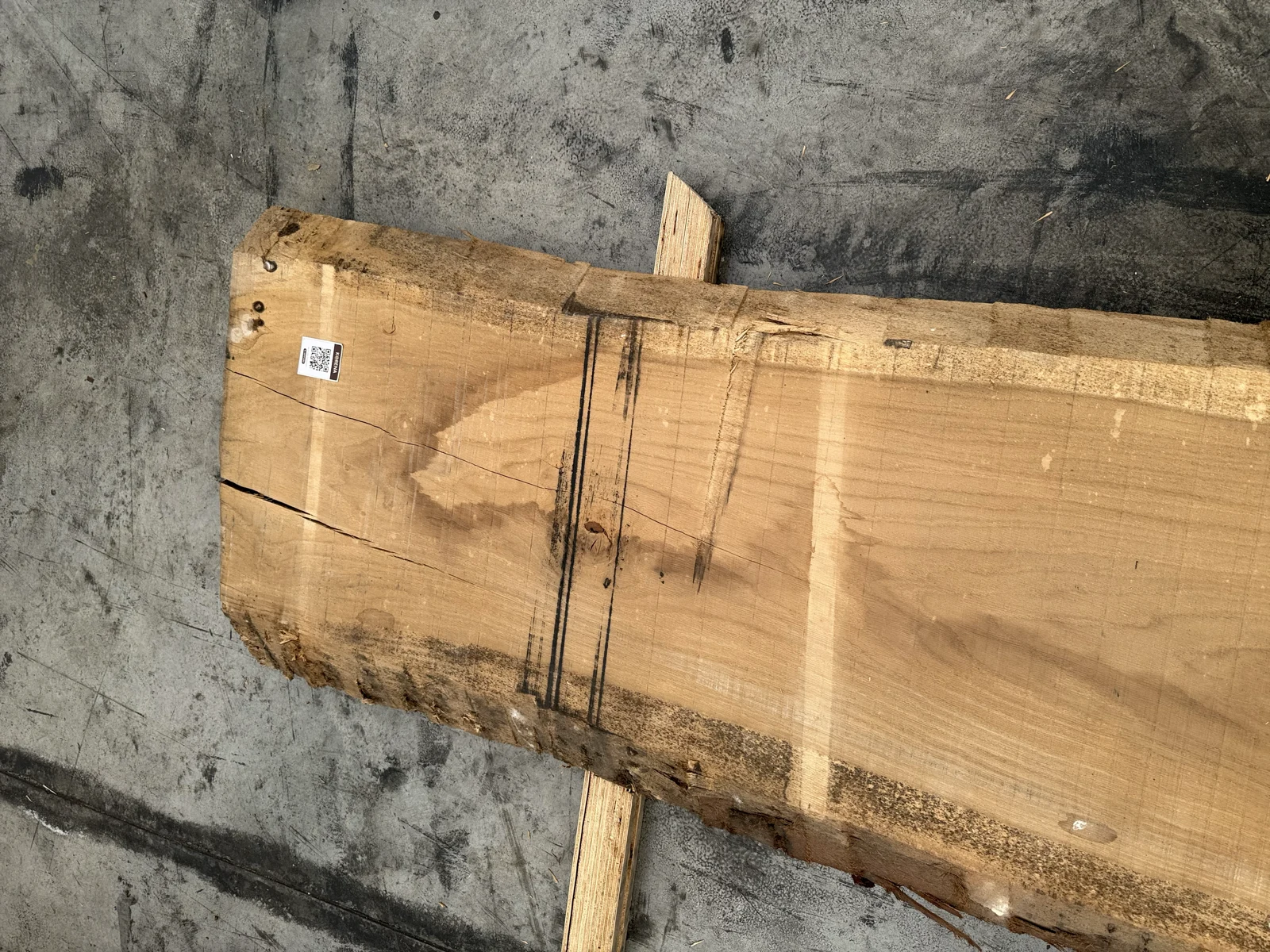
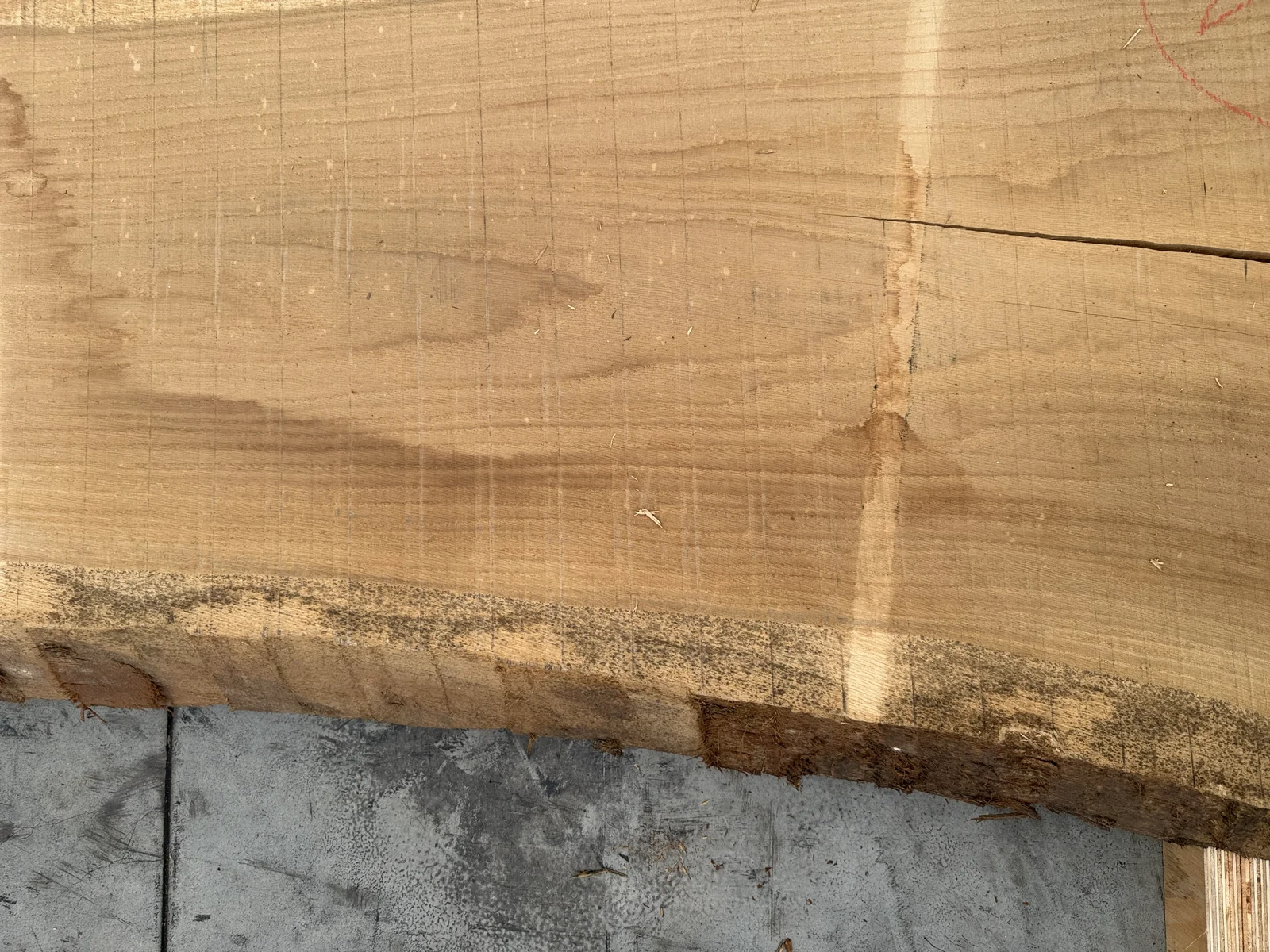
Oak has open pores, clear growth-ring structure and a strong contrast between earlywood and latewood. That structure gives the surface visual depth, but it also means the grain can remain tactile after finishing. Sanding alone does not make open pores disappear.
Quarter-sawn areas may show medullary rays as bright flecks or ribbons across the face. A slab can contain quarter-sawn, rift-sawn and flat-sawn figure as the cut moves around the log. Look at the full outline and face photographs rather than expecting one grain pattern across the entire width.
Oak is rich in tannins. Contact with iron and moisture can produce blue-black marks, including rings around unsuitable fixings or stains from metal swarf. The same reaction can be used deliberately for ebonising, but test it on an offcut or hidden area first. Colour depends on tannin content, preparation and the solution used.
On a live-edge top, oak tends to read as architectural. Broad growth rings, pale sapwood, bark inclusions and an irregular edge remain visually strong even after the base and chairs are added.
Sizes available in oak#
Oak trees can yield long and genuinely wide boards. Current KORENA stock includes six European oak slabs measuring about 3.2–3.3 m long, with individual pieces reaching roughly 1.0 m wide. Thicknesses are substantial at 70–90 mm.
That makes a one-piece European oak table top realistic for many dining-table plans. A similarly wide walnut top may require two matched boards, depending on available stock. One piece avoids a central glue line, though it can present more movement across its full width.
Do not treat maximum width as usable width without checking the outline. A slab listed as about 1.0 m at its broadest point may narrow near an end or around a natural edge. KORENA listings record width at 25, 50 and 75 per cent of the slab length, alongside the measured outline. Compare those stations with the intended leg positions, place settings and trimming lines.
The dining-table slab size guide gives practical dimensions for matching a slab to seats and room clearance.
Drying, moisture and seasonal movement#
Oak dries slowly. If the drying schedule is rushed, internal stress, surface checks and end checks can develop. Thick stock needs particular care because the centre loses moisture later than the outer material.
Current oak examples are kiln-dried, with recent moisture readings between about 8 and 10 per cent. Treat that reading as a point-in-time measurement rather than a promise that the slab will never move. Moisture changes during storage, transport and use as the timber approaches equilibrium with its surroundings.
Ask where the moisture reading was taken and check it again after delivery with a suitable calibrated meter. Let the slab acclimatise in conditions close to the intended room before final flattening or joinery. The required period varies with thickness, packaging, workshop climate and the difference between transport and indoor conditions.
Movement across the grain remains significant. A wide oak top must be free to expand and contract across its width. Use an attachment method such as table buttons, figure-eight fasteners or screws in correctly oriented slots. A rigid row of screws through a steel base can encourage splitting or distort the top.
End checks are not automatically disqualifying. Their location and depth determine whether they can be trimmed away, stabilised or accepted as part of the piece. Check both faces and the end grain before deciding.
Plan flattening allowances before choosing the final thickness. A 70 mm rough slab will not necessarily finish at 70 mm after acclimatisation, flattening and sanding.
Finishing European oak#
First decide whether you want to feel the grain. A clear hardwax oil generally keeps oak close to its natural appearance and is straightforward to maintain locally. It does not fill the open pores, so the surface will retain some texture under raking light.
For a smoother, more uniform surface, use a compatible grain filler before the finishing coats. Test the complete schedule because fillers can change contrast in the pores. Water-based products may also raise the grain and require an intermediate de-nibbing step.
White treatments can reduce the amber cast and emphasise the pore pattern. Dark and black stains also read clearly because pigment collects in the open grain. Always prepare a sample to the same sanding grit as the table. Different sanding sequences can produce visibly different stain absorption.
Avoid ordinary steel wool around unfinished or water-based-coated oak. Small iron particles can react with tannins and leave dark spots.
What an oak slab costs#
Oak is usually friendlier per square metre than walnut, but compare the actual pieces rather than relying on the species name. Current oak stock is thicker than many common table-top requirements, and that extra volume affects material price, freight, handling and machining.
As a current reference, a kiln-dried piece around 3.3 m long, 1.0 m wide and 70 mm thick is about €490 net. The final comparison should account for VAT where applicable, delivery, expected trimming and the usable surface area inside the natural outline.
Divide the price by usable area, then record thickness separately. Two slabs with similar face dimensions are not equivalent if one provides 70 mm and the other 50 mm. The thicker piece may suit a heavy top or allow more flattening, but it also adds weight and may require material removal.
For a fuller costing method, including yield and transport, see what a hardwood slab costs in Europe. The KORENA Timber Index provides a daily-refreshed European hardwood price reference, but an individual slab still needs piece-level comparison.
Picking your oak slab#
Start with the finished drawing. Mark the minimum width required at the head, centre and foot of the table, then compare those points with the listing's 25, 50 and 75 per cent width stations. Leave enough material for straightening, edge decisions and final trimming.
Review the measured outline alongside the face photographs. An outline shows where the usable wood actually sits; a single maximum-width figure does not. KORENA listings also state length, thickness, drying method, moisture reading and a precision badge, typically within 10 mm. Build that stated tolerance into the cutting plan.
Inspect knots, end checks, bark inclusions and any cracks crossing the proposed cut line. Decide which features can remain, which need stabilising and which must be removed. Ask for clarification if a photograph does not show the depth or the reverse face clearly.
These two current pieces provide a useful starting comparison:
Compare their outlines and width stations against the same drawing. Check whether a knot conflicts with a leg fixing, whether an end check falls inside the final length and whether the available thickness suits your flattening process.
Browse all oak slabs in stock when you are ready to compare pieces. I measure each slab myself in the partner yard, and every piece carries a per-piece wood passport, accessed by QR code, for recorded provenance and supporting due-diligence information.