Measurement
How to measure a live-edge slab: one method for sellers and buyers
A shared method for recording slab dimensions, volume, usable size, flatness, moisture and defects.
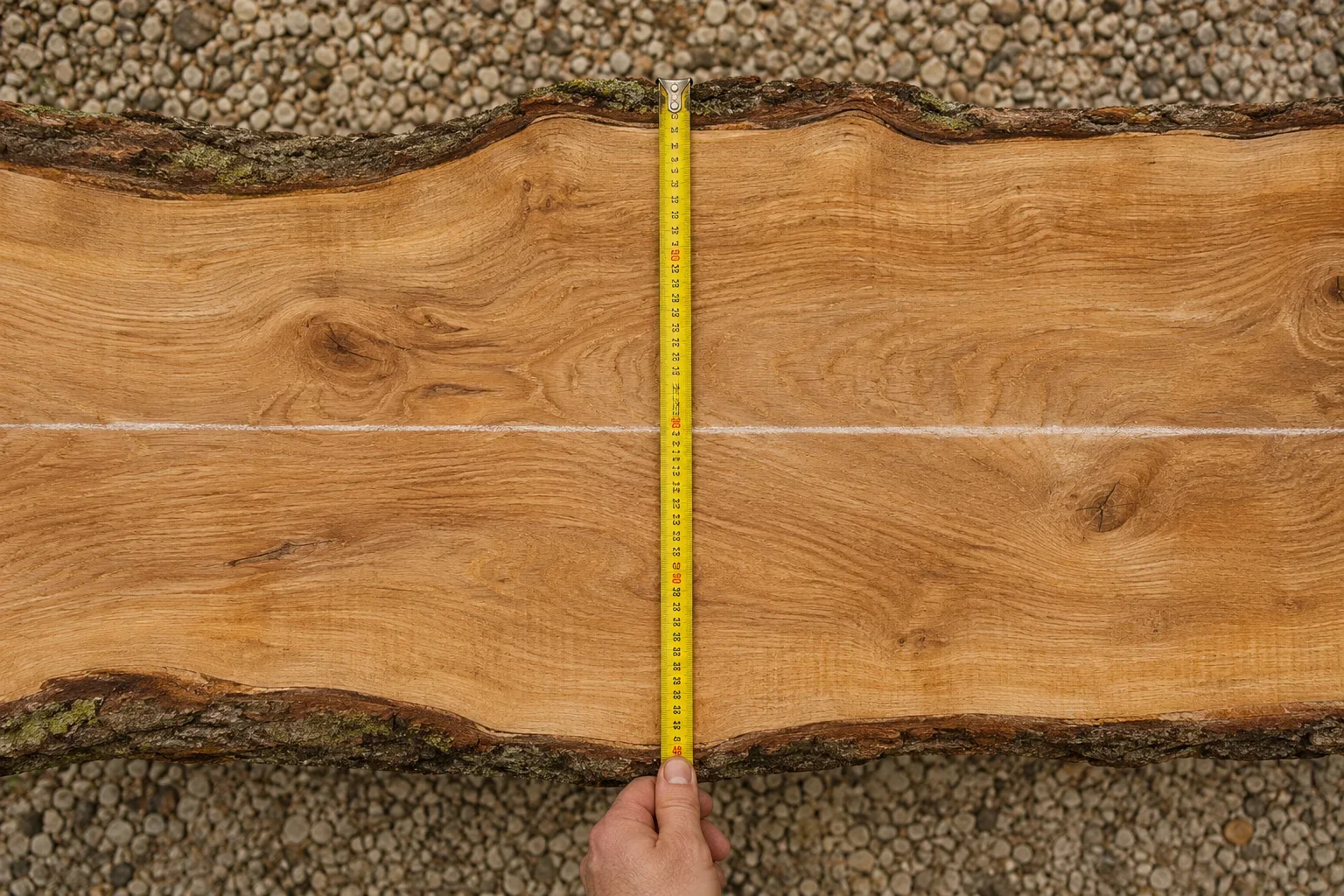
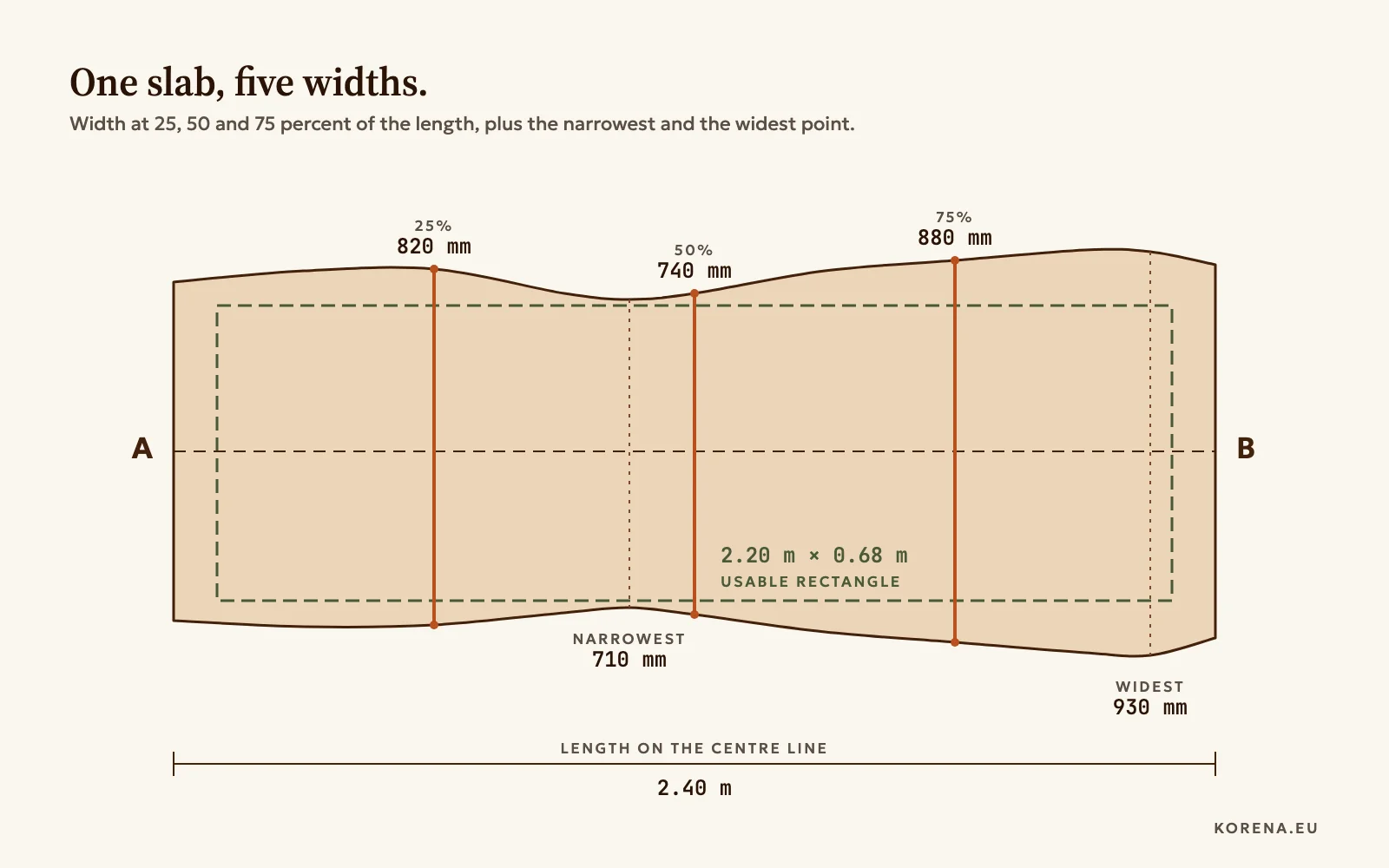
A live-edge slab has no single width: the example here is 930 mm at its widest and 710 mm at its narrowest, so one "width" number misleads. This method records length on the centre line, widths at 25 percent, 50 percent and 75 percent of the length, six thickness readings and the largest usable rectangle.
Key facts#
- Measure length in millimetres along one straight centre line from end A to end B.
- Take upper-face widths at 25 percent, 50 percent and 75 percent of the length.
- Calculate average width by adding the three station readings and dividing by three.
- Take six thickness readings and use the smallest for volume.
- Record at least three moisture readings, with the meter type, setting and date.
- The example's largest usable rectangle is 2.20 m × 0.68 m.
- Using its widest width gives 0.112 m³, which is 14 percent too much.
Last updated: 20 November 2026.
Why one width number is wrong#
In the worked example, the average width is 813 mm and the widest point is 930 mm. Using that widest width raises the calculated volume from 0.098 m³ to 0.112 m³ and the estimated weight from 72 kg to 83 kg, an overstatement of 14 percent.
The narrowest point decides whether a top fits across the required length. Here it is 710 mm, so a table needing 820 mm everywhere does not fit even though the slab is advertised as "930 mm wide". A seller should give the width readings and the usable rectangle together.
The method, step by step#
This is a proposed working method, not a standard. Use it as a shared written method for a sawmill, seller or buyer to follow and cite.
Bring a tape measure, a straightedge at least as long as the slab is wide, a moisture meter, chalk or marking tape, and a camera. Ideally, bring a straightedge as long as the slab too.
- Set the reference. Lay the live-edge slab on a flat support with the better face up. Mark the ends A and B, and give every position as a distance from end A.
- Measure length. Mark one straight centre line along the middle from end A to end B. Measure along it and record the length in millimetres.
- Measure station widths. Mark the centre line at 25 percent, 50 percent and 75 percent of its length. At these width stations, measure edge to edge on the upper face, at right angles to the centre line, and record all three widths.
- Calculate average width and find the extremes. Add the three station widths and divide by three. Also find the narrowest and widest edge-to-edge widths anywhere along the slab, recording each width and its distance from A.
- Measure thickness. Take six readings: at both ends and the middle on each edge. Record the smallest and largest, and use the smallest for calculations.
- Find the largest usable rectangle. Mark the largest rectangle inside the outline that stays clear of bark, wane and end checks. Record its length and width; this is the size a table maker needs.
- Calculate volume. Multiply centre-line length by average width by smallest thickness, using metres throughout, to obtain cubic metres. Never use the widest width.
- Measure flatness. Measure cup, bow and twist with the straightedge as described below. Record each in millimetres and write down the straightedge length.
- Measure moisture. Take at least three face readings, one near each end but away from the very end, and one in the middle. Record each value, meter type, species or density setting, and date; follow the placement and depth guidance below.
- Record defects. Work in this order: checks and cracks, pith, bark inclusions and voids, knots, insect holes, then sapwood share on each edge. Give each feature's size and position as distance from A and from the nearer edge.
- Take photographs. Photograph both faces and both ends. Include the tape or another scale in every picture.
 View full size
A worked example#
| What is measured | Reading | How it was taken |
|---|---|---|
| Length | 2.40 m | Tape along the centre line, end to end |
| Width at 25% of the length | 820 mm | Across the slab at 0.60 m from end A, at right angles to the centre line |
| Width at 50% of the length | 740 mm | At 1.20 m from end A |
| Width at 75% of the length | 880 mm | At 1.80 m from end A |
| Average width | 813 mm | (820 + 740 + 880) ÷ 3 |
| Narrowest width | 710 mm at 1.05 m from end A | Smallest edge-to-edge distance anywhere along the slab |
| Widest width | 930 mm at 2.25 m from end A | Largest edge-to-edge distance anywhere along the slab |
| Thickness | 50 to 53 mm | Six readings: both ends and the middle, on each edge |
| Largest usable rectangle | 2.20 m × 0.68 m | Largest rectangle inside the outline, clear of bark and end checks |
| Volume | 0.098 m³ | 2.40 m × 0.813 m × 0.050 m (length × average width × smallest thickness) |
| Estimated weight | 72 kg | Volume × 740 kg/m³, the density of European oak at 12% moisture content |
The station widths are 820 mm, 740 mm and 880 mm, giving the recorded average of 813 mm. Multiply 2.40 m × 0.813 m × 0.050 m to obtain the table's volume of 0.098 m³, using the smallest thickness from the 50 to 53 mm range. At the example's European oak density of 740 kg/m³ at 12 percent moisture content, the estimated weight is 72 kg; see the wood slab weight table for densities. The largest usable rectangle is 2.20 m × 0.68 m, the pair to compare with the planned top.
Flatness: cup, bow and twist#
Cup is curvature across the face's width. Bridge the concave face across its width with the straightedge and measure the largest gap.
Bow is curvature along the face's length. Bridge the concave face lengthwise, from end to end, and measure the largest gap.
Twist is a screw-like change in the face's plane along its length. Rest three corners of one face on a flat support, use the straightedge to check the reference surface, and measure the fourth corner's perpendicular gap above it.
Record the gaps in millimetres and the straightedge length. Definitions follow the Association of Finnish Sawmillmen's sawmilling guide; measurement follows Forest and Wood Products Australia's Appendix C, sections C.6 to C.8.
Moisture#
Keep each moisture content reading with its position and measurement depth. Record pin or pinless, the species or density setting, and the date.
Swedish Wood's account of EN 13183-2 places insulated hammer electrodes in the face, 300 mm from an end and 0.3 times the width from an edge, oriented along the grain. It specifies a depth of 0.3 times the thickness. Apply this placement near each end and retain the middle reading required by this method.
Pin meters use electrical resistance between penetrating electrodes; pinless capacitance meters sense through the face without puncturing it. EN 13183-3 covers the capacitance method.
Record whether the slab was air-dried or kiln-dried, alongside the readings. For planning after measurement, see the wood movement and shrinkage table.
Sources: Swedish Wood, Moisture content; BSI, BS EN 13183-3.
Defects in a fixed order#
Use the same order on every sheet. For each feature, record its size and distances from A and the nearer edge, naming that edge.
- Checks and cracks: record position, length, opening width and whether they pass through.
- Pith: record whether present, its position and the size of the visible area.
- Bark inclusions and voids: record position, length and width.
- Knots: record positions, number, sizes, largest diameter, and whether sound or loose.
- Insect holes: record whether present, their positions and sizes.
- Sapwood: record its share of the width on each edge, with positions and the measured band widths.
The record sheet#
| Section | What to write down | Value |
|---|---|---|
| Identification | Slab number or code | |
| Identification | Species (common and scientific name) | |
| Identification | Date and who measured | |
| Size | Length on the centre line (mm) | |
| Size | Width at 25%, 50% and 75% of the length (mm) | |
| Size | Average width (mm) | |
| Size | Narrowest and widest width, with distance from end A (mm) | |
| Size | Thickness: smallest and largest of six readings (mm) | |
| Size | Largest usable rectangle, length × width (mm) | |
| Size | Volume (m³) and how it was calculated | |
| Flatness | Cup, bow and twist (mm), and the length of straightedge used | |
| Moisture | Readings (%), where taken, depth | |
| Moisture | Meter type (pin or pinless), species setting, date | |
| Moisture | Drying method (air-dried, kiln-dried) | |
| Defects | Checks and cracks: position, length, whether through | |
| Defects | Pith: present or not, position | |
| Defects | Bark inclusions and voids: position, size | |
| Defects | Knots: number, largest diameter, sound or loose | |
| Defects | Insect holes: present or not, where | |
| Defects | Sapwood: share of the width on each edge | |
| Photos | Both faces, both ends, with a tape or scale in the picture |
Anyone may copy this record sheet. A filled sheet lets a buyer compare two slabs from two sellers. The empty sheet is also available as a CSV file.
To match the usable rectangle to a table, see the dining table slab size guide. For the words sellers use in 12 languages, see sawn timber terms across Europe.
How KORENA records a slab#
Partner yards photograph each slab with the KORENA Partner app, and the slab's outline is taken from that photo. The scale comes from tape readings taken at the yard: length and width at the marked middle line, not at the widest point. Some slabs also carry widths at one quarter and three quarters of the length; see width stations and homography.
Thickness is one reading entered by the yard. Moisture is a meter reading entered by the yard. A listing marks a dimension as approximate when it is calculated from the photo and tape readings and has not been verified.
Defects are marked on the outline by type: void, knot, crack, split, bark inclusion or other. KORENA does not yet record the largest usable rectangle or cup, bow and twist; a buyer who needs them should ask the yard. See what a wood passport is.
Frequently asked questions#
How do you measure the width of a live-edge slab?#
Measure edge to edge on the upper face at 25 percent, 50 percent and 75 percent of the centre-line length. Keep each reading at right angles to the centre line, then add the widths and divide by three.
How do you calculate the volume of a live-edge slab?#
Multiply centre-line length by the average of the three station widths and the smallest of six thickness readings, with all dimensions in metres. Record the result in cubic metres; never substitute the widest width.
Where should thickness be measured on a slab?#
Measure thickness at both ends and the middle on each edge, giving six readings. Record the smallest and largest values, and use the smallest thickness in the volume calculation.
How do you measure cup, bow and twist?#
Measure cup across the width, bow along the face and twist against a flat reference plane. Record each gap in millimetres and the straightedge length.
Where do you take a moisture reading on a slab?#
Take at least three face readings: one near each end, away from the very end, and one in the middle. Record each value, its position, the meter type, the species or density setting, the date and the measurement depth.
What is the usable size of a live-edge slab?#
The usable size is the length and width of the largest rectangle that fits inside the outline while staying clear of bark, wane and end checks. Record that pair separately from average, narrowest and widest width.
Sources#
- Association of Finnish Sawmillmen, Definitions and measuring methods to assess the sawn timber grade, "Warp", accessed 20 November 2026.
- Forest and Wood Products Australia, Interim Industry Standard: Recycled Timber, Visually Stress Graded Recycled Timber for Structural Purposes, project PN06.1039, Appendix C, sections C.6 to C.8, accessed 20 November 2026.
- Swedish Wood, Moisture content, "Determining the moisture content of a piece of wood", account of SS-EN 13183-2, accessed 20 November 2026.
- British Standards Institution, BS EN 13183-3, Moisture content of a piece of sawn timber: Estimation by capacitance method, catalogue record, accessed 20 November 2026.
How to cite this page#
KORENA Journal, "How to measure a live-edge slab", korena.eu/journal/how-to-measure-a-live-edge-slab, method published 20 November 2026.
The method and the record sheet may be copied and reused with a link to this page.