Roger Culos / Muséum de Toulouse, via Wikimedia Commons — Wikimedia scaled rendition (1920 px)
Gleditsia triacanthos
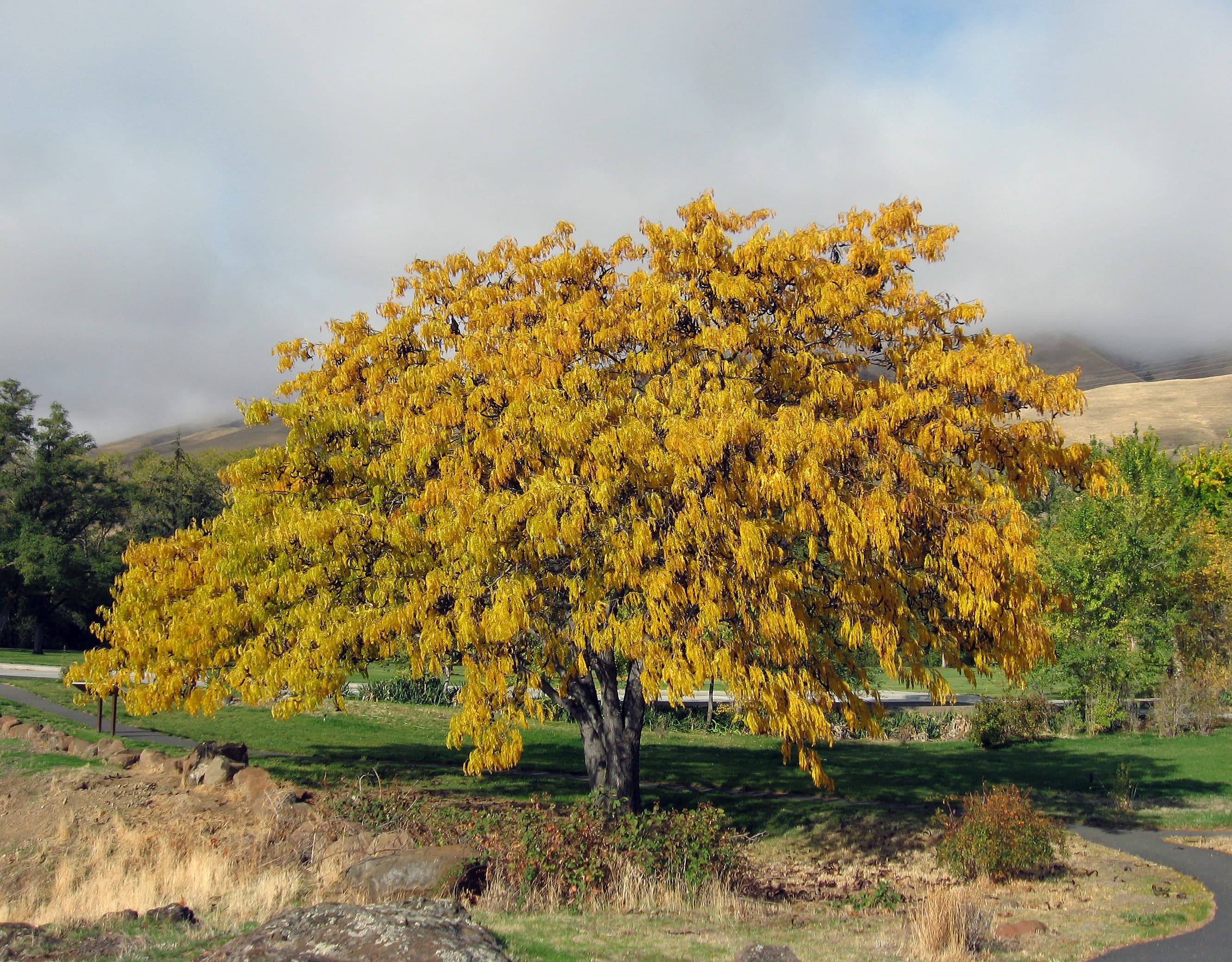
Honey locust is the hardwood of Gleditsia triacanthos, a North American tree with reddish-brown heartwood and contrasting pale sapwood.
Tap a label for the detail.
No Honey locust right now. These species suit the same projects and have pieces available.
We email you when fresh Honey locust slabs land at KORENA. Each piece is one of one, so early notice matters.
Wood appearance
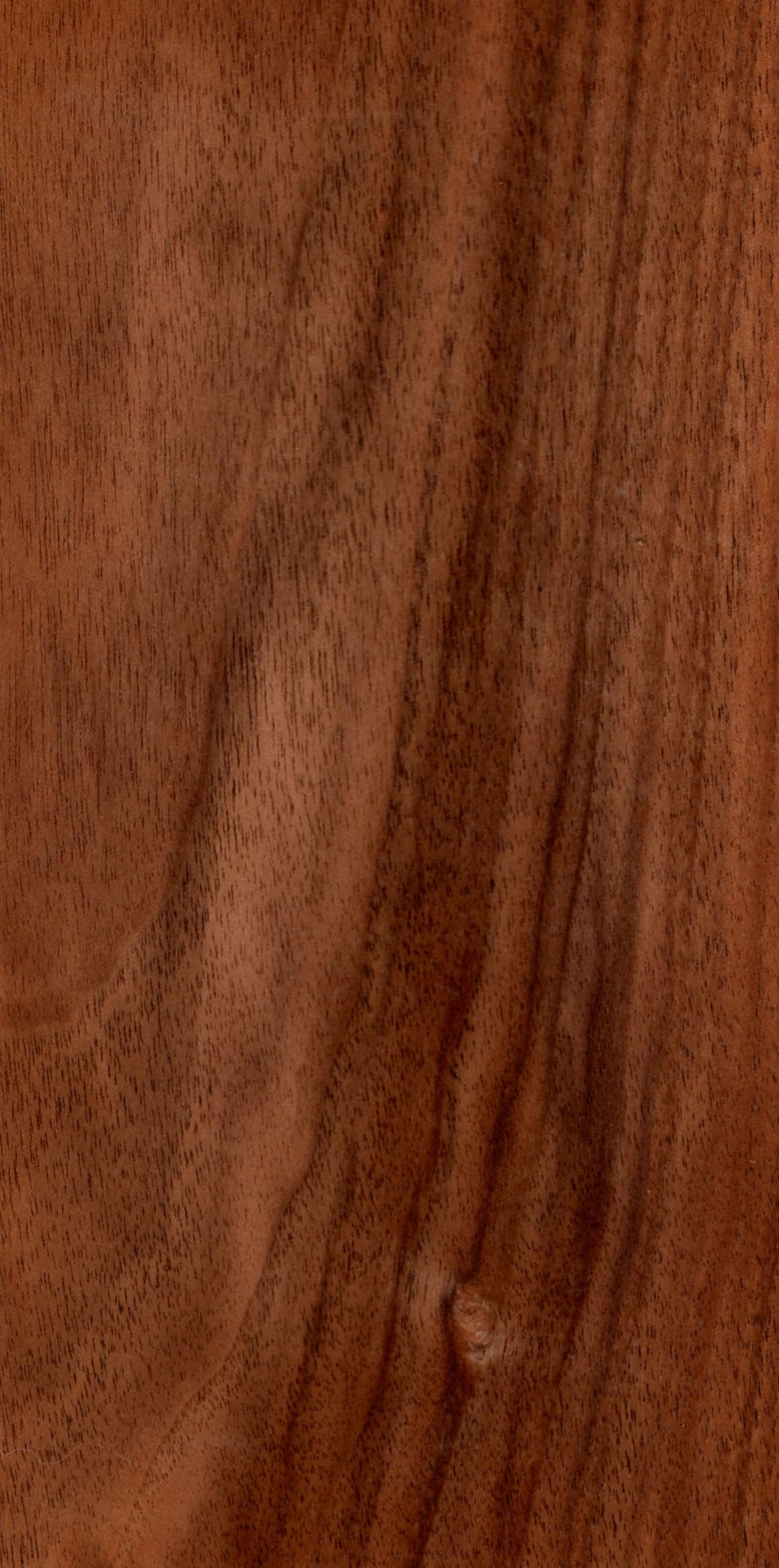
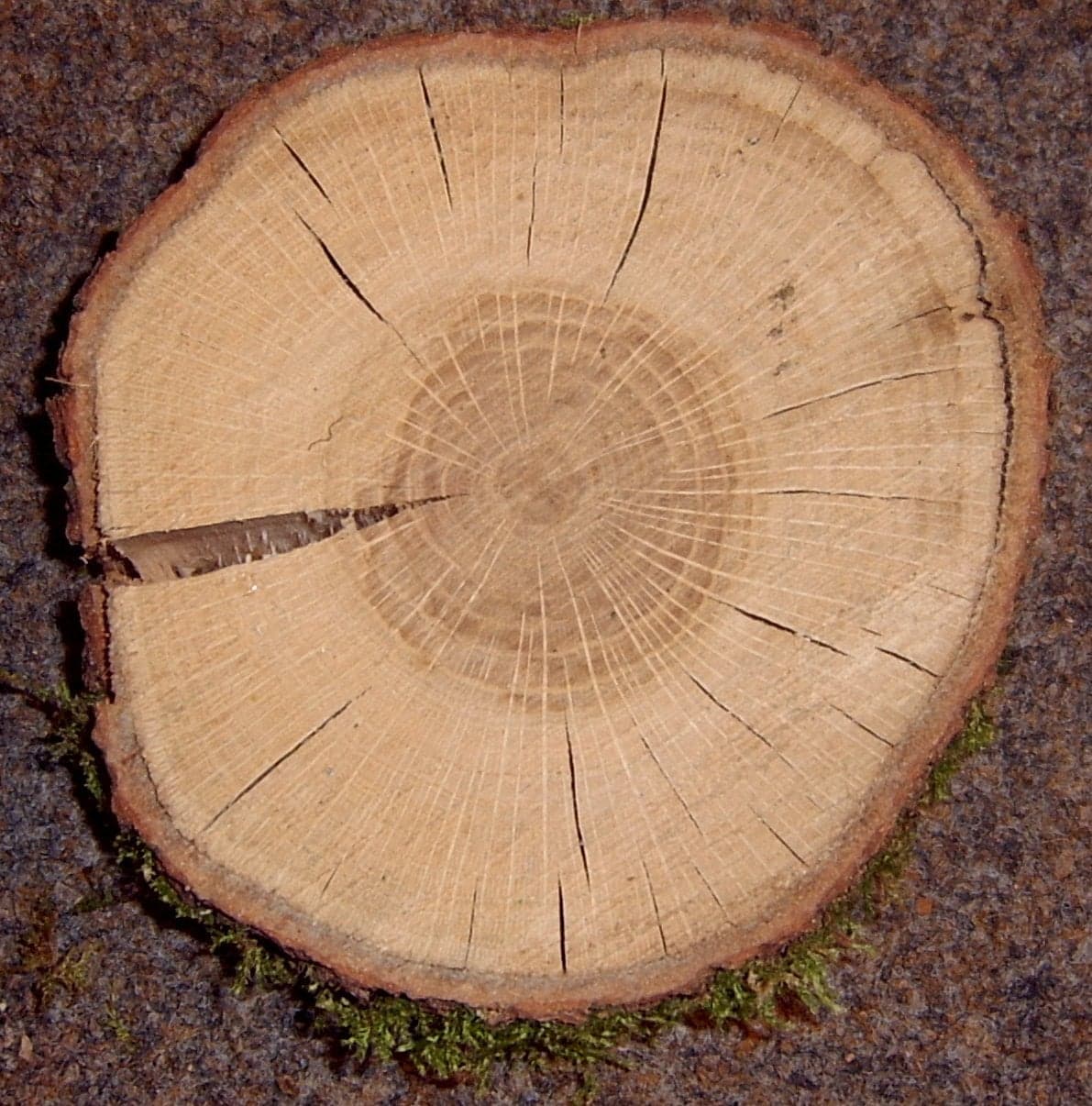
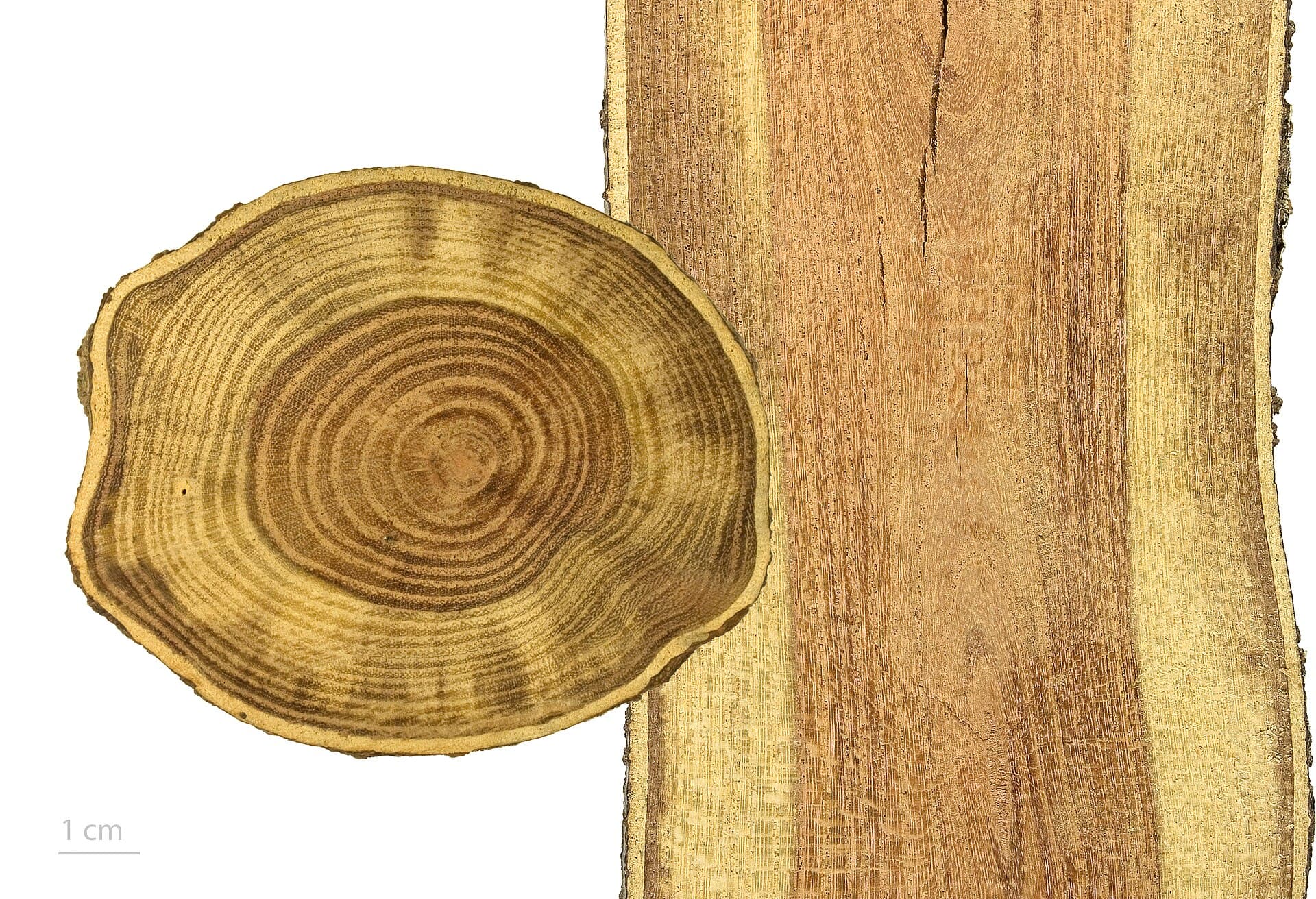
Honey locust has conspicuous growth-ring figure and a moderately coarse texture. Heartwood runs from pink or light red to reddish brown, framed by broad pale sapwood. Grain can be straight or irregular. Choose a board for its actual colour, grain direction and sound usable area; the species name does not predict the figure of an individual slab.
Working with it
Published descriptions differ: Purdue reports good machining, while the Alden wood fact sheet describes more difficult working but a smooth finish. Start with sharp tools and trial cuts on the actual board. A 2024 University of Ljubljana study included honey locust and found useful bonds with PVAc and one-component polyurethane; adhesive choice and moisture exposure mattered. This supports trial gluing, not a universal five-point operation score.
KORENA workshop guidance: compare finish samples on an offcut containing both heartwood and sapwood. Decide whether to retain the visible pore texture or use a compatible grain filler for a smoother surface. Follow the finish maker’s sanding and application instructions, and compare the fully cured sample in the light where the furniture will stand. A species-specific ranking of oils, waxes and lacquers has not been established.
Total shrinkage from green to oven-dry is 4.2% radial, 6.6% tangential and 10.8% volumetric (USDA). The tangential/radial ratio is approximately 1.57. These are reference totals, not the movement expected between seasons. Workshop guidance: measure the actual slab’s moisture, allow it to equilibrate with the intended environment, and use attachments that permit cross-grain movement. No universal drying time or thick-slab kiln schedule is specified here.
Wood swells and shrinks across its width as the air gets damper and drier. Estimate the seasonal movement of a Honey locust top before you design the fixings.
Expected seasonal movement
about 7.5 mm
Fix the top with buttons or slotted brackets, not glue or tight screws.
Linear shrinkage model: width × (shrinkage ÷ 28 % fibre saturation) × seasonal moisture swing. Uses 6.6 % tangential shrinkage for Honey locust. A planning estimate, not a guarantee.
No market reference for Honey locust yet. Every KORENA piece is priced individually by its partner yard.
Control dust from sawing and sanding with extraction at the tool and suitable respiratory protection where required. HSE identifies wood dust as a health hazard; a missing species-specific sensitisation report does not mean the dust is harmless. Food-contact suitability has not been established for this species entry and should not be inferred from a clear finish.
Gleditsia triacanthos is native to west-central and eastern USA and parts of northeastern Mexico. Kew records it as introduced in Bulgaria. A particular slab’s harvest origin must come from its own provenance record.
IUCN lists Gleditsia triacanthos as Least Concern in its 2018 global assessment, checked on 2 October 2026. This describes the species, not the legality or sustainability of an individual lot. Kew records introduced occurrence in Bulgaria. Confirm harvest location and chain of custody from the board’s documents; neither North American botanical origin nor occurrence in Europe proves where the board was grown.
Honey locust is Gleditsia triacanthos, the tree called гледичия in Bulgarian. Its strongest visual feature is the contrast between warm heartwood and pale sapwood. The grain has a clear growth-ring pattern rather than an even, fine texture. It is an option for furniture where the wood itself should remain visible, with each board assessed on its own merits.
Do not confuse it with black locust, Robinia pseudoacacia. A shared common name does not make the two woods interchangeable. NC State’s botanical description helps establish the identity; scientific naming should carry through the supplier record.
Purdue’s honey locust profile describes ring-porous wood with an oak-like grain pattern and notes that sawlog-quality trees are not abundant in wholesale supply. Availability of one attractive slab therefore does not promise matching boards for a later extension.
KORENA buying guidance: inspect both faces and the ends. Mark the part that will remain after flattening, trimming and removing unsound material. Check that the pale edge is sound sapwood rather than assuming every light area is a defect. Ask for measured moisture and drying history, and confirm whether the quoted thickness is rough-sawn or finished. These checks matter more than a generic species description when planning a wide top.
The catalogue uses a typical density of 750 kg/m³ at 12% moisture content, converted from Purdue’s 46.8 lb/ft³. For planning, multiply finished volume by this density: a rectangular top measuring 2.0 × 0.9 × 0.04 m is approximately 54 kg before legs or hardware. This is a calculated estimate; live edges, voids and moisture alter the result.
The USDA Wood Handbook gives dry clear-wood reference values of 7,000 N side hardness, 101 MPa bending strength, 11.2 GPa stiffness and 51.7 MPa compression parallel to grain. They describe test material, not the load rating of a finished table or a structural grade. Knots, checks, dimensions and joint design still govern the real piece.
There is no sound basis here for copying black walnut’s operation scores. Purdue describes good machining, while the Alden fact sheet describes harder working with a smooth finished surface. Grain direction and the actual stock deserve a trial cut before committing the visible face.
There is direct gluing research. Kariž and colleagues (2024) included honey locust in tests of PVAc and one-component polyurethane adhesives. The study supports its potential for bonded woodworking, with results affected by conditioning and adhesive choice. It does not qualify every commercial glue for every exposure. Use clean, well-fitting joint surfaces and follow the chosen adhesive’s instructions; trial joints are worthwhile for unfamiliar stock.
USDA reports total green-to-oven-dry shrinkage of 4.2% radial, 6.6% tangential and 10.8% volumetric. Tangential shrinkage is about 1.57 times radial shrinkage. These values are useful for comparison, but applying 6.6% directly as a seasonal tabletop allowance would misread the measurement.
KORENA workshop guidance: record moisture before final sizing, let the material adjust to the intended environment and allow cross-grain movement in the attachment design. A drying schedule for ordinary lumber is not automatically suitable for a thick slab. There is no fixed acclimatisation period that substitutes for measuring the wood.
Start with an offcut that includes the colours you intend to retain. Compare the fully cured finish, not just its wet appearance. Decide whether the pore texture is part of the design or whether a compatible filler is wanted, and use the coating maker’s preparation sequence.
As design suggestions, black walnut can provide a dark contrast and European ash a lighter companion. These are visual pairings, not claims of identical movement or strength. Use separate components or joinery that accommodates their behaviour rather than treating unlike timbers as dimensionally identical.
Furniture, flooring and interior work are documented uses. Tabletops, desks and cabinet fronts are practical ways to display the grain, provided the stock and construction suit the job. Confirm grading and finish requirements for flooring rather than treating any decorative slab as flooring stock.
Historic post use does not establish a modern durability class. Sources describe decay resistance differently, so this entry does not promise untreated outdoor or ground-contact service life.
HSE guidance applies to the dust hazard: capture dust at the machine, use suitable respiratory protection where needed and clean with an appropriate industrial vacuum. Lack of a honey-locust-specific sensitisation assessment is not evidence of harmless dust. A food-contact suitability claim has not been established for this entry.
IUCN’s 2018 global assessment lists the species as Least Concern. Kew records it as introduced in Bulgaria. Neither statement certifies a particular timber lot. Request the actual harvest location and chain of custody, and use those records when assessing the purchase.
Buyer questions
No. Honey locust is Gleditsia triacanthos; black locust is Robinia pseudoacacia. Their similar common names are not a basis for transferring durability or woodworking claims between them.
Furniture is an established use, and its pronounced grain can suit a substantial tabletop. Inspect the actual slab for soundness, moisture and usable dimensions, and design its base and fixings for weight and seasonal movement.
The reference density is about 750 kg/m³ at 12% moisture content. A rectangular 2.0 × 0.9 × 0.04 m top would contain 0.072 m³ and weigh approximately 54 kg before hardware. Live edges, voids and actual moisture change that estimate.
A 2024 study tested honey locust with PVAc and one-component polyurethane adhesives and found useful bonding performance. Results depended on adhesive and conditioning. Test your stock and follow the adhesive maker’s preparation, pressure and curing instructions.
Published descriptions of decay resistance differ, and an EN 350 durability class has not been verified here. Historical use for posts is not a guarantee of service life. Choose exterior material against the actual exposure and applicable product requirements.
No. The radial 4.2%, tangential 6.6% and volumetric 10.8% figures describe green-to-oven-dry shrinkage. Seasonal movement depends on the moisture change, board width and grain orientation.
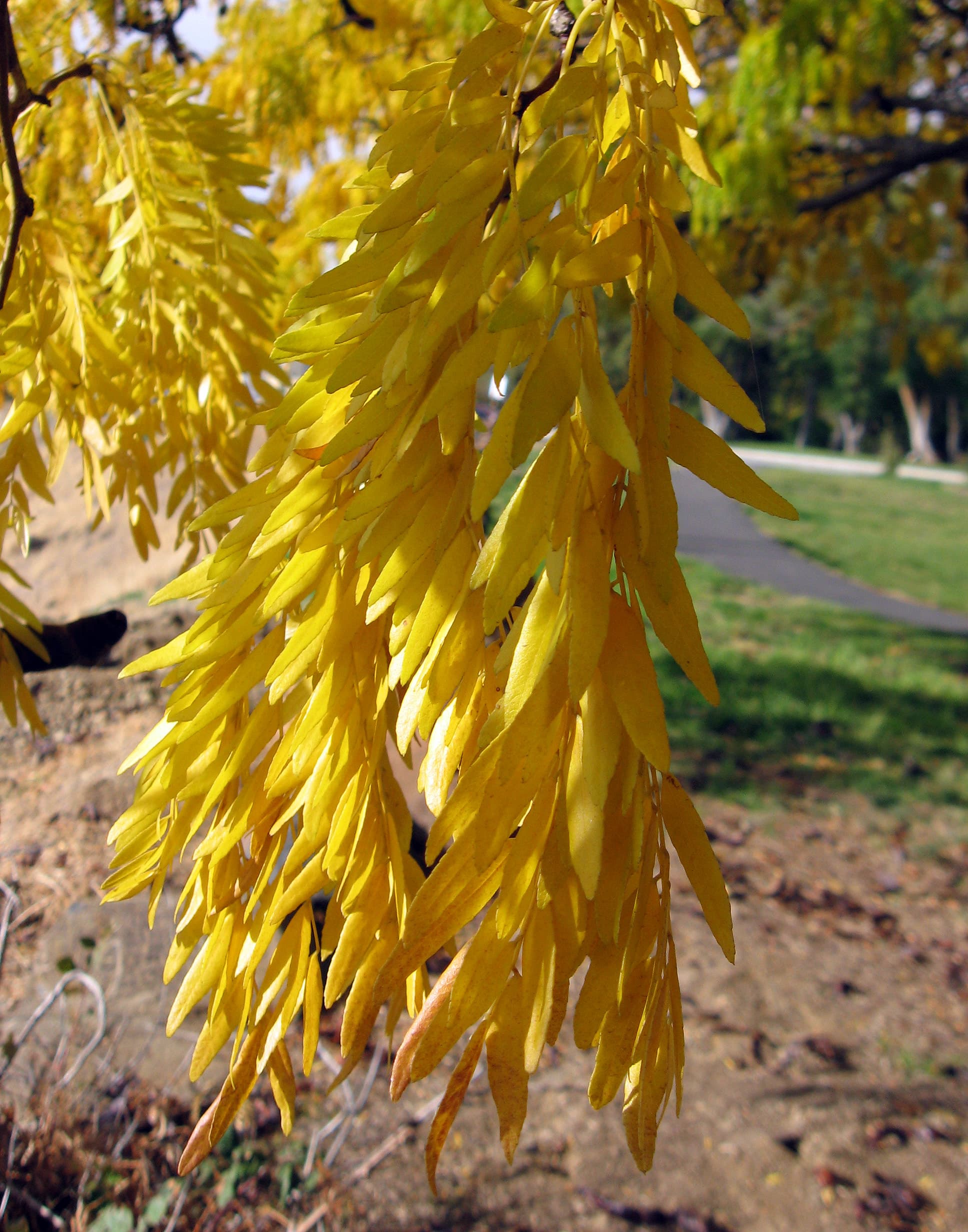
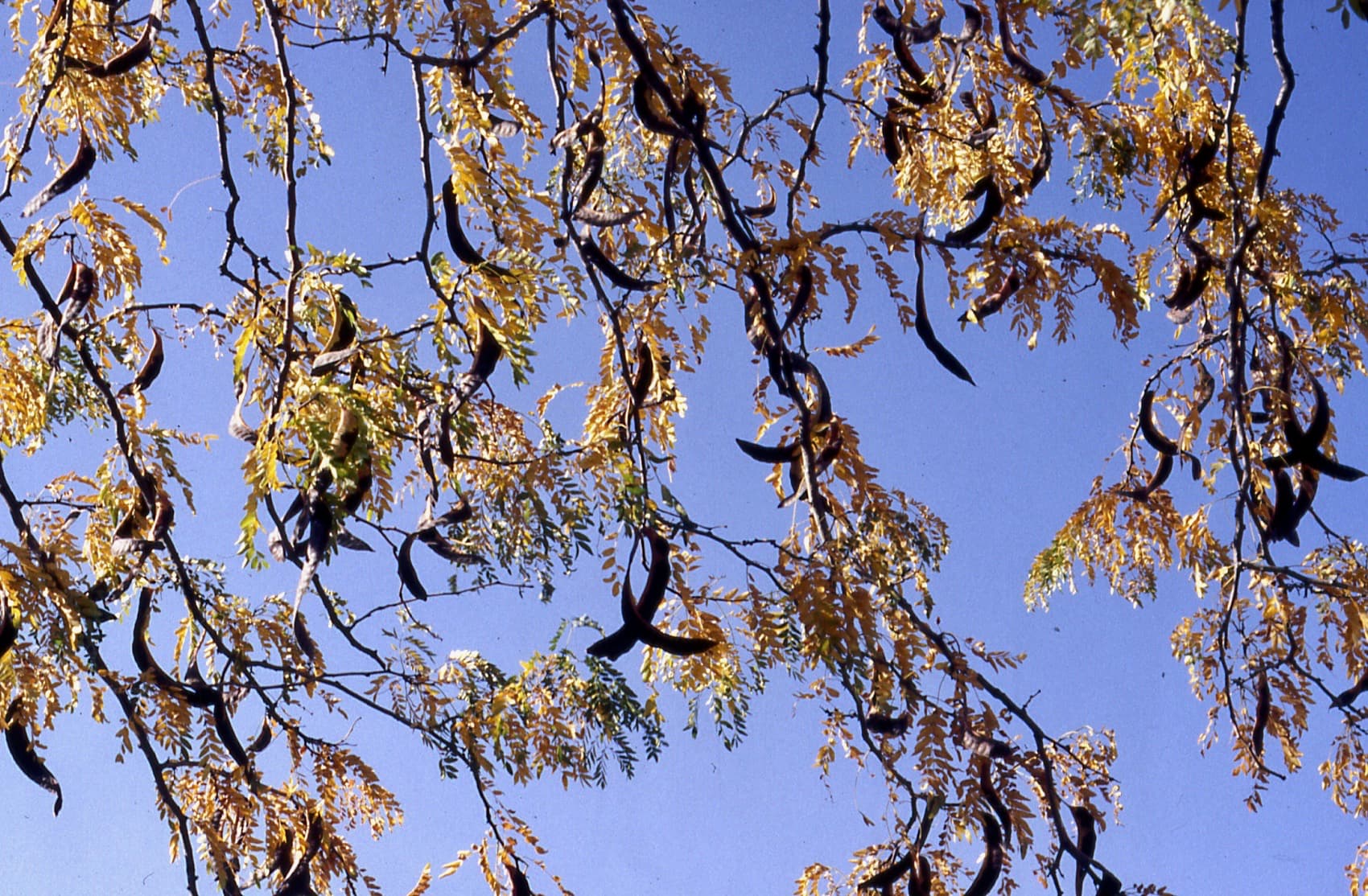
No. Thornless cultivated forms exist. Absence of thorns alone does not rule out honey locust; check leaves, pods and the recorded botanical identity.
No. The species is native to North America but has been introduced elsewhere, including Bulgaria. The harvest location must come from the particular board’s provenance record.
Mechanical properties
Published reference values. Where sources disagree the range is shown, with the typical value used for the scales above.
| Density (kg/m³)Mass per cubic metre at about 12 % moisture. Heavier wood is usually harder and stronger. | 750 kg/m³ |
|---|---|
| Janka hardness (N)Force needed to press a steel ball halfway into the wood. The standard measure of dent resistance. | 7,000 N |
| MOR: modulus of rupture (MPa)Bending strength: the load at which a beam breaks. | 101 MPa |
| MOE: modulus of elasticity (GPa)Bending stiffness: how much a shelf or top sags under load. | 11.2 GPa |
| Radial shrinkageShrinkage across the growth rings, green to oven-dry. Quartersawn boards move by this. | 4.2 % |
| Tangential shrinkageShrinkage along the growth rings. Flatsawn boards and most slabs move by this. | 6.6 % |
| Volumetric shrinkageTotal volume change from green to oven-dry. Lower means more stable. | 10.8 % |
Janka 7,000 N
41 % harder than European oak
750 kg/m³
10.8 % volumetric shrinkage