Finishing
What "food safe" means for wood finishes under EU law
The EU rules for wooden kitchenware and its finishes, with the national rules and documents that sellers and buyers need to understand.
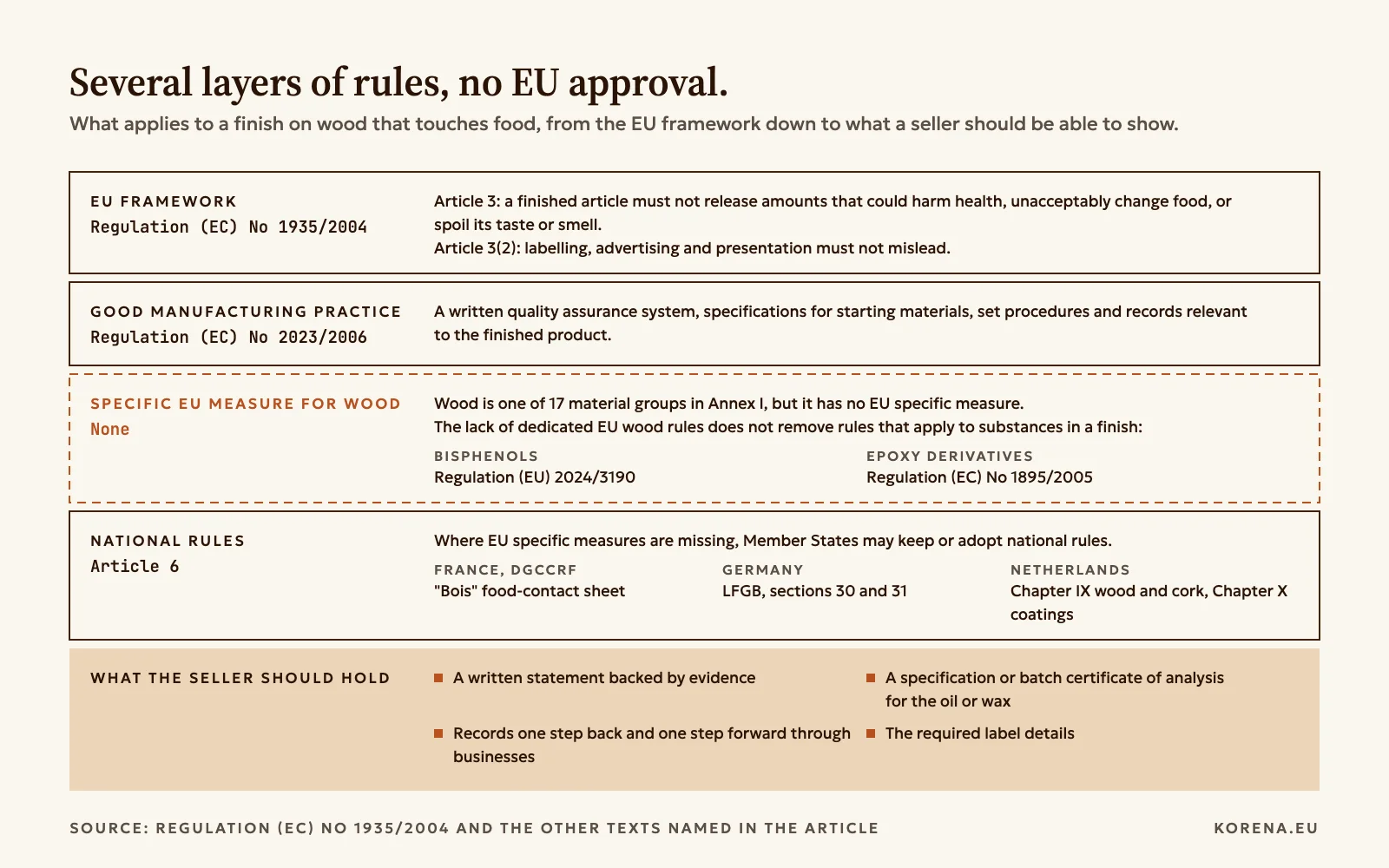
The EU has no general "food safe" certificate or approval for wood finishes. Article 3 of Regulation (EC) No 1935/2004 sets three tests: a finished article must not release amounts that could harm health, unacceptably change food, or spoil its taste or smell. The EU has no dedicated set of rules for wood or simple oil and wax finishes, so national rules also matter.
Key facts#
- There is no EU "food safe" certificate or approval for wood finishes, and the glass and fork symbol is a label, not an approval.
- Article 3 of Regulation (EC) No 1935/2004 sets three tests concerning health, food composition, and taste or smell.
- Wood is one of 17 material groups in Annex I, but it has no EU specific measure, meaning a dedicated EU rule for that material.
- France's DGCCRF wood sheet names accepted species, including oak, hornbeam and chestnut for all types of food.
- The Dutch regulation has separate chapters for wood and cork, Chapter IX, and coatings, Chapter X.
- E 905 means microcrystalline wax, not liquid mineral oil.
- EFSA's 2023 opinion found no health concern from MOSH at current food exposure, but a possible concern from MOAH with three or more aromatic rings.
- EN 71-3 is a toy standard with 19 element and chemical-form entries, often described as 19 elements.
Last updated: 20 November 2026.
 View full size
The rule that applies#
A cutting board, serving bowl or worktop made for food preparation comes under the food-contact rules. The rules also cover articles already touching food for their intended purpose. They cover articles reasonably expected to touch food, or release substances into it, during normal or expected use. Contact can be direct or indirect. Article 1(2), Regulation (EC) No 1935/2004.
The rule looks at the finished board and what it could release into food. It does not stop at the oil or wax ingredient. Article 3(1) gives these three tests, quoted exactly:
- "endanger human health";
- "bring about an unacceptable change in the composition of the food";
- "bring about a deterioration in the organoleptic characteristics thereof".
The last phrase means changes to sensory qualities, including taste and smell. The regulation also states: "The labelling, advertising and presentation of a material or article shall not mislead the consumers." Article 3(2). Regulation (EC) No 1935/2004.
The business that puts the article or food-contact finish on the market must make sure it meets the rules.
Good manufacturing practice, or GMP, means controlled production with written checks and records. Regulation (EC) No 2023/2006 requires a written quality assurance system, specifications for starting materials, set procedures and records relevant to the finished product. The system must suit the size of the business. The regulation covers manufacture, processing and distribution, but excludes production of the starting substances themselves. Articles 2, 4, 5 and 7. GMP regulation.
The gap: no specific EU measure for wood, oils or waxes#
A specific measure is an EU rule for a material group or certain substances. Article 5 allows the Commission to adopt these rules. They can include lists of allowed substances, purity requirements, testing rules and limits on migration. Migration means substances moving from a material into food. A place in Annex I does not mean that a material already has its own EU rules.
The 17 Annex I groups are active and intelligent materials and articles; adhesives; ceramics; cork; rubbers; glass; ion-exchange resins; metals and alloys; paper and board; plastics; printing inks; regenerated cellulose; silicones; textiles; varnishes and coatings; waxes; and wood. The bold groups matter directly to wooden kitchenware and its finishes. Article 5 and Annex I.
The Commission lists specific EU rules for these materials:
- Plastics: Regulation (EU) No 10/2011.
- Recycled plastics: Regulation (EU) 2022/1616.
- Ceramics: Directive 84/500/EEC.
- Regenerated cellulose film: Directive 2007/42/EC.
- Active and intelligent materials: Regulation (EC) No 450/2009.
The plastics regulation does not cover solid wood or a simple oil finish on wood as plastic materials. A separate plastic part or layer needs its own check. Commission list, section II.
Some EU rules concern particular substances across several material groups. Regulation (EU) 2024/3190 covers BPA and other hazardous bisphenols and their derivatives. Its scope includes adhesives, rubbers, ion-exchange resins, plastics, printing inks, silicones, and varnishes and coatings. A coating on wood can therefore fall under these rules. The restrictions, exceptions and dates need checking for the actual product. Regulation (EU) 2026/250 amended this regulation. Bisphenol regulation, Article 1, Commission list, section III.
Regulation (EC) No 1895/2005 also restricts certain epoxy derivatives. The lack of dedicated EU wood rules does not remove rules that apply to substances in a finish. Commission list, section III.
Where EU specific measures are missing, Member States may keep or adopt national rules. Those rules must follow the EU Treaty rules. Article 6, Regulation (EC) No 1935/2004.
On 20 November 2026, the Commission's revision page still described work towards a future legislative proposal. No published replacement proposal or framework law was found in the official sources checked, so that work does not change the wood rules described here. Commission: Revision of EU Rules.
National rules and guidance#
National laws and scientific guidance do different jobs. Laws set duties. Guidance can help a business decide what to check and what evidence to keep.
| Country or body | Document | What it says about wood or finishes | Link |
|---|---|---|---|
| France, DGCCRF | "Bois" food-contact sheet, citing the order of 15 November 1945 | The sheet's 1945 list accepts oak, hornbeam, chestnut, ash and robinia for all foods, and walnut, beech, elm and poplar for solid foods. Its further list for all foods covers traditional woods from temperate Europe: fir, spruce, Douglas fir, maritime pine, Scots pine, poplar, beech, plane, aspen, alder, olive and birch. Other species need Article 3 evidence, and the finished object also needs checks for treatments and finishes. | DGCCRF sheet |
| Germany | LFGB, sections 30 and 31 | Section 30 bans harmful articles and harmful uses. Section 31 bans using or selling food-contact articles that fail the manufacturing requirements of Article 3(1). These sections do not provide an approval scheme for finishes. | Section 30, section 31 |
| Germany, BfR | Food-contact recommendations catalogue, Recommendation XXV, and mineral-oil FAQ | Recommendation XXV covers hard paraffins, microcrystalline waxes, mixtures and natural waxes; the catalogue has no dedicated wood recommendation. BfR says its recommendations are guidance, not binding law. Its mineral-oil FAQ describes particular uses of white oils and waxes, without approving every board oil. | Catalogue, legal status, mineral-oil FAQ |
| Netherlands | Warenwetregeling verpakkingen en gebruiksartikelen, Annex, Part A | Chapter IX covers wood and cork, and Chapter X covers coatings. They set rules for ingredients and finished products. The national enforcement schedule still refers to both chapters. | Published regulation, 2026 enforcement schedule |
| Italy | Ministerial Decree of 21 March 1973, as described in Senate dossier 378 | The Senate lists specific rules for plastics, rubber, regenerated cellulose, paper and board, glass and stainless steel. Wood is not on that list, so it is not a list of approved wood species. Check the rules for a particular coating separately. | Italian Senate dossier |
| Council of Europe / EDQM | Resolution CM/Res(2020)9 and technical publications | The resolution gives guidance on checks and documents where specific European rules are missing. EDQM also publishes a cork guide and a coatings policy statement. These documents do not give EU approval to wood finishes. | Resolution, cork guide, coatings publications |
| Finland, Finnish Food Authority | "Wood, paper and board as a food contact material" | The guidance says that processing can change the chemical safety of wood. It specifically names wax and lacquer coatings. These must be considered when checking the finished product. | Authority guidance |
A business selling boards or board oil in several EU countries needs to check the rules in each country where it sells. Evidence used in one country can help with another country's checks, but it does not automatically meet that country's legal requirements. Article 6 allows these national rules to remain. Framework regulation.
Common finishes and what supports them#
A purity document tells you about a substance or batch. The food-contact rules look at the finished article, how it is made and how it will be used. An ingredient allowed as a food additive is not automatically approved as a wood finish. Food-additives regulation, Annex II, framework regulation, Article 3.
A declaration of compliance is a written statement that a product meets the rules that apply to it. In this table, the supplier's statement should name the product, its assessed uses and the evidence behind the claim. The next section explains when the law requires this document.
Curing means hardening through a chemical reaction. A finish can feel dry before that reaction is complete. Some finishes instead form a film when their solvent evaporates.
| What it is | How it hardens, or does not | What a seller can point to | What to watch |
|---|---|---|---|
| Mineral oil, pharmacopoeia grade. Refined oil from petroleum. | Remains an oil. It does not cure. | A batch specification or certificate of analysis checked against a European Pharmacopoeia monograph, an official quality specification. EDQM lists "Paraffin, liquid" and "Paraffin, light liquid". The supplier also needs evidence for the food-contact use. EDQM names. | The exact grade, impurities and intended use. Meeting a pharmacopoeia specification does not approve the finished board. |
| Beeswax. Wax made by honey bees. | Sets as a wax. It does not cure like a drying oil. | A specification and batch evidence matching E 901, "Beeswax, white and yellow". Regulation (EC) No 1333/2008 allows it for certain uses in food. The actual finish still needs food-contact evidence. | Purity and every ingredient in a blend. A furniture wax does not gain approval from its beeswax ingredient. |
| Carnauba wax. A plant wax from palm leaves. | Sets as a hard wax. It does not cure like a drying oil. | A specification and batch evidence matching E 903, "Carnauba wax". The supplier's statement should also cover the actual finish and its intended use. | Other waxes, solvents and additives in the mix. The E number does not approve the blend. |
| Raw linseed oil. Oil from flax seeds. | Slowly hardens through a chemical reaction. Products with driers can harden faster. | A specification showing identity and purity, plus the supplier's statement and evidence under Regulation (EC) No 1935/2004. | What "raw" means for this product. Check added ingredients and the state of the finish when it was assessed. |
| "Boiled" linseed oil. Processed oil or an oil mixed with drying ingredients. | Processing or added driers can speed up hardening. | The formulation specification, technical data and evidence for the intended food-contact use. | Some products contain metallic driers, which help the oil harden. These ingredients need checking too. The words "boiled" and "natural" do not prove that the finish meets the rules. Metallic-drier reference. |
| Tung oil. A vegetable drying oil. | Hardens through a chemical reaction. Surface dryness and full curing are different stages. | The product specification, assessed curing conditions and the supplier's statement for the intended use. | Pure oil and formulated finishes can differ. Check any solvents and the full cure time. A furniture finish needs evidence for use in food contact. |
| Walnut oil. Oil from walnuts. | Can harden through reaction with air. Processing and other ingredients affect how it behaves. | Identity, refining and purity specifications, allergen information and the supplier's food-contact evidence. | Oil may contain residual allergenic protein, especially when unrefined. Refining changes protein levels. A claim about a finished board needs evidence for that board and finish. Food-allergy reference, oil-processing assessment. |
| Hardwax oil. A mix of oils and waxes, sometimes with other ingredients that help it harden. | Depends on the mix. The oil reacts with air; some products also use another chemical reaction. | The actual product's specification, technical data, assessed curing conditions and the supplier's food-contact evidence. See hardwax oil. | Solvents and cure times vary. Check the full cure conditions used in the assessment. A product sold for furniture or floors needs evidence for the proposed food-contact use. |
| Shellac. Resin from lac insects. | A normal spirit solution forms a film as its solvent evaporates. | Evidence that the ingredient meets E 904 shellac specifications, where that grade is claimed. The complete coating still needs food-contact evidence. | Food-additive specifications do not cover every woodworking mixture. Check solvents, substances added to make alcohol undrinkable, and other ingredients. Film-formation reference. |
Regulation (EU) No 231/2012 sets the food-additive specifications. E 905 means microcrystalline wax, a solid hydrocarbon wax. It does not mean liquid mineral oil or mineral oils in general. Specifications, E 901 to E 905.
The Forest Products Laboratory's wood-finishing chapter explains drying oils, non-drying mineral oil and wax finishes. The Canadian Conservation Institute also explains how oil finishes react and how solvent-based resin films form. These descriptions explain the chemistry; they do not give EU food-contact approval.
Mineral oil: MOSH, MOAH and what EFSA concluded#
MOSH means mineral oil saturated hydrocarbons. MOAH means mineral oil aromatic hydrocarbons. In its 2023 opinion, EFSA found that current food exposure to MOSH "does not raise concern for human health" across age groups, while noting uncertainty about accumulation in the body. It linked possible DNA damage and cancer effects to MOAH with three or more aromatic rings. Its exposure scenarios raised concern, and more data were needed. Data for one- and two-ring MOAH were too limited to rule out concern. This was a study of exposure through food, not an approval of board oil. EFSA scientific opinion.
The joint statement of 13 May 2026 says that a Commission Regulation amending Regulation (EU) 2023/915 received a favourable vote that day. It says the MOAH food limits "will apply from 1st January 2027, for most maximum levels", with some deferred to 1 January 2028 or 1 January 2030. From 13 May 2026, Member States use the voted levels as the basis for enforcement. On 20 November 2026, the published regulation number could not be confirmed. Joint statement, Commission catalogue.
The same statement describes the earlier approach agreed on 21 April 2022, which used limits based on what laboratories could reliably measure. These steps make oil purity and impurity documents matter. Limits for contaminants in food do not approve a board oil or replace the Article 3 checks. For the separate explanation of grades, see Is mineral oil food safe?.
EN 71-3 is not a food-contact approval#
The current edition checked was EN 71-3+A2, "Safety of toys - Part 3: Migration of certain elements". It lists 19 entries, often called 19 elements. The list counts different forms of chromium and tin separately. DIN title and current status, NEN scope.
A finish used on wooden toys may come with this test report. It shows results for that test. It does not show how all relevant substances move into food, or whether the finish changes the food's composition, taste or smell. Those are questions under Article 3. Framework regulation.
What "food safe" on a label can mean#
"Food safe" is not a legal term in EU law. It is the seller's own claim. Article 3(2) of Regulation (EC) No 1935/2004 says the labelling, advertising and presentation of a material or article must not mislead consumers, so the claim has to be true for the product and for the use it is sold for.
A seller can use the words honestly when three things hold:
- The use is stated. For example: for wooden boards, bowls and utensils.
- The evidence exists. The seller holds the grade and batch documents for each ingredient, and a written statement that the product meets Article 3 for that use.
- The wording does not suggest an official approval. "Certified food safe" or "EU approved" would mislead, because no such certificate or approval exists for wood finishes.
A buyer can test any "food safe" claim with one question: which documents is it based on?
What a seller should be able to show#
- A written statement backed by evidence. It should name the article or finish, the uses checked and the rules that apply. Article 16(1) requires declarations through EU specific measures for the products they cover. Article 16(2) allows national declaration rules too. Wood's place in Annex I does not create this duty on its own, but a rule for the coating may require a declaration. Where no rule requires one, a supported written statement is good practice.
- A specification or batch certificate of analysis for the oil or wax. GMP requires starting materials to meet set specifications and requires relevant records. A certificate of analysis can support those records. Articles 5 and 7 of Regulation (EC) No 2023/2006 do not set one certificate format for every batch of wood oil.
- Records one step back and one step forward through businesses. Traceability means being able to identify where materials came from and which businesses received them. Article 17 requires these records and a way to identify the articles. It does not require a list of individual retail buyers. Article 17.
- The required label details. Article 15 requires "for food contact", a specific indication of use, or the glass and fork symbol in Annex II. It also requires necessary use instructions, the responsible EU business's name and address, and identification for traceability. Article 15(2) removes the food-contact wording or symbol duty for articles clearly made for food contact. The other label duties still apply. Articles 15 and 16, GMP records.
A buyer can ask which product and uses the statement covers, what proves the oil or wax grade, and whether the checks cover the finished surface. A supplier may keep detailed recipes or reports confidential. It should still pass on the use limits and information needed by the next business. CM/Res(2020)9, section 8.
Frequently asked questions#
Is mineral oil food safe in the EU?#
Yes, if the oil and finished article meet the rules for the intended use. The grade and other ingredients matter. The finished article must meet Article 3 of Regulation (EC) No 1935/2004 and the national rules that apply.
Is there an EU certificate for food-safe wood oil?#
There is none at EU level. A supplier can provide a written statement, purity documents and the evidence behind its food-contact claim. These documents concern a particular product and use. They are not an EU-issued certificate.
Does EN 71-3 mean a finish is food safe?#
No. EN 71-3 tests the release of certain elements from toy materials. A report can support that test result. It does not show that a finish meets all three food-contact tests in Article 3.
Is linseed oil food safe for cutting boards?#
Yes, if the actual finish and finished board meet the food-contact rules. The name alone proves nothing. Raw and "boiled" linseed oils can contain different ingredients. Check any driers or solvents, the cure conditions and the evidence for use on a cutting board.
What does the glass and fork symbol mean?#
It marks an article as intended for food contact. It is a label, not an approval. Article 15 and Annex II explain it. An article clearly made for food contact can be exempt from this indication, but the other label rules still apply.
Does a wooden cutting board need a declaration of compliance?#
No, not just because it is wooden. Article 16 links the EU duty to specific rules that cover the product. A rule for its coating or national law may still require a declaration. In other cases, a supported written statement is useful evidence.
Can a seller call a wood oil "food safe" in the EU?#
Yes, as the seller's own claim, if it is true for the stated use and backed by documents. "Food safe" is not a legal term and there is no EU certificate for it, so wording such as "certified food safe" or "EU approved" would mislead.
This page explains published rules and is not legal advice.
KORENA sells a board oil and a beeswax balm and calls them food safe in the sense described above: a seller's claim for a stated use, with the documents behind it published on each product page.
For oil grades, see the mineral-oil guide, for a comparison of finishes, the cutting-board oil guide, for the routine, how to oil a cutting board, and for the short definition, food-safe finish.
Sources#
- European Union, Regulation (EC) No 1935/2004, Articles 1, 3, 5, 6, 15, 16 and 17, Annexes I and II; consolidated text of 27 March 2021; accessed 20 November 2026.
- European Commission, Regulation (EC) No 2023/2006, Articles 1, 2, 4, 5 and 7; consolidated text of 16 March 2025; accessed 20 November 2026.
- European Commission, Food-contact materials: Legislation, sections II and III, and Revision of EU Rules; accessed 20 November 2026.
- European Union, Regulation (EU) 2024/3190, bisphenols in specified food-contact materials; accessed 20 November 2026.
- DGCCRF, Bois, especially sections 3.1 and 3.2.1; accessed 20 November 2026.
- German federal law, LFGB section 30 and section 31; accessed 20 November 2026.
- BfR, Food-contact recommendations catalogue, recommendations FAQ and mineral-oil FAQ; accessed 20 November 2026.
- Netherlands, Warenwetregeling verpakkingen en gebruiksartikelen, Staatscourant 2014, 8531, and food-contact enforcement schedule, Staatscourant 2026, 39099; accessed 20 November 2026.
- Italian Senate, Dossier 378, food-contact legislative background; accessed 20 November 2026.
- Council of Europe, Resolution CM/Res(2020)9; EDQM, cork technical guide and coatings policy publications; accessed 20 November 2026.
- Finnish Food Authority, Wood, paper and board as a food contact material; accessed 20 November 2026.
- European Union, Regulation (EC) No 1333/2008, food-additive rules, and Regulation (EU) No 231/2012, additive specifications; accessed 20 November 2026.
- EDQM, Texts adopted by the European Pharmacopoeia Commission, March 2026, monograph names; accessed 20 November 2026.
- USDA Forest Products Laboratory, Wood Handbook, Chapter 15: Finishing of Wood; National Bureau of Standards, Use of United States Government Specification Paints and Paint Materials, Technologic Paper 274, metallic driers; accessed 20 November 2026.
- Canadian Conservation Institute, Care of Furniture Finishes, Notes 7/2, coating chemistry; accessed 20 November 2026.
- Food Standards Agency, Safe Method: Food Allergies and vegetable-oil allergy risk assessment, processing and residual protein; accessed 20 November 2026.
- EFSA CONTAM Panel, Update of the Risk Assessment of Mineral Oil Hydrocarbons in Food, EFSA Journal 2023, 21(9), 8215, especially conclusions; accessed 20 November 2026.
- Standing Committee on Plants, Animals, Food and Feed, Joint Statement of 13 May 2026; European Commission, contaminants catalogue, mineral-oil section; accessed 20 November 2026.
- DIN Media, DIN EN 71-3, current edition record; NEN, EN 71-3+A2 scope; accessed 20 November 2026.
How to cite this page#
KORENA Journal, "What 'food safe' means for wood finishes under EU law", korena.eu/journal/food-safe-wood-finish-eu-rules, rules checked 20 November 2026.