What a Hardwood Slab Costs in Europe
A practical guide to comparing walnut, oak, and other slab prices by area, thickness, drying, work remaining, and landed cost.
Why the headline price misleads#
A hardwood slab is sold as a piece, but the price of the piece is only the start of the comparison. Two slabs can both be listed at 490 EUR net and still be very different buys.
One may be 3.3 m long, 0.62 m wide, 50 mm thick, and already dry. Another may be the same length, 0.95 m wide, 80 mm thick, and need less removal during flattening. The second slab contains more timber, may give more layout choices, and may finish as a stronger table top. The price tag alone hides that.
Shape matters as much as length. A live-edge slab is rarely a rectangle. A board that is 650 mm wide at one end and 480 mm at the other does not give the same usable surface as a straight 650 mm board. This is why listings should show width stations, outline, and thickness, rather than a single generous width.
KORENA listings show the measured outline, length, width at 25, 50, and 75 percent of length, thickness, moisture reading, drying method, and a precision badge, typically within 10 mm. That lets a buyer compare pieces with less guesswork. For a broader buying process, see How to buy a hardwood slab in Europe, then browse the slab catalogue.
Normalise to area and thickness#
The simplest correction is price per square metre. It is not a full answer, but it gives you a starting point.
Use length multiplied by average width. For a live-edge slab, do not use the maximum width unless the listing gives no better data. Average the measured width stations instead.
For example, take a 3.1 m walnut slab priced around 260 EUR net. If the width stations average 0.58 m, the rough area is:
3.1 m × 0.58 m = 1.80 m²
260 EUR / 1.80 m² = about 144 EUR per m² net
That number helps you compare against another walnut slab, but it does not say which piece is better. A 50 mm slab and an 80 mm slab should not be treated as equal. Extra thickness gives more room for flattening, bow correction, stronger edges, and heavier furniture. It also means more drying time, more kiln load, more weight, and higher shipping cost.
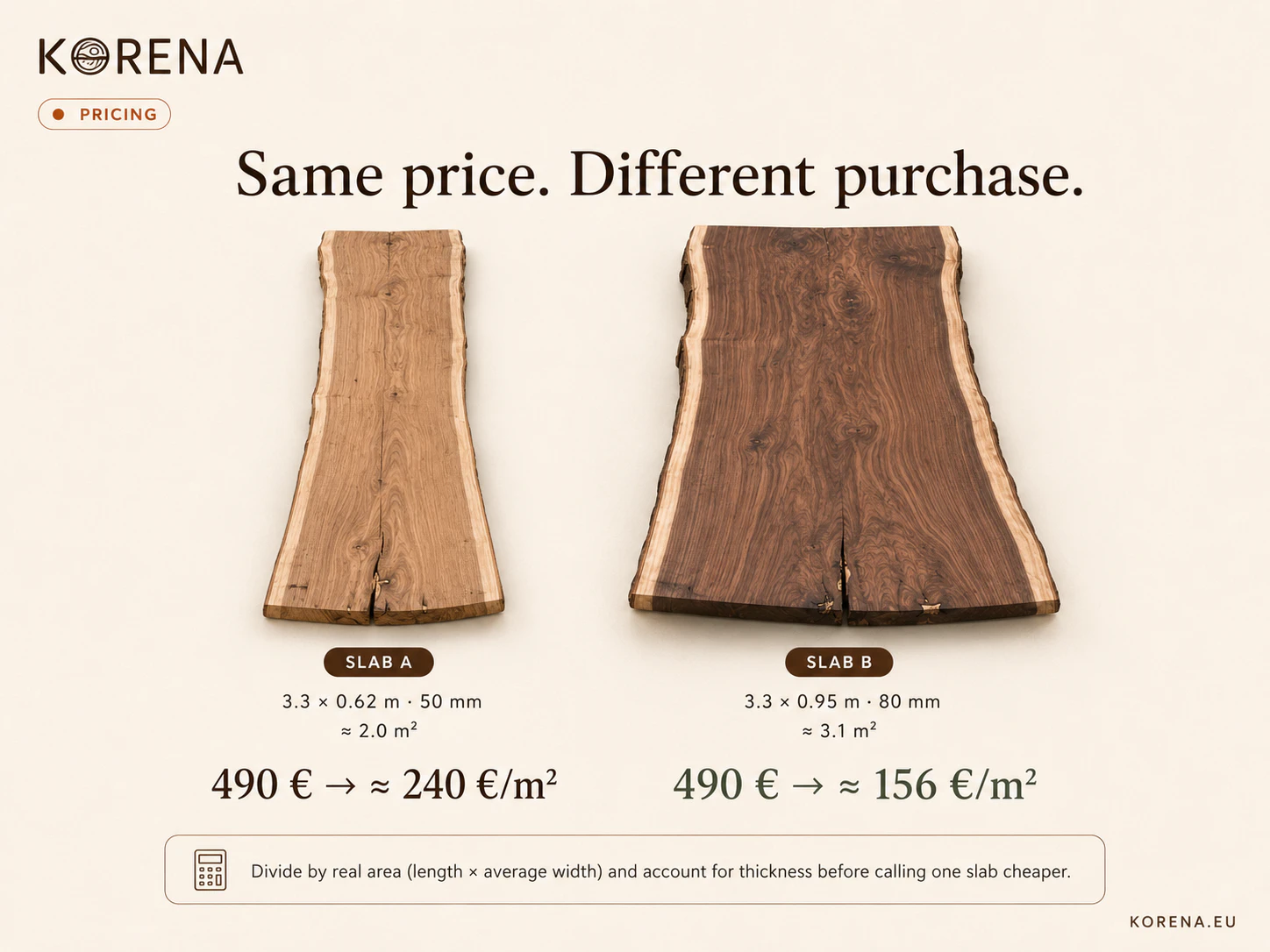
Width stations are useful because they reduce the common live-edge trap: paying for the widest point while building from the narrowest useful section. If a slab is 0.65 m wide at 25 percent, 0.55 m at 50 percent, and 0.50 m at 75 percent, the working width may be closer to 0.57 m than 0.65 m. If the design needs a 600 mm clear desk depth, that difference matters.
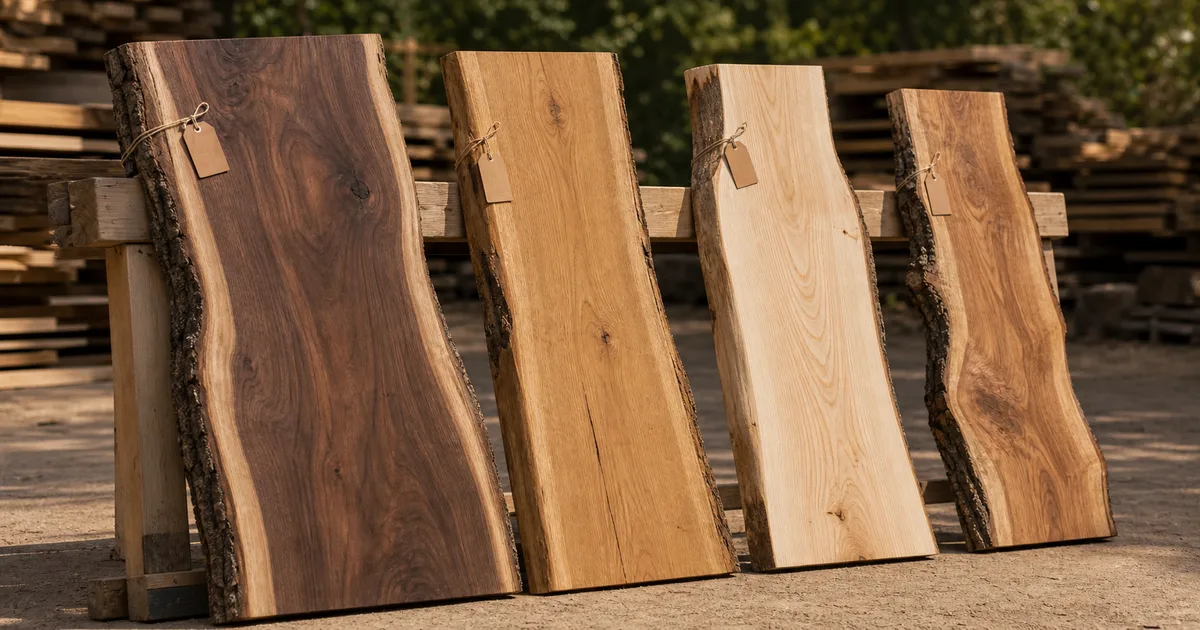
For the current KORENA stock, European walnut slabs are roughly 3.0 to 3.4 m long, around 0.5 to 0.65 m wide, 50 mm thick, kiln-dried, with recent moisture readings from about 6.5 to 11 percent, from about 180 EUR net. Current European oak slabs are about 3.2 to 3.3 m long, up to about 1.0 m wide, 70 to 90 mm thick, with a 3.3 m piece around 490 EUR net. Those are different products even before species and figure enter the comparison.
If a listing gives one width only, ask whether it is maximum width, average width, or usable width after trimming.
What drives hardwood slab prices in Europe#
Species is the obvious driver. European walnut is valued for colour, contrast, and furniture demand. The European walnut slab buying guide covers walnut-specific checks. Oak is common in Europe, but wide, thick, attractive oak slabs still take time, space, and care to produce. For oak specifics, see the European oak slab buying guide.
Width in one piece is often more important than length. Long timber is useful, but very wide single-piece timber is harder to find, harder to dry, and harder to move. A 3.3 m oak slab that approaches 1.0 m wide is a different purchase from two narrower boards that need joining.
Drying has a real cost. Kiln drying ties up stock, uses energy, and requires sorting before and after the cycle. A slab at about 7 to 8 percent moisture is closer to indoor furniture use than a wet slab from a yard. It can still move, and every workshop should check moisture again on arrival, but the risk profile is different.
Figure also affects price. Ripple, curl, pippy sections, crotch figure, strong colour, and balanced live edges can lift demand. Defects cut both ways. A crack in the right place may add character if the maker is ready to stabilise it. A crack through a table joinery area may reduce usable yield. Voids, bark inclusions, twist, cup, and end checks should be read as work, waste, or both.
Provenance also has value when it is recorded at piece level. I measure KORENA pieces myself in European partner yards. Each slab ships with a per-piece wood passport, accessed by QR at p.korena.eu, recording provenance towards EUDR due diligence. Under Regulation (EU) 2023/1115, as amended by Regulation (EU) 2025/2650, wood is a covered commodity. Due-diligence obligations apply to large and medium operators from 30 December 2026, and to micro and small operators from 30 June 2027. Operators file a Due Diligence Statement through the EU Information System and receive a reference number. Harvest plot geolocation is required, with polygons for plots over 4 hectares.
That does not make every slab expensive. It does mean that a cheap slab with unclear origin, no measurement record, and no moisture reading is not directly comparable with a measured, dry, traceable slab.
The work remaining#
A raw slab is rarely ready to become furniture. It may need flattening, trimming, sanding, crack stabilisation, resin or timber fills, bowtie keys, edge cleaning, and finish testing. Some makers want that work in-house. Others would rather pay for preparation and save workshop time.
The true comparison is raw slab plus work remaining. A cheaper slab that needs deep flattening can lose several millimetres from each face. A 50 mm slab with twist may finish thinner than expected. A 70 to 90 mm oak slab has more margin, but it is heavier and may require larger machines.
Ask direct questions before buying:
- Has the slab been flattened, or is it sawn and dried only?
- What is the current thickness, and where was it measured?
- Is the moisture reading recent, and where was the meter placed?
- Are cracks stable, open, or still moving?
- Are there metal inclusions, bark pockets, soft areas, or end checks?
- Is the quoted width the full natural edge or a likely usable width?
Finishing also changes cost. Open-grained oak may need pore filling for a glassy surface. Walnut can show sanding errors and finish blotching if rushed. Saman, with current pieces up to 4.76 m long and over 1.1 m wide, gives large-format options, but a slab of that scale needs careful handling and a workshop plan before it leaves the yard.
Shipping and the true landed cost#
A fair slab price includes the landed cost, not the listing price in isolation. Current KORENA catalogue pieces in the 3 m class can weigh roughly 50 to 115 kg depending on species, width, thickness, and moisture. That is too heavy for casual parcel handling and too awkward for poor packing.
Good shipping protects the faces, edges, and ends. It should account for forklift access, tail-lift delivery, crating, straps, dunnage, and whether the slab is travelling alone or with other timber. A lower carrier quote is not helpful if it assumes easy hand unloading or leaves the live edge exposed.
A useful quote should show:
- packing method, such as pallet, crate, or reinforced bundle
- origin yard and destination country
- carrier service level and unloading assumptions
- whether delivery is kerbside, workshop door, or freight terminal
- insurance position and what happens if damage is found on delivery
- expected lead time and customs position where relevant
Shipping risk has a price. Paying for a better crate may be cheaper than repairing a crushed corner, replacing a lost piece, or delaying a client commission.
Where to check the market#
The KORENA Timber Index is a daily-refreshed European hardwood price reference. Use it to understand direction and context, not as a quote for a specific slab.
A price reference can tell you whether a species or grade appears to be moving up or down. It cannot see the actual outline, defects, moisture reading, colour, figure, or shipping route of the piece you want. Slabs are too individual for one index number to replace inspection.
A practical method is to compare in layers. First, compare species and rough grade. Then compare area, thickness, and drying. Then look at outline and usable yield. Then add work remaining and shipping. By the end, you are judging a landed, buildable piece, rather than a headline price.
A fair-price checklist#
Use this checklist before deciding whether a walnut slab price, oak slab price, or any hardwood slab cost in Europe is fair.
| Check | What to look for | Why it matters |
|---|---|---|
| Area | Length × average width | Gives a better wood slab price per m² than headline price |
| Width stations | 25, 50, and 75 percent measurements | Shows taper and live-edge reality |
| Thickness | Current measured thickness | Sets flattening margin and finished strength |
| Moisture | Recent reading, ideally with method shown | Helps judge indoor readiness |
| Drying | Kiln-dried or air-dried | Affects risk, lead time, and price |
| Shape | Outline as well as dimensions | Shows usable yield for the intended build |
| Defects | Cracks, voids, twist, checks, soft areas | Converts beauty into labour or waste |
| Provenance | Piece-level record and passport | Helps with traceability and EUDR preparation |
| Preparation | Flattened, sanded, filled, or raw | Changes workshop time and final cost |
| Shipping | Crate, carrier, unloading, insurance | Determines landed cost and damage risk |
The fair price is the one that still makes sense after these checks. A 260 EUR net walnut slab can be good value if the area, moisture, and shape suit the job. A 490 EUR net oak slab can be good value if the extra width and thickness reduce joining, waste, and machining risk. A cheaper piece can be the right buy for a workshop with time and equipment. A prepared piece can be the right buy when schedule, client certainty, and lower handling risk matter more.
The key is to compare the same thing: usable dry timber, delivered safely, with enough information to plan the work.