EUDR Timber Buying Checklist for Furniture Makers
A practical EUDR supplier checklist covering species, harvest origin, legality, DDS references and the link between each slab and its records.
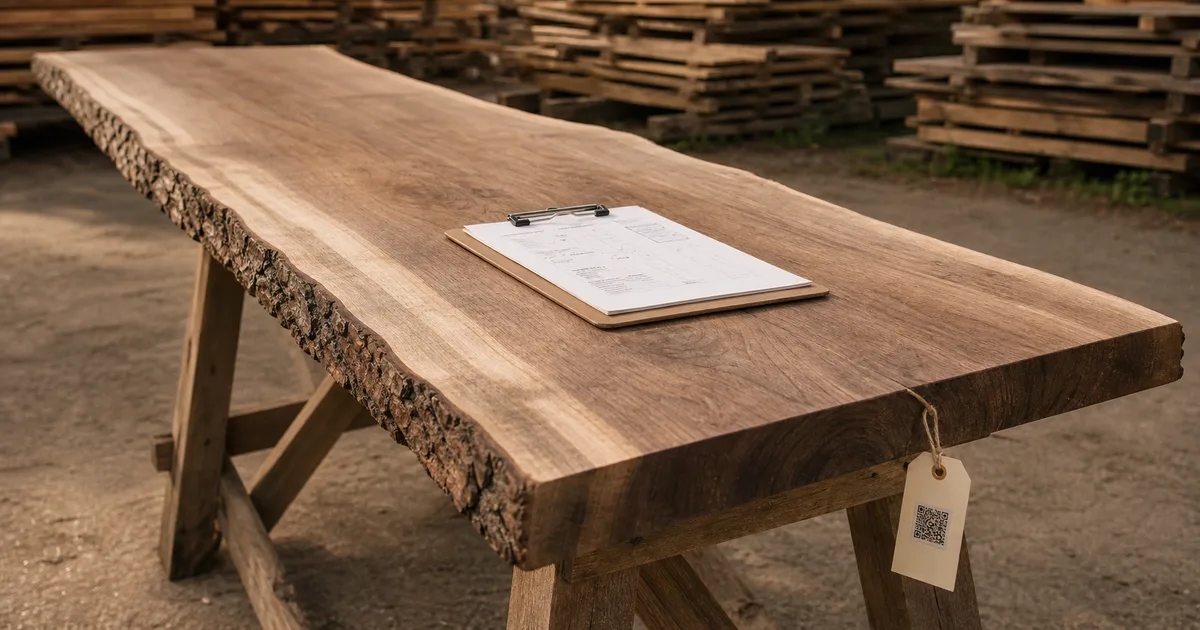
Why run this checklist now?#
Wood is a covered commodity under the EU Deforestation Regulation, Regulation (EU) 2023/1115, as amended by Regulation (EU) 2025/2650. The headline application dates are 30 December 2026 for large and medium operators, and 30 June 2027 for micro and small operators. Product and business-status exceptions can affect timing, so check your own position.
Supplier readiness varies. One yard may have plot records linked to each log. Another may have a country name on an invoice and little else. Five minutes of questions before purchase is easier than reconstructing a chain after the slab has been cut into a table.
This checklist is a purchasing control, not legal advice. It helps a workshop ask consistent questions, record the answers and spot missing information. For a broader explanation, read EUDR for hardwood buyers.
First, know your role#
A private buyer purchasing timber for personal use, without placing it on the market, making it available or exporting it, has nothing to file in the EUDR Information System. A commercial workshop may be an operator, downstream operator or trader depending on what it imports, places on the EU market, supplies or exports. Those roles do not carry identical duties.
Do not decide from company size alone. Establish what happens to the timber, where it enters the market and whether you sell or export the resulting product. Check your own position against the current regulation and guidance, or take qualified advice. Your supplier’s DDS does not automatically settle every obligation you may have.
The EUDR timber buying checklist#
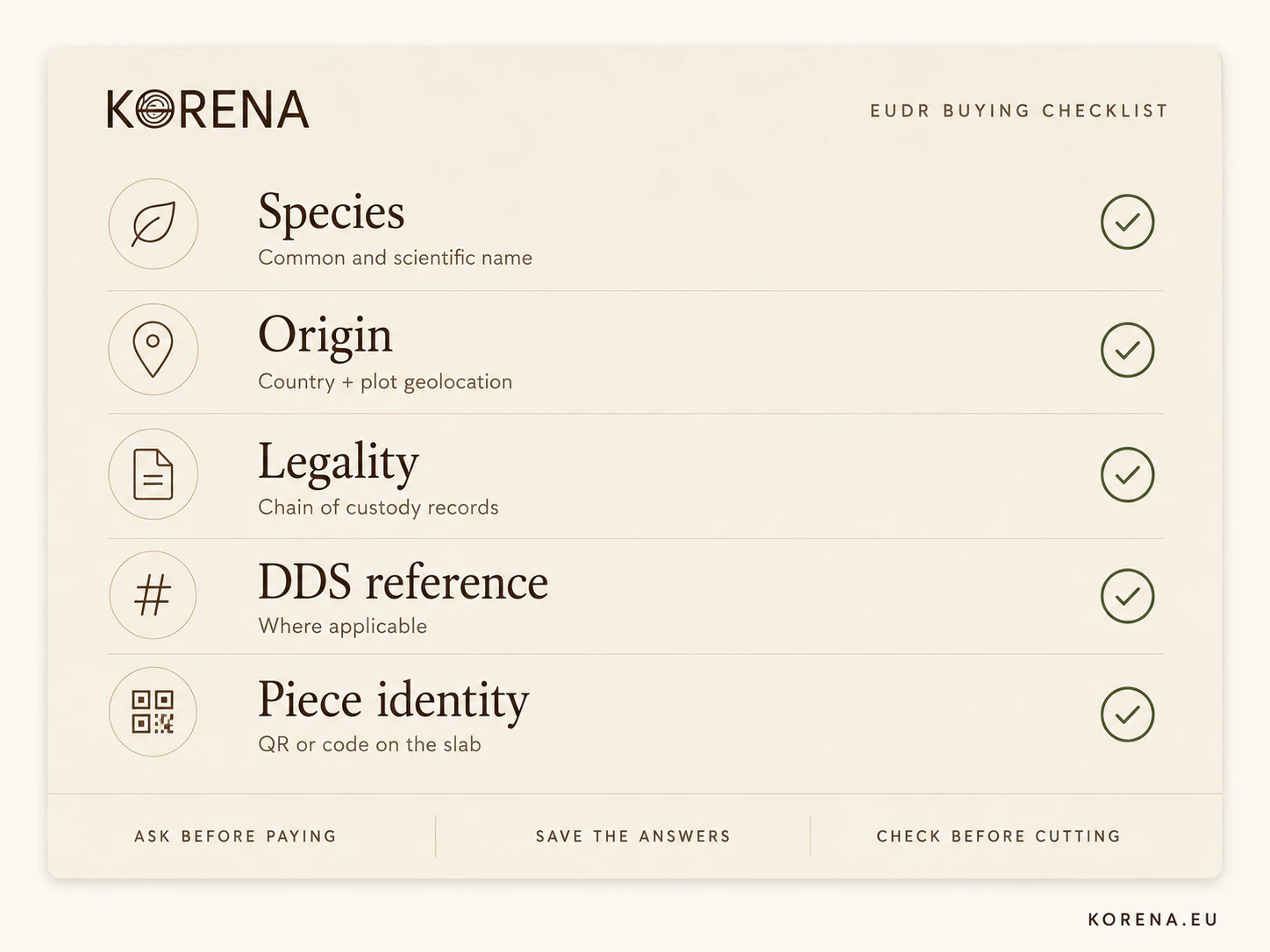
Use this against any timber supplier. Save the response with the quote, invoice and piece identifier.
1. Species#
- Ask for the common or trade name and the scientific name.
- Check that both names match across the listing, quote, invoice and supporting records.
- Compare the claim with the physical piece. Colour and grain can raise a question, but visual inspection alone may not prove species.
- If the supplier is uncertain, ask what identification method supports the claim. Record uncertainty rather than converting a guess into a fact.
“European hardwood” is not a species. “Oak” may still be too broad if the scientific name is absent, since European oak alone covers both Quercus robur and Quercus petraea. If a batch contains several species, each needs a clear identity.
2. Origin and harvest plot#
- Record the country of production. Do not accept the seller’s country or milling country as a substitute unless it is also the harvest country.
- Ask whether geolocation for every harvest plot is held and can support the relevant due diligence record.
- Confirm the coordinates relate to the timber offered, rather than to a general forest, estate or supplier address.
- For plots over 4 hectares, check that geolocation is recorded as a polygon describing the plot perimeter.
- If timber from several plots was mixed, ask how every plot is accounted for.
A supplier may have sound reasons for controlling access to plot data. You still need a clear answer on whether the required data exists, who holds it and how it connects to the product.
3. Legality and chain of custody#
- Ask who harvested the timber and under what right or permit.
- Ask who bought the logs, who milled them and which businesses held the timber before the present yard.
- Request evidence relevant to the laws of the country of production. The exact documents vary by country and harvest.
- Look for unexplained changes in names, quantities, dates or species between records.
- Write down any gap in the chain. A confident verbal explanation is not a document.
Legality evidence and traceability answer different questions. A harvesting permit may support legal production. It does not, by itself, show that the slab on the rack came from that harvest.
4. Paperwork#
- Ask whether a Due Diligence Statement, or DDS, applies to the product at this stage.
- Where applicable, obtain the DDS reference number and retain it with the purchase record.
- Check that the invoice identifies the timber clearly. For a one-off slab, a unique piece code is better than “one oak board”.
- Ask whether the documents refer to this piece, a log, a parcel or a broad batch.
- Check dates, quantities, supplier names and country information for agreement.
- Save the actual documents. “Available on request” is not useful until the files arrive and can be read.
A DDS reference number shows that a statement was submitted through the EU Information System. It is not a quality certificate, proof of species, or a substitute for checking your role and records.
5. Physical identity#
- Find the identifier on the slab, label or packaging.
- Match that identifier to the listing, invoice and supporting record before cutting.
- Photograph the identifier and the whole piece on receipt.
- If there is a QR code or digital passport, open it and check that its species, dimensions and supplier information describe the piece in front of you.
- Record any mismatch immediately and ask the supplier to correct or explain it in writing.
Keep one folder per purchase. Use the piece code in the folder name, then store the invoice, supplier answers, DDS reference where applicable, photographs and documents inside it.
Red flags worth stopping for#
Pause the order if the species remains “European hardwood”, the country of production is missing, or the seller repeatedly promises documents that do not arrive. Treat copied certificates with no product identifier cautiously. A forest certificate may be useful evidence, but it does not necessarily connect a one-of-one slab to a harvest plot.
Batch paperwork also needs scrutiny. It can be valid for timber managed as a batch, yet the supplier should explain how the individual slab remains linked to that batch. If the explanation relies entirely on memory, the link may be lost when stock moves or staff change.
Inconsistent dates deserve a question, as do invoices that rename species or origin. A missing answer does not prove wrongdoing. It does mean you lack information that may be necessary for a buying decision or your own compliance work.
What good piece-level documentation looks like#
A useful record brings the commercial and regulatory identity together. It names the species, identifies the country and source chain, states which documents apply, and ties those records to a code carried by the physical slab. Measurements help confirm identity, even though outline, width, thickness and moisture are not substitutes for EUDR due diligence.
I measure each KORENA piece myself at European partner yards. Each listing records the outline, length, widths at 25, 50 and 75 per cent, thickness, moisture reading, drying method and a precision badge, typically within 10 mm. A per-piece QR opens a wood passport that keeps provenance and piece records together. Read what is a wood passport for its scope and limits.
That record makes a practical check possible: scan the code, compare the measured outline and dimensions with the delivered slab, then review the provenance fields. It cannot make incomplete upstream information complete, and a dimensional match does not prove legal harvest. It does reduce the risk of attaching the right documents to the wrong piece.
Before paying, ask the questions. Before cutting, repeat the identity check. You can browse documented slabs to see how piece-level records are presented in practice.