Measurement
How much does a wood slab weigh? Weight tables by species and thickness
Our reference tables show slab weights by species, size and thickness, with guidance on moisture, shipping, lifting and table bases.
Audio by MediaThrive. Pressing the button loads their player, which saves your player settings in this browser.
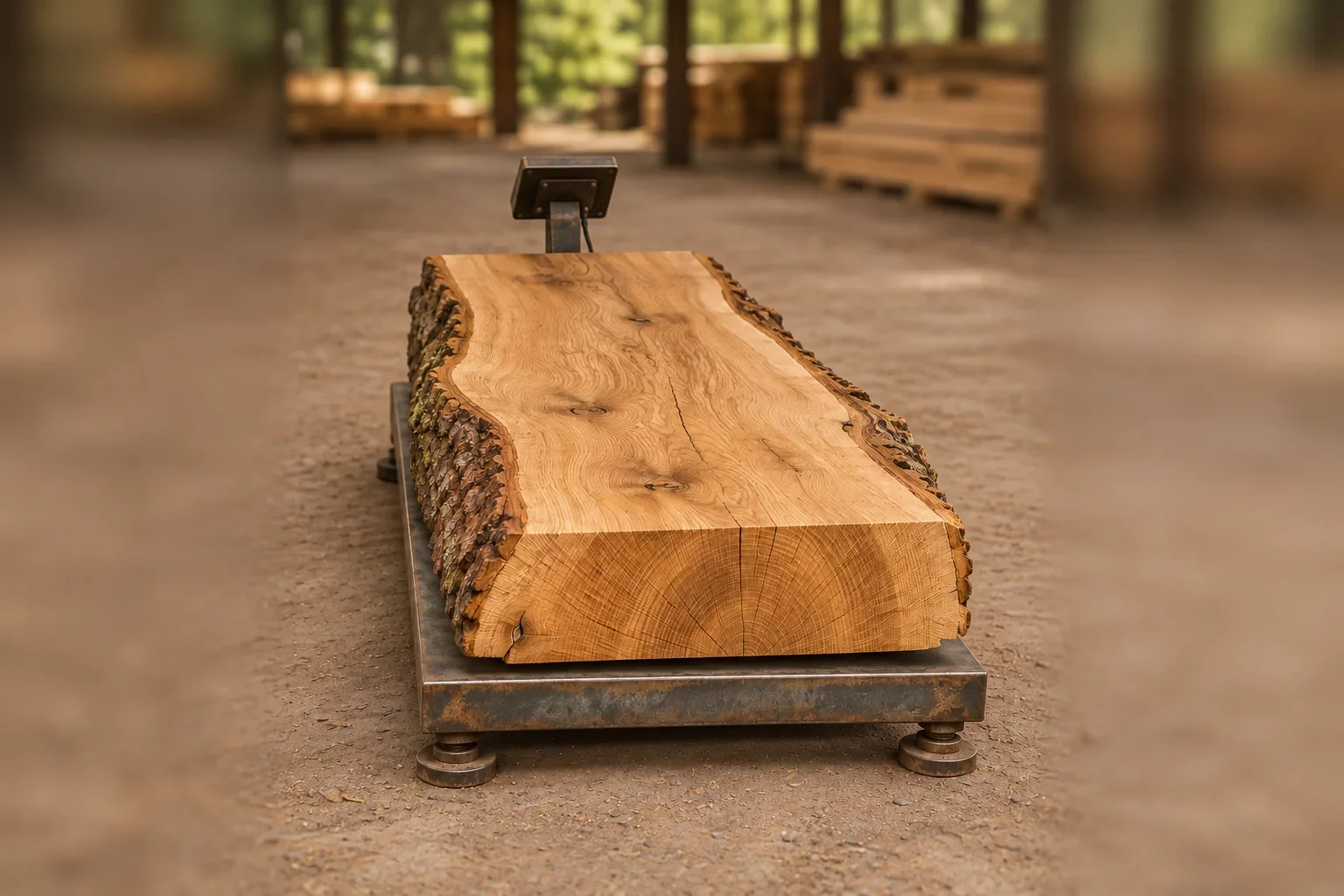
A wood slab's weight is its volume times the density of the species. A European oak slab 2.4 m long, 0.9 m wide on average and 50 mm thick is 0.108 m³ and weighs about 80 kg at 12 percent moisture content. The same slab in European walnut weighs about 71 kg.
Key facts#
- A slab's weight in kilograms is its volume in cubic metres multiplied by the species density in kilograms per cubic metre.
- European oak has a reference density of 740 kg/m³ at 12 percent moisture content, which gives 37.0 kg per square metre at 50 mm thickness.
- A slab measuring 2.4 m × 0.9 m × 50 mm weighs about 80 kg in European oak and about 71 kg in European walnut at 12 percent moisture content.
- Norway spruce at 450 kg/m³ is the lightest species in our table, and hornbeam at 830 kg/m³ is the heaviest.
- A European oak top measuring 3.0 m × 1.0 m × 80 mm weighs about 178 kg at 12 percent moisture content.
- Freshly felled European beech has a reference density of 1070 kg/m³, compared with 710 kg/m³ at 12 percent moisture content, making it 51 percent heavier per unit volume.
- DPD CLASSIC collected parcels and DHL Paket in Germany list 31.5 kg per parcel, so table-size slabs travel as pallet freight.
- The UK Health and Safety Executive's guidance uses 25 kg as its filter value for men lifting close to the body and says the law sets no fixed weight limit.
Source: our calculations from the species table; CIRAD's oak sheet; Silva Fennica Monographs; DPD; DHL; HSE's lifting guidance and manual handling overview.
Last updated: 20 November 2026.
Calculate a slab's weight#
In words, multiply length by average width, thickness and density to estimate weight.
Weight (kg) = length (m) × average width (m) × thickness (m) × density (kg/m³).
All slab weights on this page are our calculations from the densities in the species table. These are estimates for the wood alone, without legs, packaging or a pallet. Displayed volumes and weights are rounded.
Express thickness in metres before multiplying. The dimensions and density should describe the wood at the same moisture content.
For a top whose surface area is already known, the shortcut is:
Weight per square metre (kg/m²) = density (kg/m³) × thickness (m).
The oak example uses CIRAD's reference density of 740 kg/m³: 0.108 m³ × 740 kg/m³ ≈ 80 kg. The same volume multiplied by CIRAD's European walnut density of 660 kg/m³ gives about 71 kg.
The formula follows the definition of density as mass divided by volume in the USDA FPL Wood Handbook.
Wood density by species#
| Species | Scientific name | Density at 12% moisture (kg/m³) | Source |
|---|---|---|---|
| European oak | Quercus robur, Q. petraea | 740 | CIRAD Tropix 7 species sheet |
| European beech | Fagus sylvatica | 710 | CIRAD Tropix 7 species sheet |
| European ash | Fraxinus excelsior | 680 | CIRAD Tropix 7 species sheet |
| European walnut | Juglans regia | 660 | CIRAD Tropix 7 species sheet |
| Black walnut | Juglans nigra | 609 | USDA FPL, Hardwoods of North America |
| Sycamore maple | Acer pseudoplatanus | 640 | CIRAD Tropix 7 species sheet |
| Sweet chestnut | Castanea sativa | 640 | CIRAD Tropix 7 species sheet |
| Hornbeam | Carpinus betulus | 830 | Molnár and Bariska (2002), as reproduced in Pozsgayné Fodor (2023) |
| Robinia | Robinia pseudoacacia | 740 | CIRAD Tropix 7 species sheet |
| European cherry | Prunus avium | 600 | CIRAD Tropix 7 species sheet |
| European elm | Ulmus spp. | 673 | Frey-Amon timber reference (Ulmus spp.) |
| European lime | Tilia cordata, T. platyphyllos | 545 | W.A.V.E. species catalogue (2025) |
| Silver birch | Betula pendula | 623 | Forests 2020, 11, 445 (study mean) |
| European larch | Larix decidua | 600 | PEFC reference density values |
| Norway spruce | Picea abies | 450 | CIRAD Tropix 7 species sheet |
| Scots pine | Pinus sylvestris | 550 | CIRAD Tropix 7 species sheet |
The table ranges from CIRAD's Norway spruce reference of 450 kg/m³ to the hornbeam reference of 830 kg/m³ reproduced in Pozsgayné Fodor's dissertation. CIRAD gives European oak and robinia the same reference density, 740 kg/m³. Other references differ by a few percent: PEFC lists European walnut at 670 kg/m³, silver birch at 660 kg/m³ and Norway spruce at 460 kg/m³, all at 12 percent moisture content.
Density at 12 percent moisture content describes the wood's mass and volume in that moisture condition, including its remaining water. The USDA FPL Wood Handbook defines moisture content relative to the mass of oven-dry wood. It is not the water's share of the total wet weight.
Species differ because their wood structure differs. The Forests birch study links density to anatomy, growth and position within the tree. CIRAD's oak sheet states that slow-grown oak is less dense than fast-grown oak.
The European lime row covers the species named in the table, and the elm row covers Ulmus species. The Forests study reports a silver birch mean of 623 kg/m³ at 12 percent moisture content. Keep these source scopes when quoting a density.
Weight per square metre by thickness#
All entries below are kilograms per square metre.
| Species | 30 mm | 40 mm | 50 mm | 60 mm | 80 mm | 100 mm |
|---|---|---|---|---|---|---|
| European oak | 22.2 | 29.6 | 37.0 | 44.4 | 59.2 | 74.0 |
| European beech | 21.3 | 28.4 | 35.5 | 42.6 | 56.8 | 71.0 |
| European ash | 20.4 | 27.2 | 34.0 | 40.8 | 54.4 | 68.0 |
| European walnut | 19.8 | 26.4 | 33.0 | 39.6 | 52.8 | 66.0 |
| Black walnut | 18.3 | 24.4 | 30.4 | 36.5 | 48.7 | 60.9 |
| Sycamore maple | 19.2 | 25.6 | 32.0 | 38.4 | 51.2 | 64.0 |
| Sweet chestnut | 19.2 | 25.6 | 32.0 | 38.4 | 51.2 | 64.0 |
| Hornbeam | 24.9 | 33.2 | 41.5 | 49.8 | 66.4 | 83.0 |
| Robinia | 22.2 | 29.6 | 37.0 | 44.4 | 59.2 | 74.0 |
| European cherry | 18.0 | 24.0 | 30.0 | 36.0 | 48.0 | 60.0 |
| European elm | 20.2 | 26.9 | 33.6 | 40.4 | 53.8 | 67.3 |
| European lime | 16.4 | 21.8 | 27.2 | 32.7 | 43.6 | 54.5 |
| Silver birch | 18.7 | 24.9 | 31.1 | 37.4 | 49.8 | 62.3 |
| European larch | 18.0 | 24.0 | 30.0 | 36.0 | 48.0 | 60.0 |
| Norway spruce | 13.5 | 18.0 | 22.5 | 27.0 | 36.0 | 45.0 |
| Scots pine | 16.5 | 22.0 | 27.5 | 33.0 | 44.0 | 55.0 |
European oak weighs 37.0 kg/m² at 50 mm thickness and 59.2 kg/m² at 80 mm. Norway spruce weighs 22.5 kg/m² at 50 mm. Thickness and species both change the weight of a top with the same surface area.
For any size, multiply the relevant kilograms per square metre by the top's area in square metres. That area is length multiplied by average width when both dimensions are in metres. This works for sizes absent from the ready weight tables.
Keep the thickness of the piece being considered in the calculation. For a finished top, use its finished dimensions. For a rough slab awaiting flattening or trimming, use its current dimensions when planning transport.
Common slab weights at 50 mm#
| Slab size (length × average width) | Volume (m³) | European oak | European beech | European ash | European walnut | Sycamore maple | Sweet chestnut | European elm |
|---|---|---|---|---|---|---|---|---|
| 1.2 m × 0.6 m | 0.036 | 27 kg | 26 kg | 24 kg | 24 kg | 23 kg | 23 kg | 24 kg |
| 1.8 m × 0.8 m | 0.072 | 53 kg | 51 kg | 49 kg | 48 kg | 46 kg | 46 kg | 48 kg |
| 2.0 m × 0.9 m | 0.090 | 67 kg | 64 kg | 61 kg | 59 kg | 58 kg | 58 kg | 61 kg |
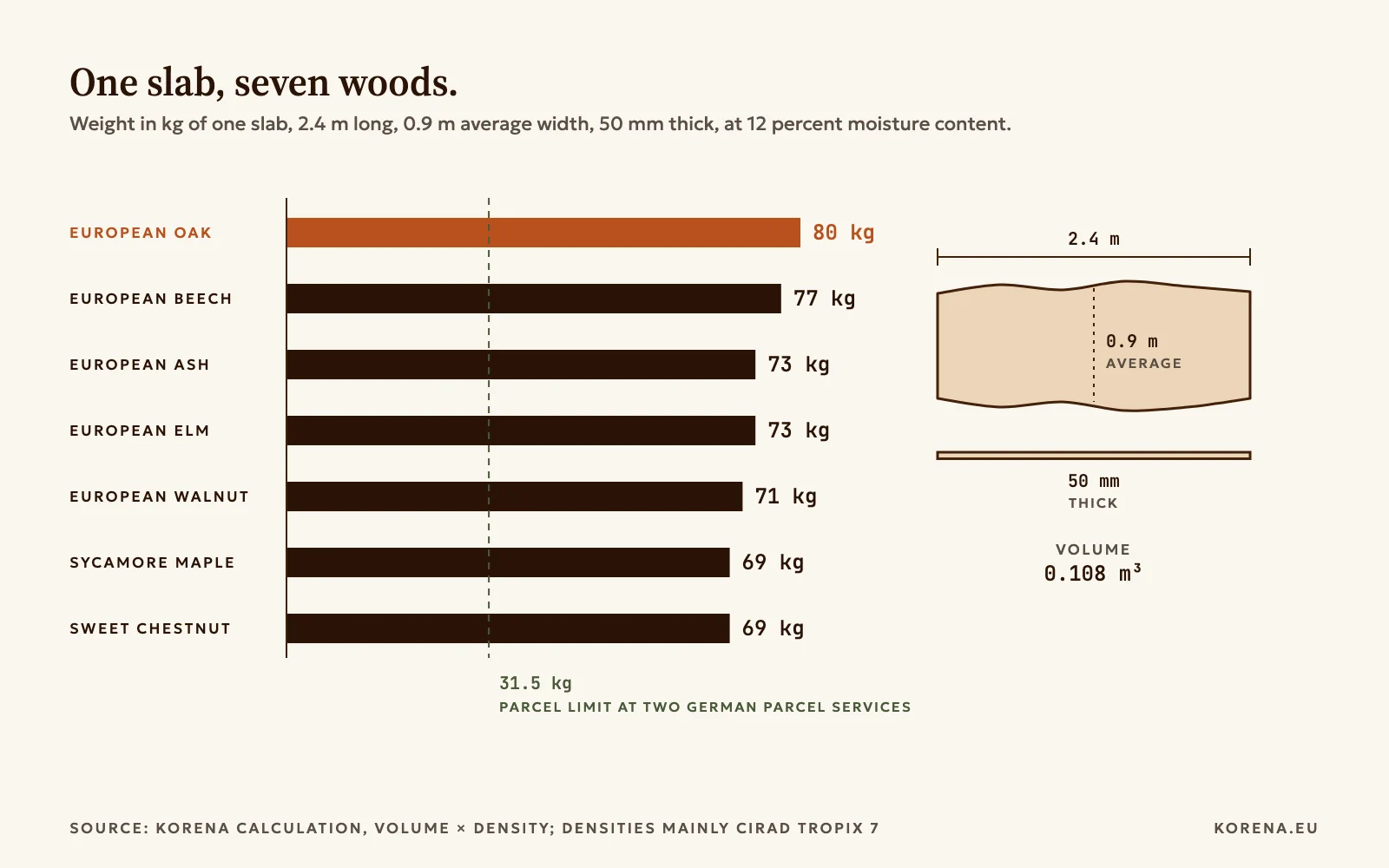
| 2.4 m × 0.9 m | 0.108 | 80 kg | 77 kg | 73 kg | 71 kg | 69 kg | 69 kg | 73 kg |
| 2.4 m × 1.0 m | 0.120 | 89 kg | 85 kg | 82 kg | 79 kg | 77 kg | 77 kg | 81 kg |
| 3.0 m × 1.0 m | 0.150 | 111 kg | 106 kg | 102 kg | 99 kg | 96 kg | 96 kg | 101 kg |
At 50 mm thickness, a 2.4 m × 0.9 m slab weighs about 80 kg in European oak and 71 kg in European walnut. At 3.0 m × 1.0 m, the corresponding weights are 111 kg and 99 kg.
 View full size
Common slab weights at 80 mm#
| Slab size (length × average width) | Volume (m³) | European oak | European beech | European ash | European walnut | Sycamore maple | Sweet chestnut | European elm |
|---|---|---|---|---|---|---|---|---|
| 1.2 m × 0.6 m | 0.058 | 43 kg | 41 kg | 39 kg | 38 kg | 37 kg | 37 kg | 39 kg |
| 1.8 m × 0.8 m | 0.115 | 85 kg | 82 kg | 78 kg | 76 kg | 74 kg | 74 kg | 78 kg |
| 2.0 m × 0.9 m | 0.144 | 107 kg | 102 kg | 98 kg | 95 kg | 92 kg | 92 kg | 97 kg |
| 2.4 m × 0.9 m | 0.173 | 128 kg | 123 kg | 118 kg | 114 kg | 111 kg | 111 kg | 116 kg |
| 2.4 m × 1.0 m | 0.192 | 142 kg | 136 kg | 131 kg | 127 kg | 123 kg | 123 kg | 129 kg |
| 3.0 m × 1.0 m | 0.240 | 178 kg | 170 kg | 163 kg | 158 kg | 154 kg | 154 kg | 162 kg |
At 80 mm thickness, a 2.4 m × 0.9 m slab weighs about 128 kg in European oak and 114 kg in European walnut. At 3.0 m × 1.0 m, the corresponding weights are 178 kg and 158 kg.
Live edge and average width#
For a live edge slab, use average width because the edges are irregular. The widest point would treat the full length as equally wide.
Measurements at width stations describe the changing outline. For a strongly tapered or uneven slab, choose an area estimate that represents the whole shape. Do not add an arbitrary allowance simply because a piece has a live edge.
Bark and sapwood do not change the geometric method. Measure the material that remains in the piece being considered. Removing bark, trimming an edge or cutting the slab shorter changes the dimensions to enter in the formula.
At KORENA, we list individually measured slabs with a per-piece wood passport. For transport planning, distinguish the weight of the wood from the weight of the complete packed shipment.
Moisture changes weight#
A slab loses weight as drying removes water. Our main density table describes wood at 12 percent moisture content. The green figures below describe freshly felled wood reported by the named sources.
| Species | Density at 12% moisture (kg/m³) | Density freshly felled (kg/m³) | Freshly felled is heavier by | Source of the fresh figure |
|---|---|---|---|---|
| European oak | 740 | 1000 | 35% | Silva Fennica Monographs 1 (2000), Quercus robur |
| European beech | 710 | 1070 | 51% | Silva Fennica Monographs 1 (2000) |
| Black walnut | 609 | 929 | 53% | USDA FPL, Hardwoods of North America |
| Hornbeam | 830 | 970 | 17% | Molnár and Bariska (2002), as reproduced in Pozsgayné Fodor (2023) |
| Silver birch | 623 | 850 | 36% | Silva Fennica Monographs 1 (2000) |
| Norway spruce | 450 | 800 | 78% | Silva Fennica Monographs 1 (2000) |
USDA FPL lists black walnut at 929 kg/m³ green and 609 kg/m³ at 12 percent moisture content. Silva Fennica gives European beech a central green density of 1070 kg/m³, compared with CIRAD's 710 kg/m³ reference in our dry table. The percentage column compares the listed reference densities.
These figures are not measurements of the same slabs before and after drying. Several rows combine references, and the green oak figure covers Quercus robur. The percentage comparison does not predict the weight loss of a particular slab.
The USDA FPL Wood Handbook explains that both wood mass and volume change with moisture. Drying can therefore change dimensions as well as weight. Current dimensions and current moisture content belong together in a calculation.
The term kiln dried describes a drying process. It does not provide a current moisture measurement. Check the moisture information for the piece when choosing a density for transport or furniture planning.
Source: USDA FPL, Hardwoods of North America; Silva Fennica Monographs; the dry density references named in the table.
What the weight decides#
Parcel or pallet freight#
We checked these carrier limits on 20 November 2026. Each applies to the named service.
| Carrier and service | Maximum single-parcel weight | Service scope |
|---|---|---|
| DPD CLASSIC, collected parcels | 31.5 kg | DPD Germany's service for Germany and Europe |
| DHL Paket | 31.5 kg | DHL Germany's domestic parcel service |
DPD's parcel shipping page separately limits Pickup parcelshop drop-off to 20 kg. The booking channel matters, as do the route and package dimensions. A package must meet the size conditions as well as the weight limit.
The slab tables put most table-size tops above these parcel limits, so plan for pallet freight. Give the carrier the packed weight and outside dimensions. Confirm how the load will be unloaded and where it will be placed on arrival.
Source: DPD, Parcel shipping: DPD CLASSIC; DHL, Päckchen and Paket.
Lifting and moving#
The UK Health and Safety Executive says the law sets no fixed manual handling weight limit. Its guidance uses 25 kg for men lifting close to the body between knuckle and elbow height, assuming an easy grip with both hands, reasonable conditions and a stable stance. Plan for two or more people or lifting equipment when a slab exceeds the applicable filter value, especially with long slabs that are awkward to grip. HSE calls for a more detailed assessment for team handling or loads that are difficult to grasp.
Source: HSE, Manual handling at work: A brief guide, INDG143(rev4).
Choosing a table base#
The base must be rated for the top plus what stands on it. Ask the base maker for the load rating and compare it with the weight from this page.
Frequently asked questions#
How much does an oak slab weigh?#
Using CIRAD's European oak density, we calculate about 80 kg for a slab measuring 2.4 m × 0.9 m × 50 mm at 12 percent moisture content. Density varies from tree to tree, so an individual slab can be lighter or heavier.
What is the weight of oak per m3?#
CIRAD's CHÊNE sheet gives the European oak reference we use: 740 kg/m³ at 12 percent moisture content. It covers Quercus robur and Quercus petraea. This is a reference average, and moisture content affects the weight.
How heavy is a walnut table top?#
Using CIRAD's European walnut density, we calculate about 71 kg for a 2.4 m × 0.9 m × 50 mm top at 12 percent moisture content. Black walnut has a different reference density: USDA FPL lists 609 kg/m³ at the same moisture content. Specify the species.
How do you calculate the weight of a live edge slab?#
Multiply length, average width and thickness, all in metres, by the species density in kg/m³. Width measurements along the slab account for its irregular edges. For a freight booking, weigh the packed piece.
Does kiln dried wood weigh less?#
Wood loses weight as drying removes water. USDA FPL lists black walnut at 929 kg/m³ green and 609 kg/m³ at 12 percent moisture content. Kiln drying describes a process; the current moisture content is what matters when choosing a density for a weight estimate.
How to cite this page#
KORENA Journal, "How much does a wood slab weigh?", korena.eu/journal/wood-slab-weight-table, figures checked 20 November 2026. Last updated: 20 November 2026.
When quoting a weight, include the species, thickness or dimensions, moisture condition and unit. Identify calculated weights as our calculations. When quoting a density, name the original institution or study shown in the source column.
Related reading: dining table slab sizes and buying a hardwood slab in Europe.
Sources#
References marked for recheck could not be reopened during this session.
- CIRAD, CHÊNE, Tropix 7, species sheet, physical properties, accessed 20 November 2026.
- Bavarian State Institute of Forestry, Das Holz der Eiche: Eigenschaften und Verwendung, LWF Wissen 75, Tabelle 3, access attempted 20 November 2026; recheck pending.
- Finnish Society of Forest Science and Finnish Forest Research Institute, Birch As Sawn Timber and in Mechanical Further Processing in Finland: A Literature Study, Silva Fennica Monographs 1 (2000), Appendix 3, accessed 20 November 2026.
- CIRAD, HÊTRE, Tropix 7, species sheet, physical properties, accessed 20 November 2026.
- CIRAD, FRÊNE, Tropix 7, species sheet, physical properties, accessed 20 November 2026.
- CIRAD, NOYER, Tropix 7, species sheet, physical properties, accessed 20 November 2026.
- Holz vom Fach, Nussbaum (europäisch), Holzarten-ABC, entry nussbaum-europaeisch, accessed 20 November 2026.
- USDA Forest Products Laboratory, Hardwoods of North America, FPL-GTR-83 (1995), Juglans nigra, Weight, accessed 20 November 2026.
- USDA Forest Products Laboratory, Wood Handbook: Wood as an Engineering Material, FPL-GTR-282, moisture chapter and drying chapter, accessed 20 November 2026.
- Holz vom Fach, Nussbaum (amerikanisch), Holzarten-ABC, entry nussbaum-amerikanisch, accessed 20 November 2026.
- CIRAD, ERABLE SYCOMORE, Tropix 7, species sheet, physical properties, accessed 20 November 2026.
- Holz vom Fach, Ahorn, Holzarten-ABC, entry ahorn, accessed 20 November 2026.
- CIRAD, CHÂTAIGNIER, Tropix 7, species sheet, physical properties, accessed 20 November 2026.
- University of Sopron, Fanni Pozsgayné Fodor, Acetylation of European Hornbeam (Carpinus betulus L.) Wood for Outdoor Applications, Dissertation (2023), Table A27, access attempted 20 November 2026; recheck pending.
- Holz vom Fach, Hainbuche, Holzarten-ABC, entry hainbuche, accessed 20 November 2026.
- CIRAD, ROBINIER, Tropix 7, species sheet, physical properties, accessed 20 November 2026.
- Verlag Handwerk und Technik, Arbeitsheft Grundkenntnisse Holztechnik, Lernfelder 1 bis 4, Section 4.5 Holzfeuchte, access attempted 20 November 2026; recheck pending.
- CIRAD, MERISIER, Tropix 7, species sheet, physical properties, accessed 20 November 2026.
- Holz vom Fach, Kirschbaum (europäisch), Holzarten-ABC, entry kirschbaum-europaeisch, accessed 20 November 2026.
- Frey-Amon, Ulme, Ruste, Ulmus sp., Rohdichte and moisture footnote, accessed 20 November 2026.
- W.A.V.E. project, Catalogue des essences du projet W.A.V.E. et de leur utilisation potentielle, Version vulgarisée (2025), TILLEUL, access attempted 20 November 2026; recheck pending.
- Holz vom Fach, Linde, Holzarten-ABC, entry linde, accessed 20 November 2026.
- Warsaw University of Life Sciences, Dobrowolska, Wroniszewska and Jankowska, Density Distribution in Wood of European Birch (Betula pendula Roth.), Forests 2020, 11, 445, Table 4, accessed 20 November 2026.
- Holz vom Fach, Birke, Holzarten-ABC, entry birke, accessed 20 November 2026.
- PEFC, Reference Density Values of Wood Species and Wood-Based Panels, species density entries, accessed 20 November 2026.
- CIRAD, MELEZE, embedded in the Lycée Alexandra David-Néel timber attestations, Tropix 6.0, Fiche 224, access attempted 20 November 2026; recheck pending.
- CIRAD, EPICEA, Tropix 7, species sheet, physical properties, accessed 20 November 2026.
- CIRAD, PIN SYLVESTRE, Tropix 7, species sheet, physical properties, accessed 20 November 2026.
- DPD Germany, Parcel shipping: DPD CLASSIC, service comparison, collected parcels and Pickup parcelshop drop-off, accessed 20 November 2026.
- DHL Germany, Päckchen and Paket, domestic Paket weight bands, accessed 20 November 2026.
- UK Health and Safety Executive, Manual handling at work, Overview, specific weight limits, accessed 20 November 2026.
- UK Health and Safety Executive, Manual handling at work: A brief guide, INDG143(rev4), lifting and lowering risk filter, accessed 20 November 2026.