EUDR for Hardwood Buyers in Europe
Plain language on EUDR dates, roles, due diligence, geolocation and the records to ask for before buying hardwood slabs online.
What EUDR is, in one paragraph#
The EU Deforestation Regulation, Regulation (EU) 2023/1115, sets rules for placing certain commodities and products on the EU market, and for exporting them from the EU. Wood is a covered commodity, and sawn wood, wooden furniture and several other wood products sit in its annex. In plain terms, relevant wood products must be deforestation-free, produced in line with the relevant laws of the country of production, and covered by a Due Diligence Statement (DDS) or, where the amended regime allows it, a simplified declaration. For wood, deforestation-free includes harvest without causing forest degradation after 31 December 2020. The core EUDR hardwood requirements are evidence of species, lawful harvest, deforestation-free origin, risk assessment and a filed statement where required. For a furniture maker, this is practical, not abstract: species, origin, supplier records and harvest-location evidence become part of the buying decision. For background, see What is EUDR? Why wood traceability matters.
This guide is practical buying guidance for hardwood slabs. It is not legal advice. Your role can change depending on whether you buy privately, sell finished furniture, import goods, export goods, or act as a trader.
The dates that matter#
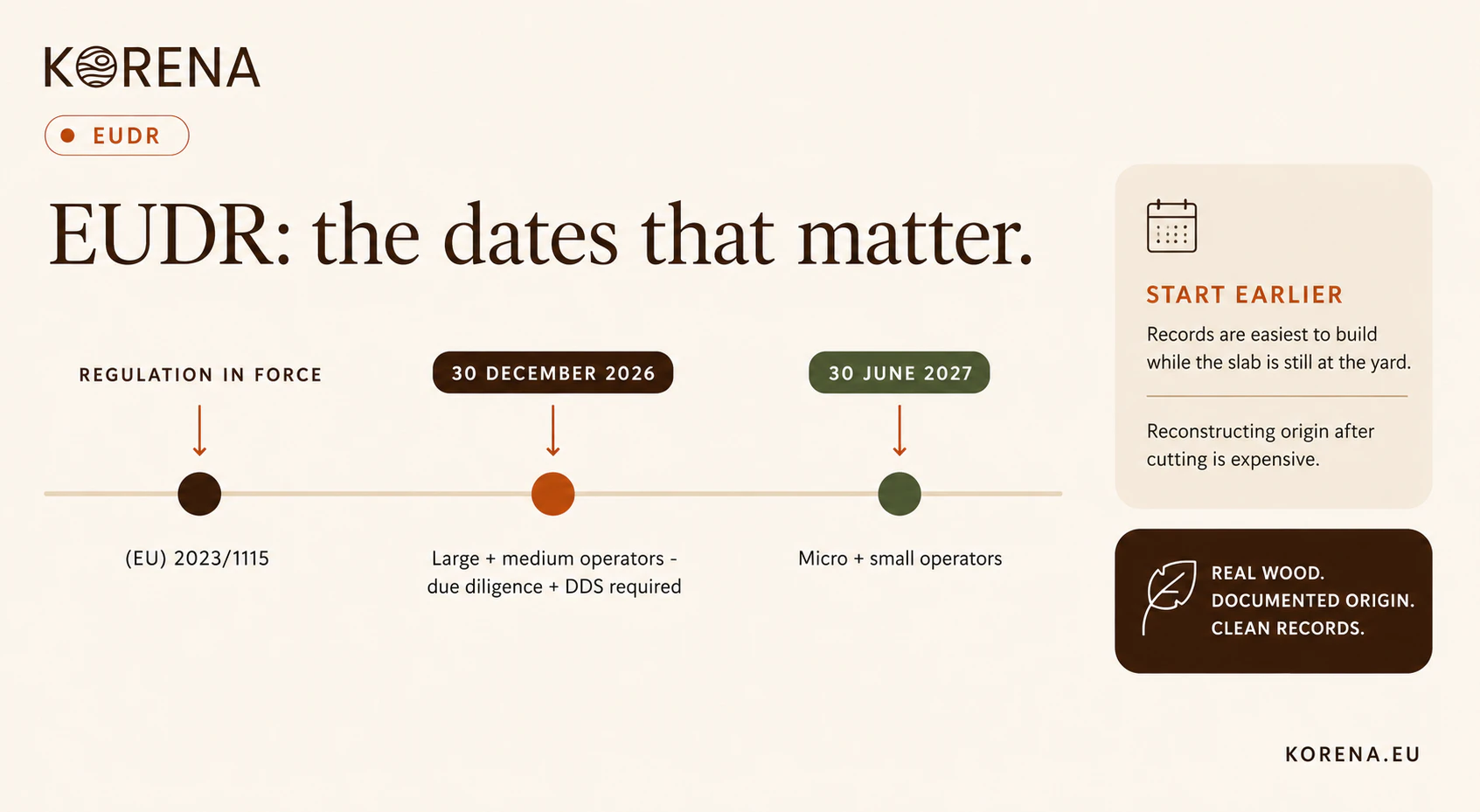
Regulation (EU) 2025/2650 amended the application dates. The core due-diligence obligations apply from 30 December 2026 for large and medium operators and traders. For micro and small operators, the key date is 30 June 2027. Those dates matter because the work behind a clean record starts earlier than the filing date.
'Placing on the market' has a specific meaning: the first making available of a relevant commodity or relevant product on the Union market in the course of commercial activity. A slab harvested in Europe, bought by a yard, sold to a marketplace, and then sold to a workshop may have several commercial steps. The first EU market placement, later making available, and any export from the EU can carry different duties. If wood enters from outside the EU, the first EU business making it available can become the operator.
For buyers, the deadline should be treated as a record deadline, not a panic date. It is much easier to record harvest origin, supplier identity and plot information while a slab is still at the yard. Once slabs are split, resawn, surfaced or moved through several hands, the origin trail can become expensive to prove.
Who has to do what#
The EUDR uses roles, not job titles. An operator places relevant products on the EU market for the first time, or exports them. A trader makes relevant products available on the market after that. A downstream operator places or exports products made using relevant products, such as furniture made from covered wood.
A private individual buying a walnut slab for a table at home normally files no DDS for that purchase. A studio buying slabs and selling finished tables is in a different position. Wooden furniture appears in the EUDR product list, so a professional maker should understand whether the finished piece is already covered by upstream due diligence, whether a reference number must be retained, and whether any new duty arises when the furniture is sold or exported. Non-SME traders and downstream operators have stronger registration and information duties than smaller traders, but small businesses still need records. Check your own position before relying on a supplier's short answer.
The buyer's commercial risk is simple. If you cannot connect a finished table to a timber record, you may struggle to answer a customer's procurement question, a gallery's supplier form, or a later compliance check. Even before the legal dates, serious trade buyers are already asking for better provenance.
The three pillars of due diligence#
EUDR due diligence has three pillars: information, risk assessment and risk mitigation. A DDS is the filing that follows from that work. It is not a decorative certificate attached at the end.
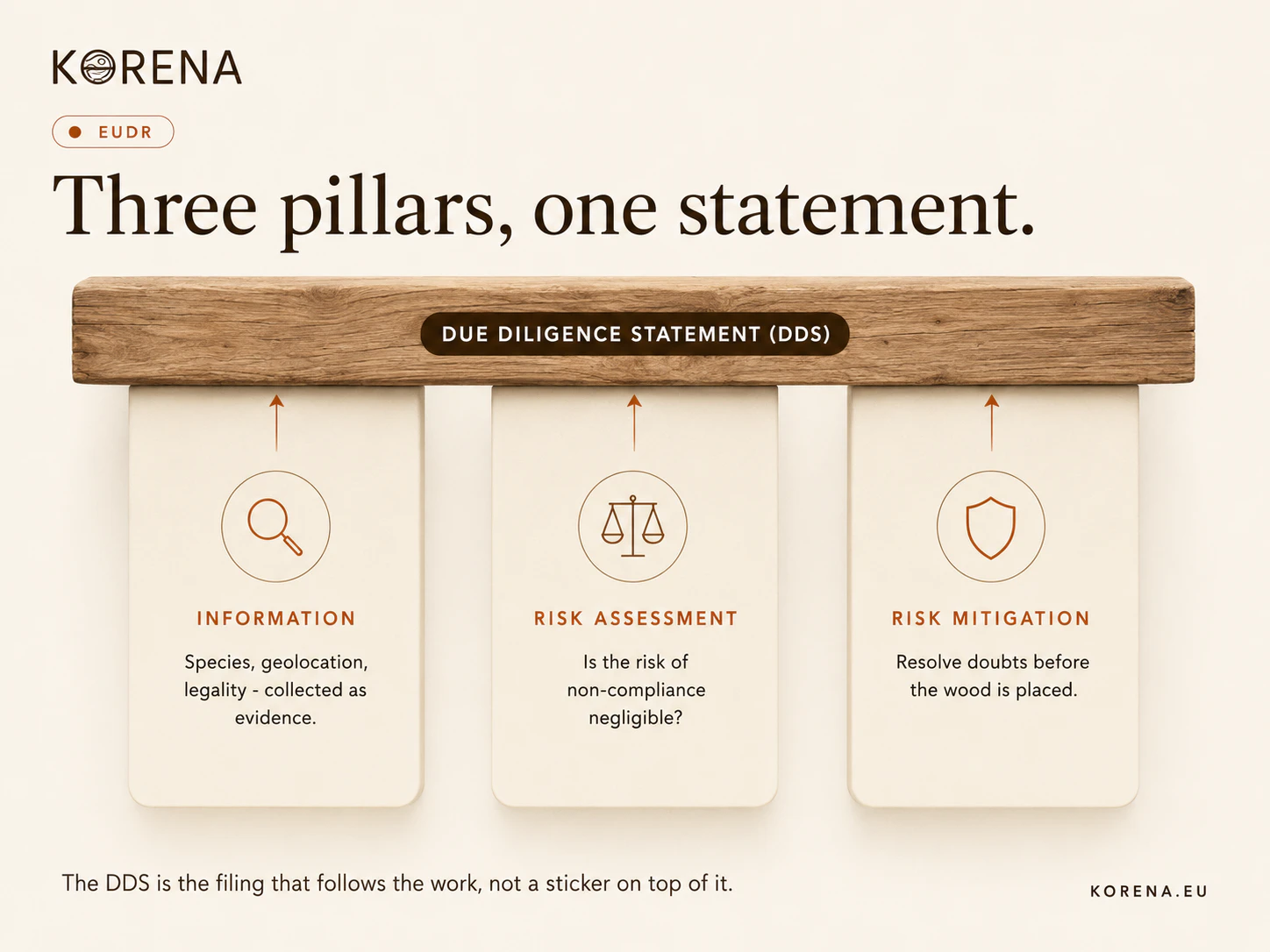
| Pillar | What it means | Hardwood buying check |
|---|---|---|
| Information | Collect evidence for the product, the commodity, the supplier, the country of production, and the geolocation of harvest plots. | Ask for common and scientific species names, piece identity, supplier details, country and region of production, and plot evidence where required. |
| Risk assessment | Check whether the records show no or only negligible risk of non-compliance. | Look for vague origin claims, mixed batches, unclear species, missing harvest dates, and weak supplier paperwork. |
| Risk mitigation | Reduce any non-negligible risk before the product is placed or exported. | Request clearer documents, separate suspect stock, avoid uncertain origins, or choose a different piece. |
The geolocation rule is one of the biggest changes for wood buyers. Operators must collect the geolocation of the plots of land where the relevant commodities were produced, along with the production date or time range. For plots over 4 hectares, geolocation is provided as polygons with enough latitude and longitude points to describe the perimeter. That does not mean every workshop has to become a mapping office. It does mean that a seller who cannot explain where the wood came from is creating a problem for the next professional buyer.
After due diligence, the operator submits the DDS through the EU Information System and receives a reference number. That reference number has to travel down the supply chain where relevant. A reference number is useful, but it does not replace judgement. If the product, species, quantity or supplier record does not match the slab in front of you, ask for clarification before you buy.
What this means when you buy a slab#
Premium hardwood slabs are awkward compliance objects because each piece is different. A live-edge walnut slab with a curved outline is not an interchangeable board from a pallet. If the seller treats it as a vague batch, you inherit the uncertainty.
For every slab, ask questions that connect the physical piece to the origin record:
- What species is claimed, and can the seller provide the common and scientific name?
- Where was the slab sourced, and which yard supplied it?
- Who holds the provenance paperwork and supplier records?
- Is harvest plot geolocation available where required, and if not, why not?
- What is the drying method, thickness and current moisture reading?
- Does the listing show the actual outline and measured dimensions of this piece?
- Who is the operator for this transaction, and will a DDS reference number be available when the law applies?
- Are there any species or origin restrictions that affect this slab?
A moisture reading is useful for making furniture. It is not EUDR evidence. You need both technical slab data and provenance data.
A good online slab listing should help you check the timber before the truck arrives. Look for the measured outline, total length, width stations at 25/50/75 percent of length, thickness, moisture reading, drying method and a precision badge. A precision badge within 10 mm tells you how much trust to place in the dimensions. It does not prove legal harvest, but it ties the passport record to the physical item.
Price should be read with the same discipline. Current KORENA stock includes ten European Walnut slabs, 3.0 to 3.4 m long, around 0.5 to 0.65 m wide, 50 mm thick, kiln-dried, with recent moisture readings from about 6.5 to 11 percent, from about 180 EUR net. There are six European Oak slabs at 3.2 to 3.3 m, up to about 1.0 m wide, 70 to 90 mm thick, with a 3.3 m piece around 490 EUR net. There are also four Saman slabs up to 4.76 m long and over 1.1 m wide. Those figures help you sense the market, but the right question is still piece by piece: is this slab measured, identified and documented? For live catalogue material, browse documented slabs.
The KORENA Timber Index is a daily-refreshed European hardwood price reference. Use it as context, then judge the actual slab by its dimensions, moisture, defects, yield and records. A low price does not cancel provenance risk.
How KORENA structures this#
KORENA is built around piece-level records. I measure the pieces myself in European partner yards with a phone-based capture system, recording the outline, length, width stations, thickness, moisture reading, drying method and the stated precision badge. The point is to stop treating premium slabs as generic stock photos with a length and a price.
Each slab ships with a per-piece wood passport. The QR points to p.korena.eu, so the record can travel with the material into a workshop, a client meeting or an archive folder. The passport carries the species, measured identity, yard origin and provenance records available for that piece. For a plain explanation of the format, see what is a wood passport.
This passport is a record layer. It is not a magic legal shield. KORENA records provenance toward EUDR readiness, while the formal DDS obligation sits with the operator placing goods on the market or exporting them. If KORENA is the operator in a transaction after the relevant application date, KORENA has to meet the operator duties for that transaction. If another business is the operator, the passport helps build the file, but that business still has to check its own role and risk.
That distinction matters for professional buyers. An EUDR-compliant timber marketplace should make the evidence easier to inspect before purchase. It should not ask the maker to reconstruct origin from a handwritten yard note after the slab has been cut.
Start before the deadline#
The practical move is to change buying habits before the legal dates arrive. Start asking for species, supplier identity, yard origin, plot records where required, and the DDS reference number when applicable. Use the EUDR buying checklist for a tighter set of questions before paying a deposit.
Records are easiest to build at the yard. The slab still has its stack context, yard markings, supplier memory and batch link. After it is surfaced, trimmed, photographed for sale, moved to another warehouse and cut into a table, the clues fade. A seller who says 'we can find that later' is asking you to accept future admin risk.
For workshops, the sane policy is simple. Buy named species. Keep invoices, piece IDs, wood passport links, photos of labels, moisture readings and delivery documents. Save DDS reference numbers when they exist. If a client later asks whether the table used EUDR compliant timber, you can answer with records rather than memory.
EUDR will not make every hardwood purchase simple. Yard practices vary, historical stock exists, reclaimed wood needs careful proof, and some supply chains are easier to document than others. The direction is still clear. For premium hardwood, origin is part of the product. A slab that arrives with measured identity and provenance records is easier to buy, easier to sell, and easier to defend.