What Is a Wood Passport? A Per-Piece Timber Record
A wood passport connects one physical slab to its measurements, moisture reading, origin, photographs and provenance records.
The idea in one paragraph#
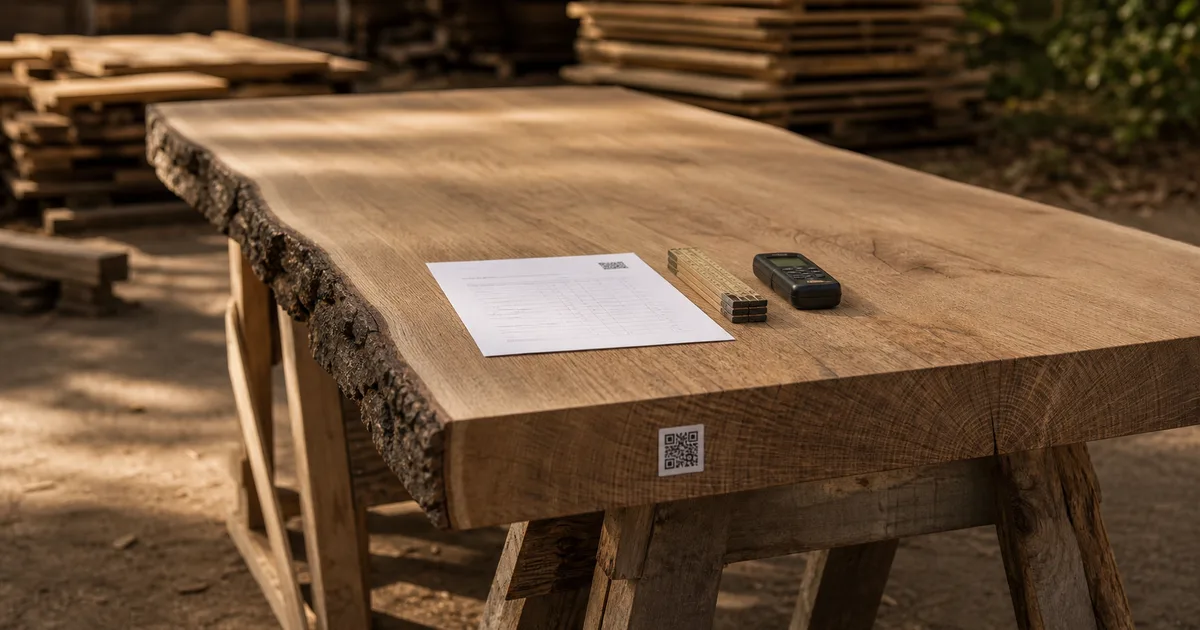
A wood passport is a record assigned to one physical piece of timber. It connects that piece to its identity, species, measurements, condition, origin and supporting documents. This matters for hardwood slabs because each slab is a one-off product. Two boards cut from the same tree can differ in outline, width, sapwood, checks, figure and moisture. A batch description cannot express those differences. With piece-level identity, the measurements and evidence shown online refer to the slab that arrives in the workshop. The passport can remain associated with it after sale, giving later owners a way to identify the timber and review the available record.
What a KORENA wood passport contains#
A KORENA wood passport begins with a unique piece identifier. Every measurement, photograph and provenance record is associated with that identifier rather than only with a species or stock batch.
The record includes the commercial species name and its scientific name. Scientific names reduce ambiguity because common timber names vary between countries, languages and yards. A buyer should still treat species identification as evidence supplied by the seller, particularly where closely related species are difficult to distinguish visually.
Each slab listing shows its measured outline. It also states the overall length, thickness and widths taken at stations 25, 50 and 75 per cent along the length. These stations are more useful than a single maximum width when planning a table, worktop or matched set. They show how the usable width changes along an irregular live edge.
A precision badge states the expected measurement tolerance, typically within 10 mm. That qualification matters. Timber edges are irregular, and a phone-based capture is not the same as a machinist measuring a finished rectangular component. Buyers should allow for trimming, flattening, edge loss and their own final tolerances.
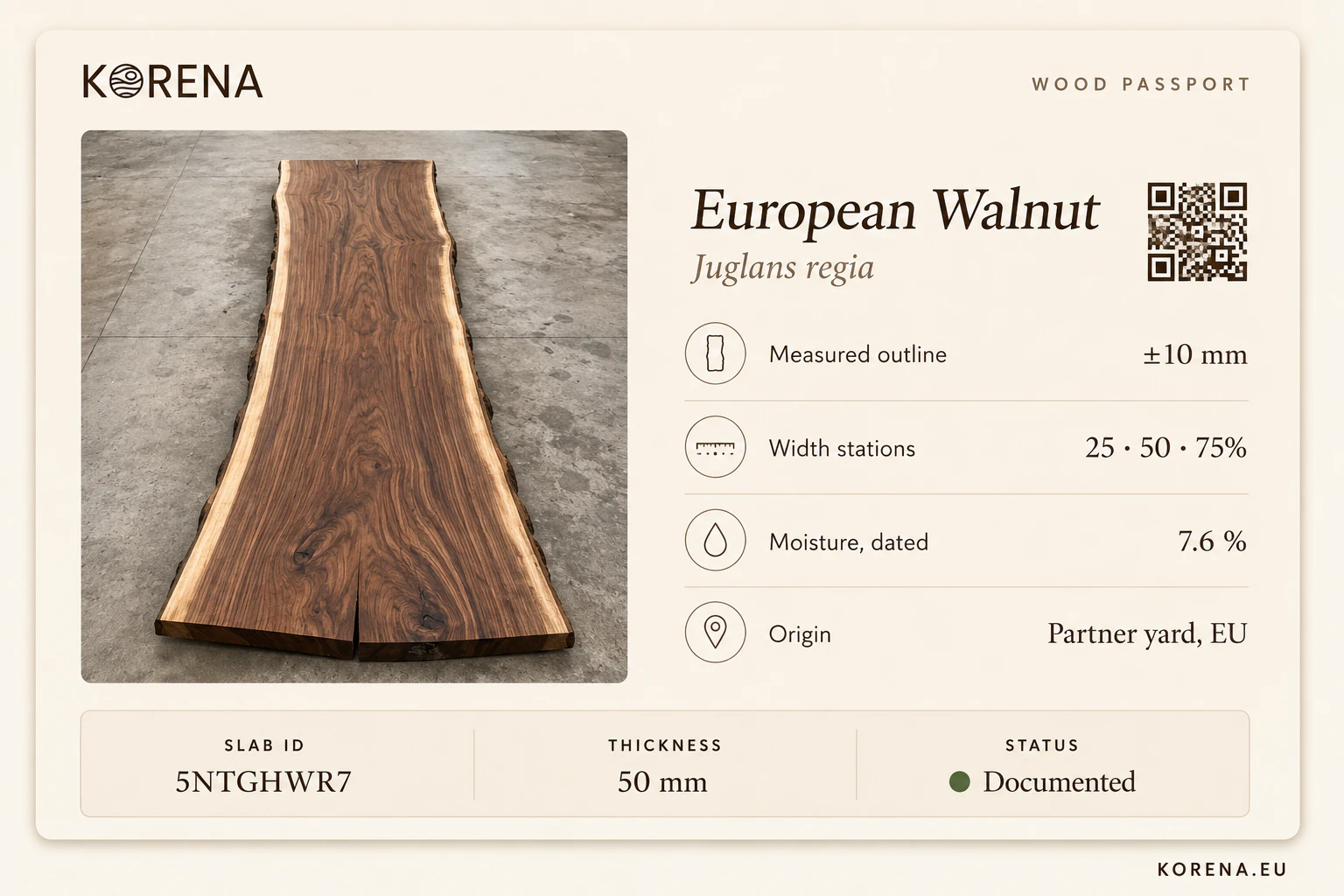
The passport also records thickness, drying method and a moisture reading with its date. Moisture is a reading taken at a particular place and time, not a permanent property. It can change during storage and transport or after the slab enters a heated workshop. If the date, measuring position or conditions are important to a job, ask for the reading and method before machining.
One current piece shows the shape of the record: slab 5NTGHWR7, a 3.1 m European walnut live-edge slab, lists a measured length of 3099 mm, 50 mm thickness and a dated 7.6 per cent moisture reading.
Photographs show the actual piece and include measurement evidence where available. They help a buyer check the outline, colour, sapwood, knots, checks and other visible features against the dimensional record. Photographs can still conceal depth, movement or defects on an unshown face, so uncertain areas should be queried before purchase.
The origin section identifies the supplying partner yard and records the available origin information. KORENA sources slabs through European partner yards, and I measure each piece myself in those yards. Provenance records are collected with the piece toward EUDR due diligence. The amount and form of source documentation can vary by yard, so a passport should distinguish recorded evidence from assumptions.
How the QR works on the physical slab#
Each KORENA slab carries a QR code. Scanning it opens p.korena.eu using a per-piece token, which resolves to the passport for that slab. The token provides the connection between the physical timber and its digital record.
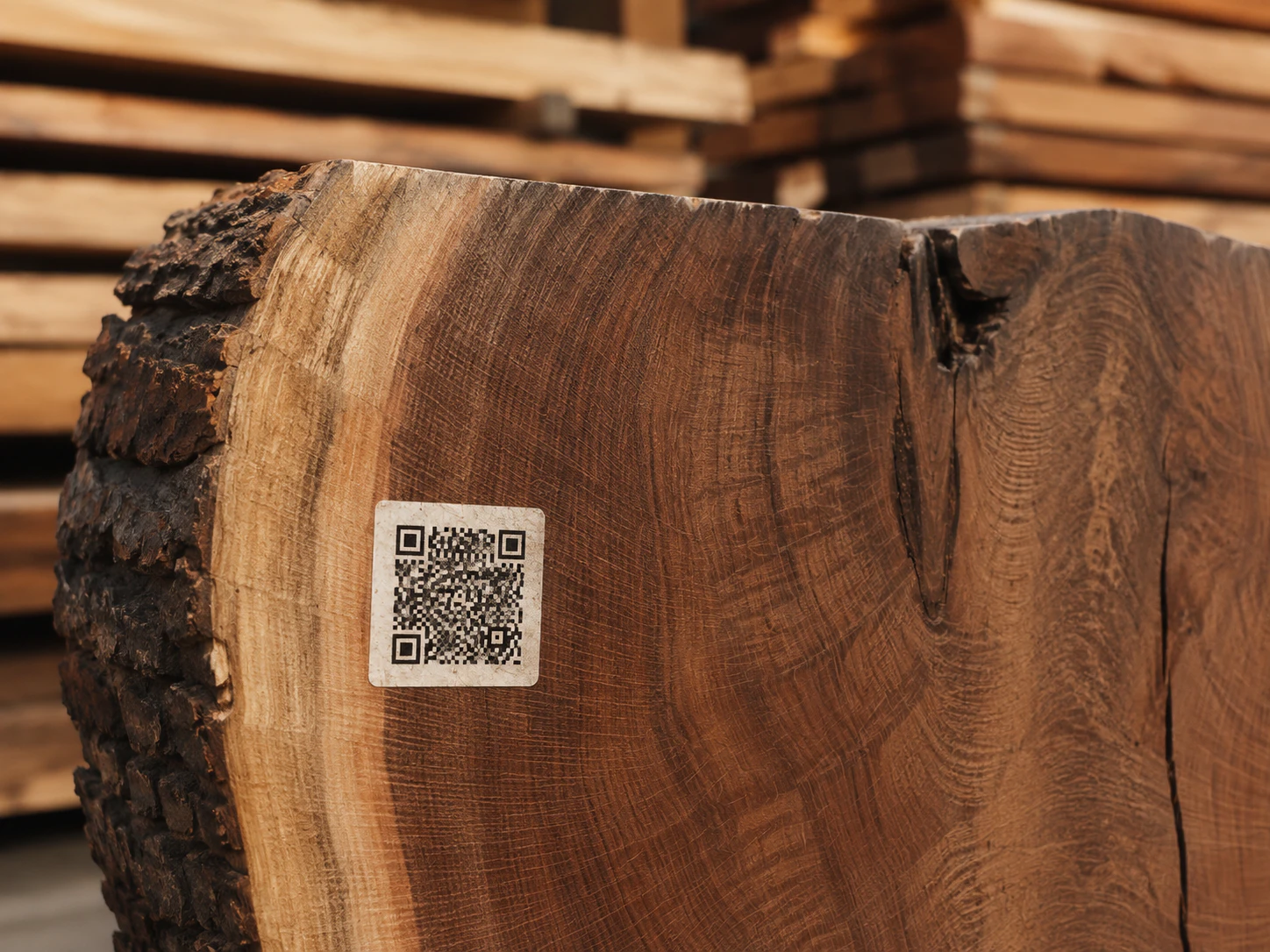
This link is useful at several points. A buyer can inspect the passport before ordering, compare the delivered slab with its outline and photographs, and reopen the record later from the workshop. The passport stays associated with the piece through the sale rather than disappearing when the product listing closes.
The QR label should remain attached or be kept with the workshop records until the slab has been processed. Once a slab is cut into several parts, the original passport describes the source slab. It does not automatically provide a separate identity for every resulting component. A maker who needs continuity should record which finished components came from that identifier.
You can browse the slab catalogue to see how individual pieces are presented before purchase.
Why per-piece records beat batch paperwork#
Batch paperwork can answer useful questions about a consignment, supplier or group of boards. It cannot, by itself, tell two similar slabs apart. If several walnut slabs share a delivery note, the note does not establish which one had a particular outline, 7 to 8 per cent moisture reading or set of width measurements.
Piece-level facts include length, thickness, width at specific stations, sapwood distribution, knots, checks and photographed faces. Attaching those facts to a stable identifier makes them easier to verify. On delivery, a buyer can compare the slab with the passport rather than relying on a generic species description.
This also gives both sides a clearer reference if there is a dispute. A claimed dimensional difference can be considered against the stated measurement method and precision badge. A visible feature can be compared with the dated photographs. The passport does not prevent movement, damage or mistakes, but it defines which piece and which evidence are being discussed.
Resale is another practical case. A later owner may no longer have the original listing or invoice. A persistent identifier can preserve the recorded species, origin and measurement history. The new owner should still state any changes since the original capture, including cutting, flattening, drying, damage or refinishing.
What a wood passport means under EUDR#
Wood is a covered commodity under the EU Deforestation Regulation, Regulation (EU) 2023/1115, as amended by Regulation (EU) 2025/2650. Due-diligence obligations apply to large and medium operators from 30 December 2026 and to micro and small operators from 30 June 2027.
A wood passport can support the information-gathering part of that work. It can keep the species, country and origin records, supplier information and geolocation-linked evidence associated with the piece. Harvest plot geolocation is required under EUDR, with polygons required for plots over 4 hectares.
The passport is not the Due Diligence Statement. The relevant operator files the DDS through the EU Information System and receives a reference number. Nor does a QR code, by itself, establish that every legal requirement has been met. Risk assessment, any required risk mitigation and submission remain the responsibility of the operator.
The useful role of the passport is narrower and concrete. It keeps one slab's identity and available evidence together, which reduces the chance that documents become detached from the timber they are meant to support. Read What is EUDR? Why wood traceability matters for the regulatory context. EUDR for hardwood buyers explains the buyer's position, while the EUDR buying checklist turns the requirements into purchase checks.
Ask who is acting as the EUDR operator for the transaction and whether a DDS reference number applies. A passport and a DDS perform different functions.
What to check on any wood passport#
The term wood passport is not enough on its own. Check what the record actually proves and how closely it is tied to the physical piece.
Look first for a unique identifier that also appears on the slab, label or referenced documents. A passport page without a physical link can be copied or assigned to the wrong board.
Measurements should state the method and tolerance. For an irregular slab, look for an outline or several width stations rather than one optimistic maximum width. Confirm whether thickness is rough, average or minimum, and leave enough material for flattening and trimming.
A moisture entry should include a date. If a reading will influence immediate machining or installation, ask where and how it was taken. The current moisture may differ after transport or storage.
Origin information should name the yard and country, then connect to harvest or supplier records where available. Vague claims such as “European timber” are not equivalent to a documented source. For EUDR purposes, check whether the evidence reaches the required harvest-plot geolocation.
Finally, supporting documents should reference the same piece identifier, or provide a clear chain from the piece to a consignment and source record. If that connection is missing, ask the seller to explain it. A useful passport makes uncertainty visible instead of filling gaps with confident wording.