What Is EUDR? Why Wood Traceability Matters in Europe
EUDR is changing online wood buying: buyers need to know where each slab grew, who cut it, and how it was dried.
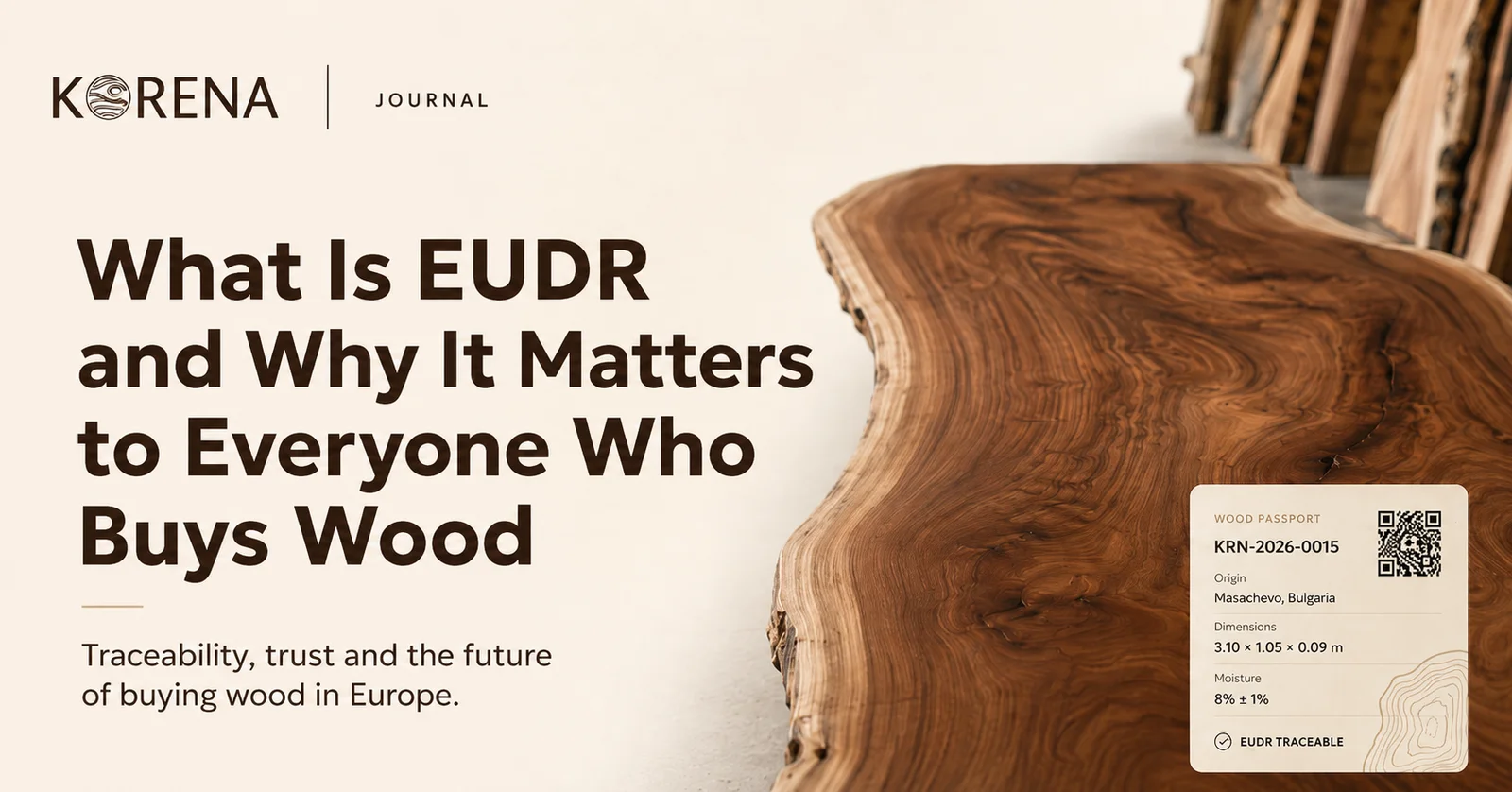
Wood has always carried a story.
Where it grew. Who cut it. How it was dried. Why its grain looks the way it does. What it might become in the hands of a maker, carpenter, designer or furniture workshop.
For a long time, most of that story lived in conversations.
You visited a yard. You walked between stacks. You asked questions. You inspected the material. You trusted the person selling it.
That way of buying wood still has value. It is physical, practical and human.
But the market is changing.
Buyers want more confidence. Workshops want less risk. Designers want materials they can specify with certainty. Suppliers need better digital records. And across Europe, regulations are pushing the wood industry toward something that should have been normal long ago:
Clear origin, traceable supply chains and proof behind the product.
That is where EUDR comes in.
What is EUDR?#
EUDR stands for the European Union Deforestation Regulation.
In simple terms, it is an EU regulation designed to make sure that certain products sold in, made available within, or exported from the European Union are not linked to recent deforestation or forest degradation.
The regulation covers several commodities, including:
| Covered commodity | Why it matters |
|---|---|
| Wood | Timber, boards, slabs and certain wood-based products can be linked to forest impact if origin is not controlled |
| Cattle | Connected to land-use change in some regions |
| Cocoa | Often linked to pressure on tropical forests |
| Coffee | Requires better origin and farm-level transparency |
| Palm oil | One of the major commodities associated with deforestation risk |
| Rubber | Included because of plantation-related land-use risks |
| Soy | Connected to land conversion in some regions |
For the wood industry, the key idea is simple:
Wood should not be just beautiful, useful and valuable. It should also be traceable.
EUDR does not mean that wood is a bad material.
Quite the opposite.
Wood is one of the most important natural materials we have. It is renewable, long-lasting, repairable and capable of becoming furniture, interiors, instruments, tools and objects that can live for generations.
But responsible wood and anonymous wood are not the same thing.
The future belongs to wood that can be trusted.
Why wood is part of the regulation#
Wood can be one of the best materials in the world.
It stores character. It can last for decades. It can be repaired, reused, refinished and transformed. A single slab can become a dining table, a reception desk, a bar top, a guitar blank, a sculpture or a piece of architecture.
But that value depends on trust.
A beautiful piece of wood with no clear origin creates questions:
-
Where did it come from?
-
Was it harvested legally?
-
Can its origin be verified?
-
Can the seller support the claim?
-
Can the buyer use it in a professional project without reputational or compliance risk?
In the old market, many of these questions were answered informally.
In the new market, informal trust is not enough.
This is especially important for premium hardwood, where the customer is often buying a specific piece for a specific project. The grain, figure, colour, shape, cracks, live edge, dimensions, moisture and origin all matter.
In that world, traceability is not paperwork.
It is part of the product.
What does EUDR require in practice?#
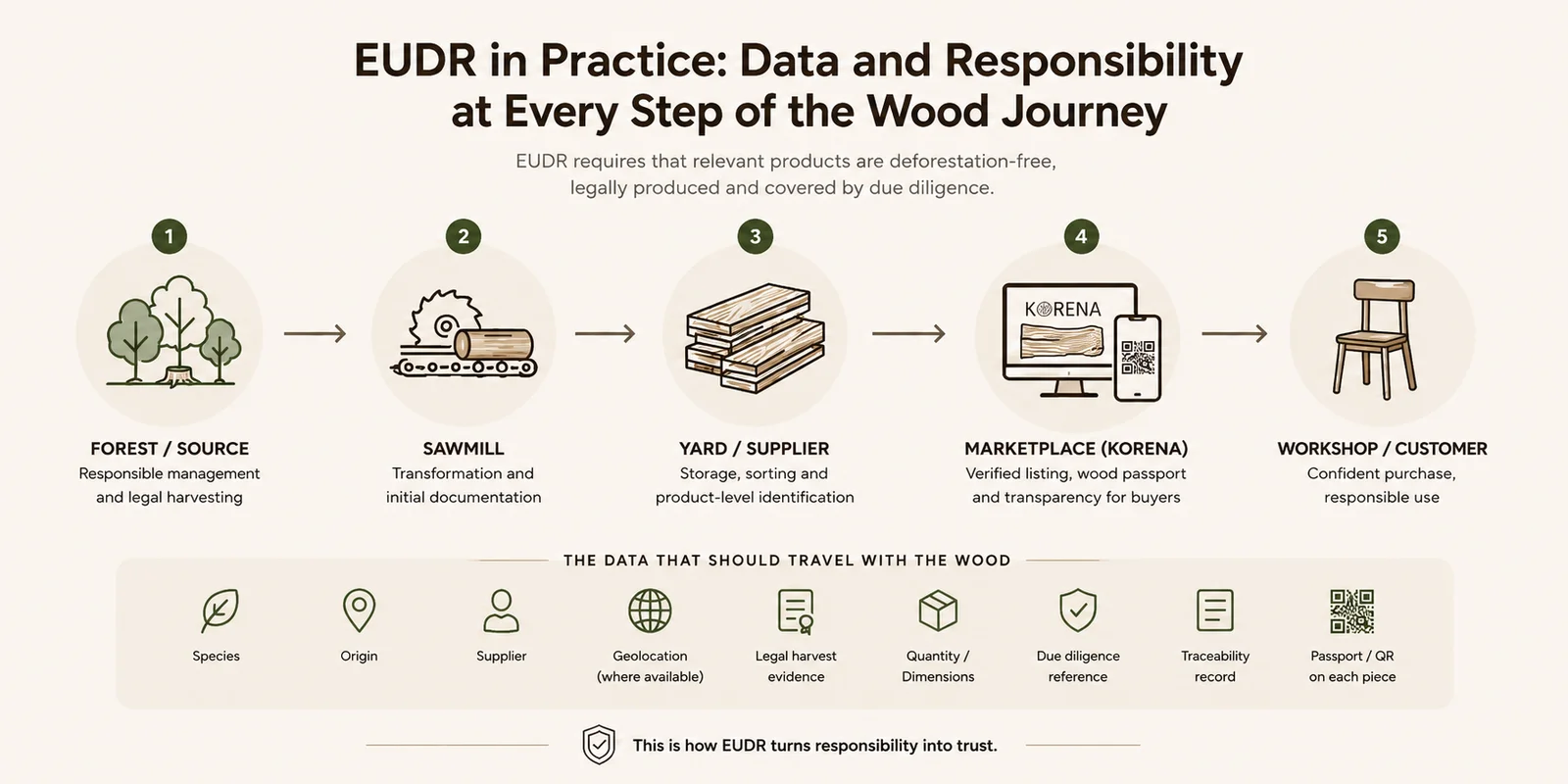
At its core, EUDR asks companies in the supply chain to prove that relevant products are:
| Requirement | Plain English meaning |
|---|---|
| Deforestation-free | The product must not be linked to recent deforestation or forest degradation |
| Legally produced | The material must follow the laws of the country where it was produced |
| Covered by due diligence | The company must collect information, assess risk and keep records before placing or exporting the product |
That sounds legal and complicated, but the practical meaning is simple:
You need to know where the material comes from, understand the risk and keep records that support the claim.
For wood products, this can include information such as:
-
wood species
-
country of production
-
source location
-
supplier information
-
product description
-
quantity
-
transaction records
-
legal harvest evidence
-
traceability documentation
-
due diligence reference, where applicable
This is a major shift for an industry where too much material has historically moved as anonymous stock.
A stack of boards with a vague description is no longer enough.
A beautiful slab with no origin story will become harder to sell.
A supplier who cannot provide data will become less competitive.
And a buyer who wants to work professionally will increasingly ask not only:
“How does it look?”
but also:
“Can you prove where it came from?”
Why this matters to buyers#
Most buyers do not want to become compliance experts.
A furniture maker does not wake up excited to read EU regulations. A designer does not want to spend hours checking timber paperwork. A customer buying a one-off walnut table does not want to decode legal documents.
They want confidence.
They want to know that the piece they are buying is real, correctly described and responsibly sourced.
They want to know:
-
Is this the exact piece I selected?
-
Are the dimensions accurate?
-
Is the moisture level clear?
-
Is the species correctly stated?
-
Is the origin documented?
-
Can I trust this material for my project?
This is where the definition of “premium wood” changes.
For years, premium wood mainly meant beauty and rarity.
Today, that is no longer enough.
| Old premium wood | New premium wood |
|---|---|
| Rare | Rare |
| Beautiful | Beautiful |
| Expensive | Properly documented |
| Visually impressive | Traceable |
| Hard to find | Verified |
| Selected by eye | Project-ready |
The best wood will still be judged by grain, colour, figure and character.
But the best wood businesses will also be judged by the quality of their data.
Why this matters to wood yards and suppliers#
Many traditional wood yards already have good material.
The problem is not always the quality of the wood.
The problem is that the wood is not digitally ready.
A yard may know its stock. The owner may know the story of a log. The team may know which stack contains the best walnut, oak, ash or elm.
But if that knowledge is not structured, photographed, measured and connected to product-level records, it is difficult to sell remotely and difficult to scale.
EUDR increases the pressure on suppliers to improve their systems.
Wood yards and sawmills will need better ways to manage:
| Operational area | What needs to improve |
|---|---|
| Stock identity | Every important piece or batch needs a clear ID |
| Origin data | Source and supplier information must be stored properly |
| Product photos | Buyers need to see the exact material |
| Measurements | Dimensions, thickness and quantity need to be reliable |
| Species information | Wood type must be clear and consistent |
| Moisture readings | Drying and usability should be easier to understand |
| Storage location | Teams need to find the exact piece quickly |
| Documents | Supporting records must be attached and retrievable |
| Customer proof | Buyers need information they can actually understand |
This does not mean every yard needs to become a software company.
But it does mean that the old model of “come here and look around” will not be enough for the next generation of buyers.
The best suppliers will not only have good wood.
They will have good data.
From anonymous stock to product-level trust#
The most important shift is this:
Wood is moving from bulk inventory to product-level identity.
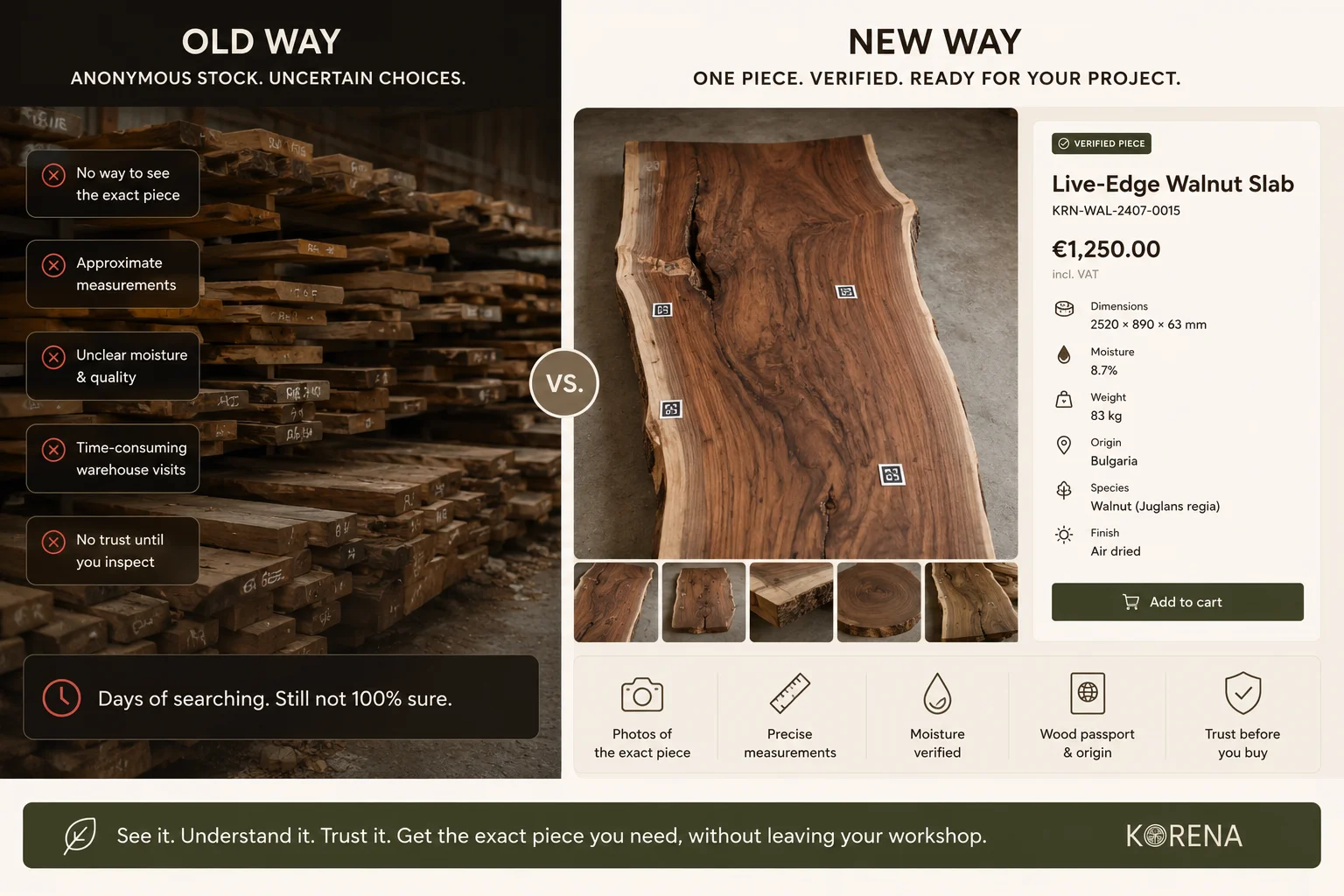
In the old model, the customer often bought a category:
oak board, walnut slab, ash plank, beech material, 50 mm thickness, approximate quality.
In the new model, the customer wants to buy the exact piece.
The exact board.
The exact slab.
The exact surface, dimensions, defects, grain and story.
That is where digital traceability becomes powerful.
Not because it satisfies a checkbox, but because it makes the product easier to understand, compare, trust and buy.
For a small workshop, this saves time.
For an interior designer, it reduces uncertainty.
For a premium customer, it adds confidence.
For the supplier, it turns stock into a stronger sales asset.
Where KORENA fits#
KORENA was built around a simple belief:
The future of premium hardwood is one piece, one passport, one buyer, one clear story.
We do not see premium hardwood as anonymous material sold only by the cubic metre.
We see every slab and board as its own product.
Each piece deserves its own identity:
-
photos
-
dimensions
-
thickness
-
weight, where relevant
-
moisture
-
species
-
visible characteristics
-
storage location
-
supplier information
-
traceability record
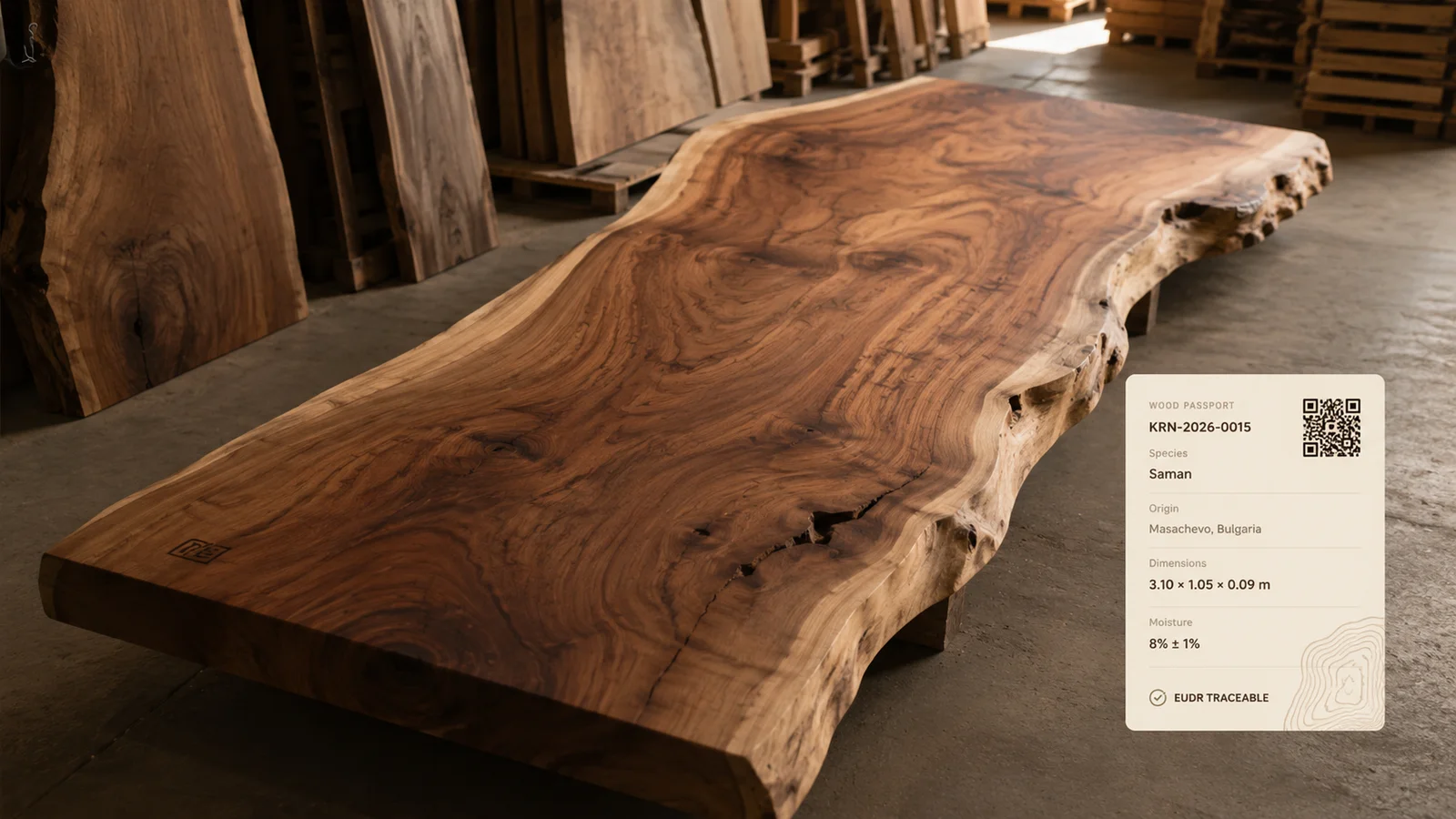
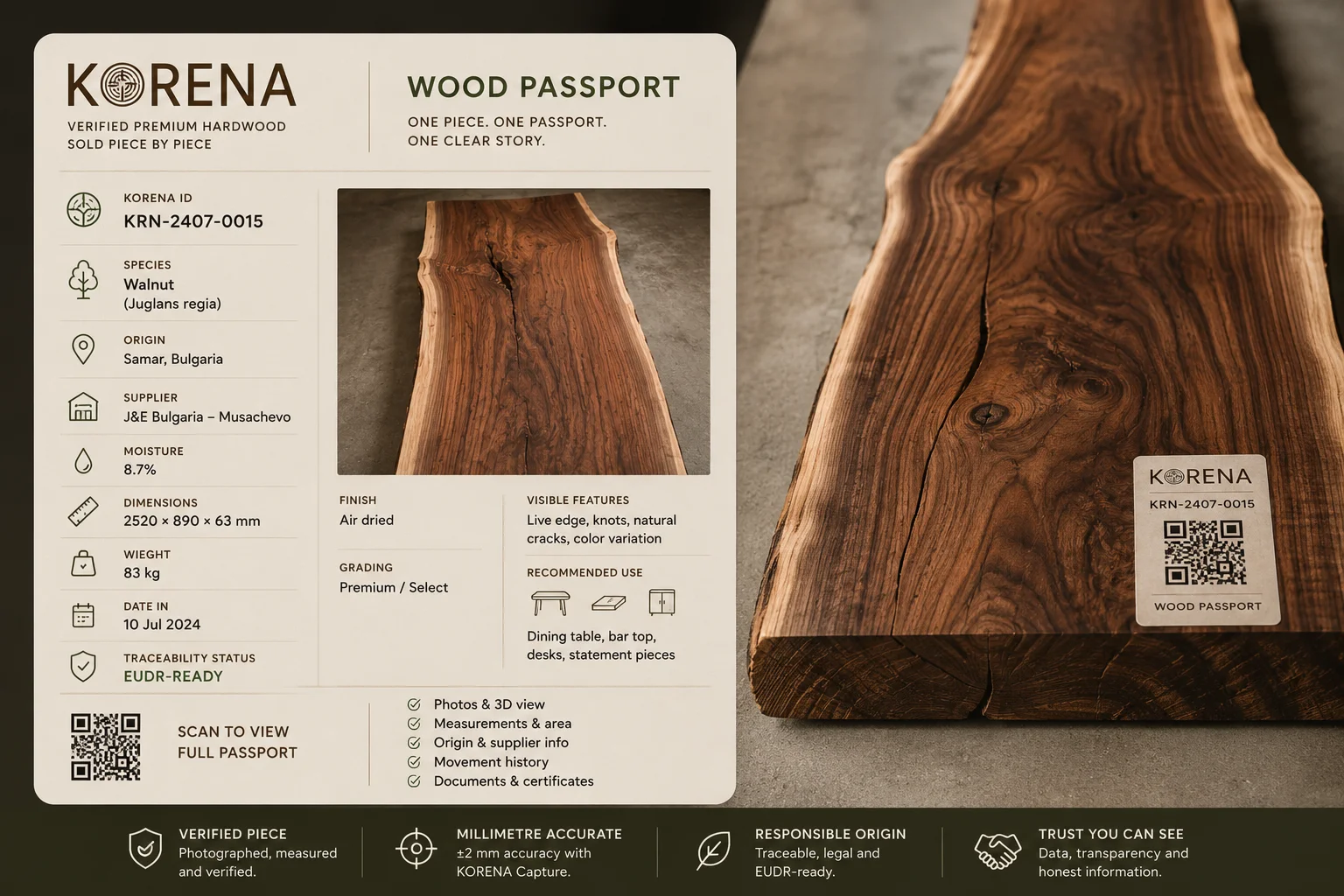
That is why KORENA is building around wood passports.
A wood passport is not just a nice extra feature.
It is a practical trust layer.
It helps buyers understand what they are looking at. It helps workshops choose material remotely. It helps suppliers present their best stock properly. And it creates a structure for the kind of traceability that the European market is now moving toward.
A passport does not replace legal due diligence.
A QR code does not magically solve compliance.
But the right data, connected to the right piece from the beginning, makes trust easier to build and easier to prove.
That is the direction the industry needs.
What should a modern wood passport include?#
A useful wood passport should be simple enough for a buyer to understand and structured enough to support professional trade.
At minimum, it should include:
| Passport field | Why it matters |
|---|---|
| Unique product ID | Makes the piece identifiable |
| Wood species | Helps buyers choose the right material |
| Country or region of origin | Supports traceability |
| Supplier or yard | Shows where the material came from |
| Dimensions | Helps buyers plan projects |
| Thickness | Critical for furniture and processing |
| Weight | Important for transport and handling |
| Moisture reading | Helps assess stability and readiness |
| Photos of the exact piece | Reduces uncertainty |
| Visible features and defects | Helps avoid surprises |
| Processing history | Shows what has been done to the material |
| Storage location | Helps the team find the piece quickly |
| QR code | Connects the physical piece to the digital record |
| Traceability status | Gives the buyer confidence |
| Supporting documents | Keeps proof connected to the product |
The point is not to overwhelm the customer.
The point is to make trust visible.
A good wood passport turns a piece of material into a documented product. It helps the buyer understand what they are buying before they pay, before they arrange transport and before they commit it to a project.
Why this affects everyone, not only importers#
It is easy to think that EUDR only matters to large importers, exporters or legal departments.
That is a mistake.
Even when the strict legal obligations differ by company role, product type and business size, the market effect moves through the whole chain.
If importers need better documentation, they will ask suppliers for better information.
If yards need better records, they will change how they manage stock.
If workshops want to avoid risk, they will prefer sellers who can provide clearer data.
If designers want to specify responsible material, they will choose products with traceability.
If customers become more aware, they will ask better questions.
This is how regulation becomes market expectation.
Not overnight.
Not perfectly.
Not without friction.
But clearly.
The direction is obvious:
Less anonymous material. More verified material.
Regulation alone is not enough#
EUDR can create pressure.
It can define rules.
It can force companies to take traceability more seriously.
But regulation alone does not create trust.
A PDF that nobody understands is not trust.
A certificate disconnected from the actual piece is not trust.
A product page with beautiful photos but no real data is not trust.
Trust happens when the physical material, the digital record and the buyer experience connect.
That is the real challenge for the wood industry.
The future is not just paperwork.
The future is usable traceability.
The buyer should be able to see the piece, understand the measurements, check the species, know the origin, scan the passport and feel confident that the product is what it claims to be.
This is what modern wood commerce should look like.
The future of wood is transparent#
Wood will always be emotional.
People choose it because it feels alive. Because no two pieces are the same. Because it carries warmth, texture, age and character in a way industrial materials rarely can.
But the next chapter of wood is not only about beauty.
It is about proof.
The strongest wood businesses in Europe will be the ones that combine physical material with digital trust.
The best yards will not only store wood. They will document it.
The best marketplaces will not only list products. They will verify them.
The best buyers will not only ask for price. They will ask for origin, data and confidence.
At KORENA, we believe this is a good thing.
Good wood deserves more than a vague label.
It deserves a clear identity.
One piece. One passport. One story.
That is how premium hardwood should be bought and sold in Europe.
Disclaimer#
This article is for general information only and should not be treated as legal advice. EUDR obligations depend on the product, role in the supply chain, company size and specific transaction.