Why Wood Moisture Changes in Transit, and Why That Is Normal
A slab can read differently on arrival because wood exchanges moisture with air. Learn what is normal and what to check first.

A slab left our kiln this spring at 8% moisture content.
A few weeks later, when it arrived at the buyer’s workshop, the meter read 9.5%.
That is a 1.5-point change.
For someone buying premium hardwood online, that number can raise a fair question: did the slab change? Did something go wrong? Was the listing inaccurate?
The short answer is no.
This is normal wood behaviour. A hardwood slab is not a sealed object. It reacts to the air around it, slowly absorbing or releasing moisture until it reaches balance with its environment.
At KORENA, we show the moisture content recorded at kiln-out, and we clearly state that moisture content may vary by up to ±2% at delivery. Not because we are being vague, but because that is how wood behaves in the real world.
The slab when it left the kiln#
The slab in this example was European walnut (Juglans regia), with a wide flat face and a pronounced live edge along one side.
Approximate rough dimensions:
| Measurement | Value |
|---|---|
| Length | 1900 mm |
| Width | 950 mm |
| Thickness | 50 mm |
| Kiln-out moisture content | 8% |
| Delivery moisture content | 9.5% |
The slab was measured, photographed, recorded, and documented when it came out of the kiln. At that point, it was at 8% moisture content.
That number is not random. For hardwood intended for furniture and heated interiors, the target range is usually around the level the wood will later settle at indoors. Drying the slab to this range gives it a controlled starting point before it moves into storage, transport, a workshop, and eventually a finished interior.
The kiln does not freeze the wood in time. It simply brings the slab to a controlled condition.
After that, the slab continues being wood.

What we measured when it arrived#
When the slab arrived and was unwrapped, the moisture meter showed 9.5%.
The reading was roughly consistent on both faces, with slightly higher readings near the live edge. That is expected. End grain, bark channels, and more open exposed areas can react faster to surrounding air than the middle of the slab.
The important point is this:
The slab had not become a different product.
Its shape was still the shape we documented. Its outline was still the same slab. Its movement potential had not suddenly changed. It was simply sitting in different air than it had been in three weeks earlier.
A 1.5-point rise between kiln-out and delivery sits well inside the ±2% delivery variation we publish.
That is not a defect. That is the material adjusting.
A surface reading is not the whole slab#
A moisture meter reading at delivery tells you a lot, but it does not tell you everything.
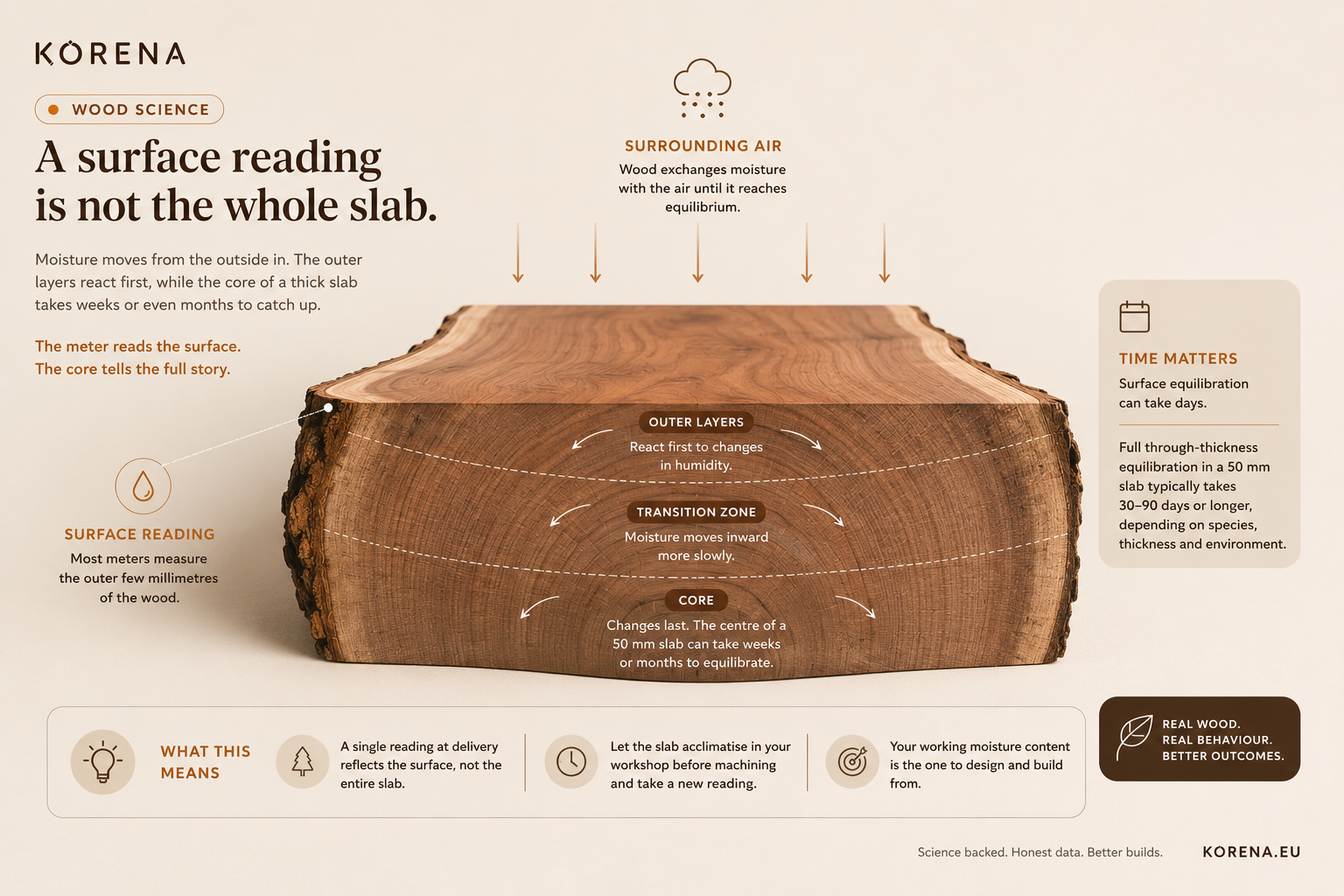
Most practical shop readings reflect the outer layers of the slab more than the full core. In a 50 mm thick slab, the surface can react to ambient conditions much faster than the centre of the board.
So when the surface reads 9.5%, the core may still be closer to the original kiln-out value.
That matters because thick hardwood does not equalise instantly. The surface moves first. The inside follows more slowly. Full through-thickness equilibration can take weeks or even months, depending on thickness, species, air movement, humidity, and storage conditions.
This is why a delivery reading should be treated as useful information, not as the final working number.
Why wood moves between kiln and workshop#
Wood is always trying to reach balance with the air around it.
The wood science term for this is equilibrium moisture content, or EMC.
Every environment has a different EMC. A heated room in winter is usually dry. A storage bay, truck, or unheated workshop can be more humid. A slab placed in those spaces will slowly adjust.
If the surrounding air is drier than the wood, the slab gives off moisture.
If the surrounding air is more humid than the wood, the slab absorbs moisture.
That is exactly what happened here.
The slab left the kiln at 8%. During storage and transit, it spent time in air that was more humid than the kiln environment. The outer layers absorbed some moisture. By the time it reached the workshop, the surface reading had moved to 9.5%.
A truck is not a kiln. A warehouse is not a kiln. A workshop is not a kiln.
And that is the whole point.
A kiln gives the slab a controlled starting point. The real world gives it its next environment.
Does 1.5% moisture drift change the slab size?#
A little, yes.
But not in a dramatic or worrying way.
Hardwood moves across the grain as its moisture content changes. As a practical working approximation, many hardwoods move tangentially by roughly 0.25% of their width for every 1% change in moisture content.
For a slab around 950 mm wide, a 1.5-point change can mean a few millimetres of movement across the width.
That is why KORENA publishes realistic tolerance bands around slab outlines and measurements. We do not pretend wood is metal. We measure carefully, document honestly, and explain the tolerances clearly.
For this slab, the expected dimensional effect of the moisture drift sits within the measurement tolerance we publish for the outline.
The slab changed because wood changes.
It did not become wrong.

What this means for makers#
A slab at 8% and a slab at 9.5% can be the same slab in different air.
Neither number is automatically “wrong”.
The useful question is not:
Can you guarantee the moisture content will never change?
No serious seller can promise that.
The useful questions are:
What was the moisture content at kiln-out?
And:
When did the slab come out of the kiln?
Those two numbers tell you the condition the slab left in. After that, you need to give the wood time to settle into its working environment.
For most makers, the practical advice is simple:
Let the slab acclimatise before flattening, machining, or final joinery.
Place it in the workshop or the room where it will be processed. Give it time. Around two weeks is a sensible practical starting point for many workshop scenarios, though thicker slabs and more extreme environments may need longer.
Then take a new reading.
That acclimatised number is the one to work from.
The kiln-out number is the reference point. The workshop number is the working number.
How KORENA handles this#
KORENA lists the moisture content recorded at kiln-out for every slab.
We also state that moisture content may vary by up to ±2% at delivery.
That is the honest way to sell real hardwood online.
We are not trying to make wood sound simpler than it is. We are trying to make the buying process clearer, safer, and more predictable for makers, workshops, designers, and studios.
Every slab is photographed, measured, documented, and sold as one exact piece.
But it is still wood.
And wood moves.
That is not a flaw. That is the material.
Key takeaways#
-
A moisture content change of up to ±2% between kiln and delivery is expected behaviour, not a defect.
-
A delivery moisture reading often reflects the outer layers of the slab more than the full core.
-
Thick slabs need time to equalise through their full depth.
-
Let the slab acclimatise before flattening, machining, or final joinery.
-
Ask for the kiln-out moisture content and kiln-out date instead of expecting wood to never move.
-
KORENA publishes the kiln-out moisture content and uses realistic delivery tolerances because that is the honest way to sell premium hardwood.
Glossary#
Moisture content, MC
The amount of water in wood, expressed as a percentage of the wood’s oven-dry weight.
Equilibrium moisture content, EMC
The moisture level at which wood is balanced with the surrounding air and is no longer gaining or losing moisture.
Kiln-out date
The date when the slab came out of the kiln at its target moisture content.
Through-thickness equilibration
The process by which moisture becomes balanced not only at the surface, but through the full thickness of the slab. In thicker slabs, the core usually lags behind the surface.