KORENA
HolzMöbelWerkstattPartnerJournal

Entdecke neue Bohlen als Erstes

Erhalte eine E-Mail, wenn neues Holz eintrifft.

Ein paar E-Mails pro Monat. Kein Spam, jederzeit abmeldbar.

KORENA

Entdecke Massivholz, handgefertigte Möbel, Werkzeuge und Produkte zur Holzbehandlung auf KORENA.

Einkaufen

  • Produkte ansehen
  • Archiv verkaufter Bohlen
  • Bestellung verfolgen

Lernen

  • KORENA-Journal
  • Holzartenführer
  • Glossar
  • Pflanzenpässe und Befallsgebiete
  • Vergleichen
  • Autoren

Hilfe

  • Über uns
  • So funktioniert es
  • Verkäufer werdenNeu
  • Bohle anfragen
  • Kundenservice
  • Dokumentvorlagen
  • Presse

Kaufen

  • Verkaufsbedingungen
  • Widerrufsrecht
  • Rückgaben und Gewährleistung
  • Versand und Lieferung

Vertrauen

  • Datenschutzerklärung
  • Cookie-Richtlinie
  • Holzherkunft und EUDR
  • Barrierefreiheit

Impressum

  • Rechtlicher Hinweis / Impressum
  • Zulässige Nutzung
  • Geistiges Eigentum und Inhalte

© 2026 KORENA. Alle Rechte vorbehalten.

Betrieben von der Martial Labs Ltd. (BG, EIK 207453941). KORENA ist ein Handelsname der Martial Labs Ltd.

Wir respektieren Ihre Privatsphäre

Wir verwenden notwendige Cookies, damit die Website funktioniert. Mit Ihrer Einwilligung würden wir auch Cookies für Analyse, personalisierte Inhalte und Werbung verwenden. Sie können Ihre Entscheidung jederzeit auf der Seite Einwilligungseinstellungen ändern. Sehen Sie unsere Cookie-Richtlinie und Datenschutzerklärung.

  1. Startseite
  2. /
  3. Holzarten
  4. /
  5. Europäische Eibe

Taxus baccata

Europäische Eibe

Rare, culturally significant, and exceptionally durable. Dramatic orange-red heartwood against cream sapwood, and the wood of the English longbow.

  • This species is recorded as commercially grown in Europe. This does not establish where an individual piece was harvested; check its origin details.
  • Botanische Gruppe. Nadelhölzer sind Koniferen, Laubhölzer stammen von Laubbäumen.
  • Die botanische Familie, zu der die Holzart gehört.
Benachrichtigen, wenn verfügbarReferenzholzart. Derzeit keine Stücke auf Lager.
  • Projekteignung
  • Auf Lager
  • Aussehen
  • Verarbeitung
  • Quellen und Schwinden
  • Preis
  • Sicherheit und Herkunft
  • Fragen
  • Technische Daten

Passt es zu Ihrem Projekt?

Ideal für

  • Turned bowls, vessels, and spindles (a traditional turner's wood)
  • Longbows and traditional archery stock
  • Decorative wall panels and feature surfaces
  • Cabinet accents, drawer fronts, and inlay
  • Small statement furniture, side tables, stools, lamp bases
  • Carved and sculptural pieces

Kein Europäische Eibe im aktuellen Drop

Ähnliche Holzarten auf Lager

Derzeit kein Europäische Eibe. Diese Holzarten eignen sich für dieselben Projekte und sind verfügbar.
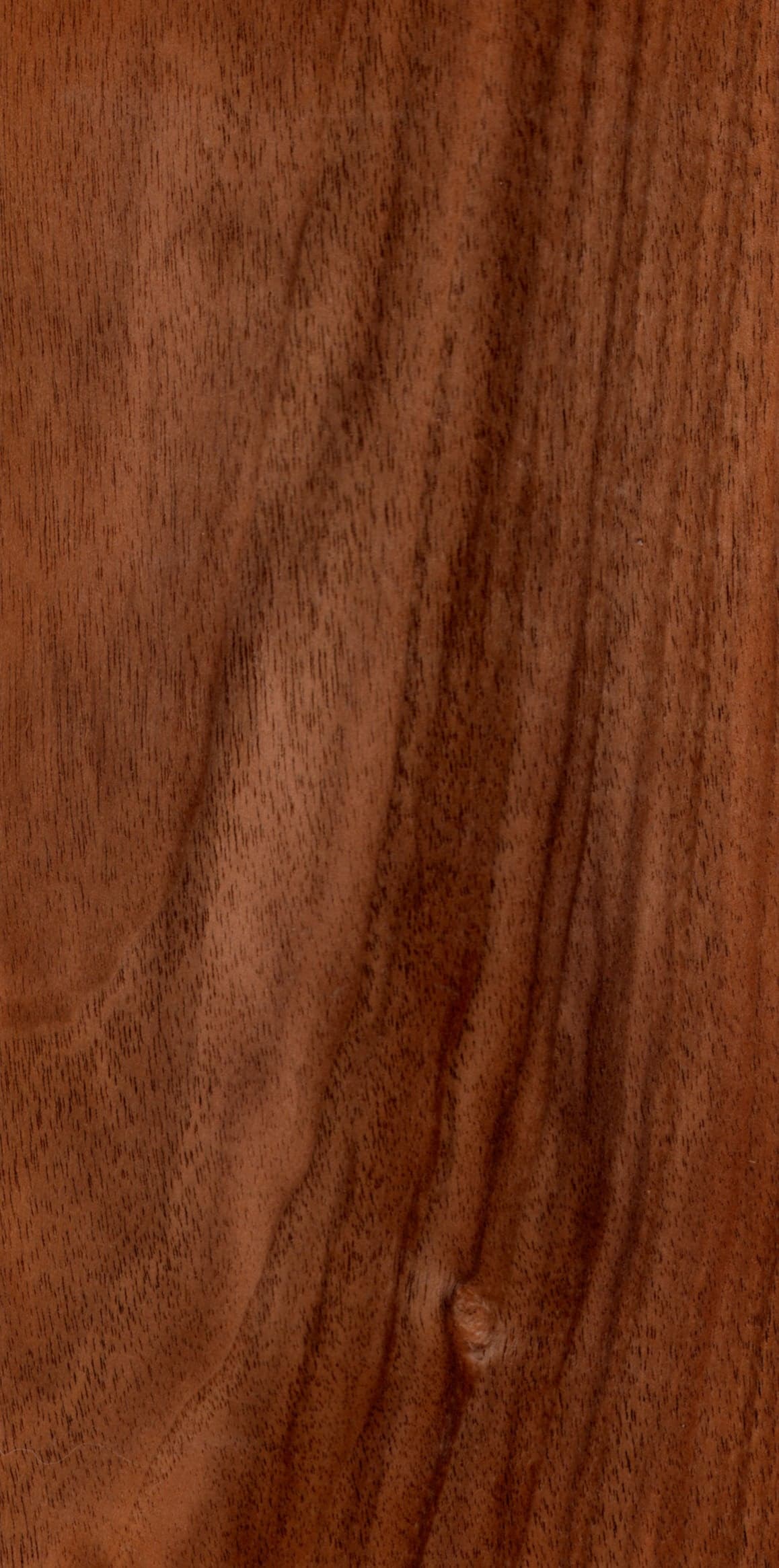
  • Europäischer Nussbaum: Holzmaserung

    Europäischer Nussbaum

    Juglans regia

    12 Stücke

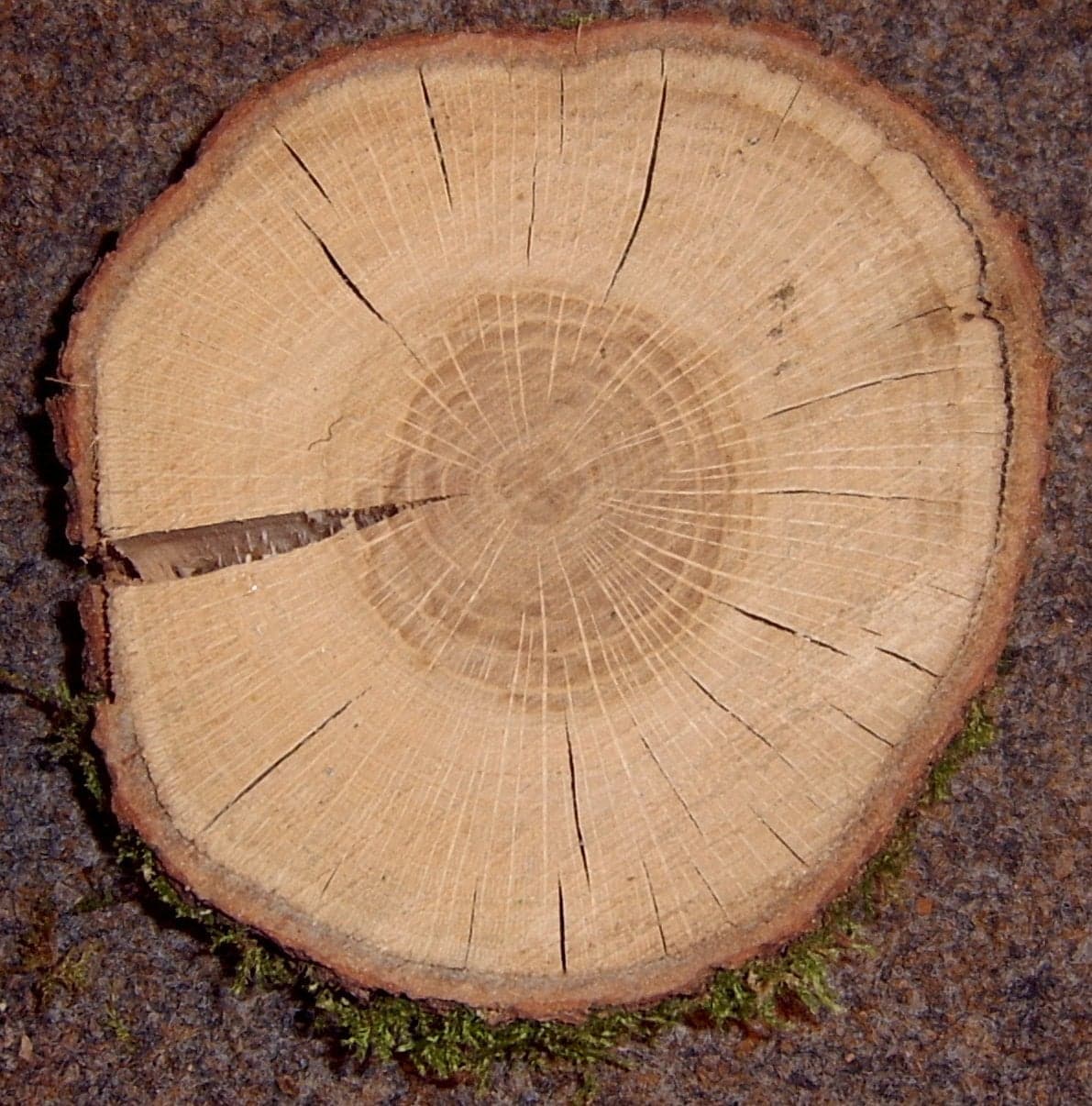
  • Europäische Eiche: Holzmaserung

    Europäische Eiche

    Quercus robur

    6 Stücke

  • Saman: Holzmaserung

    Saman

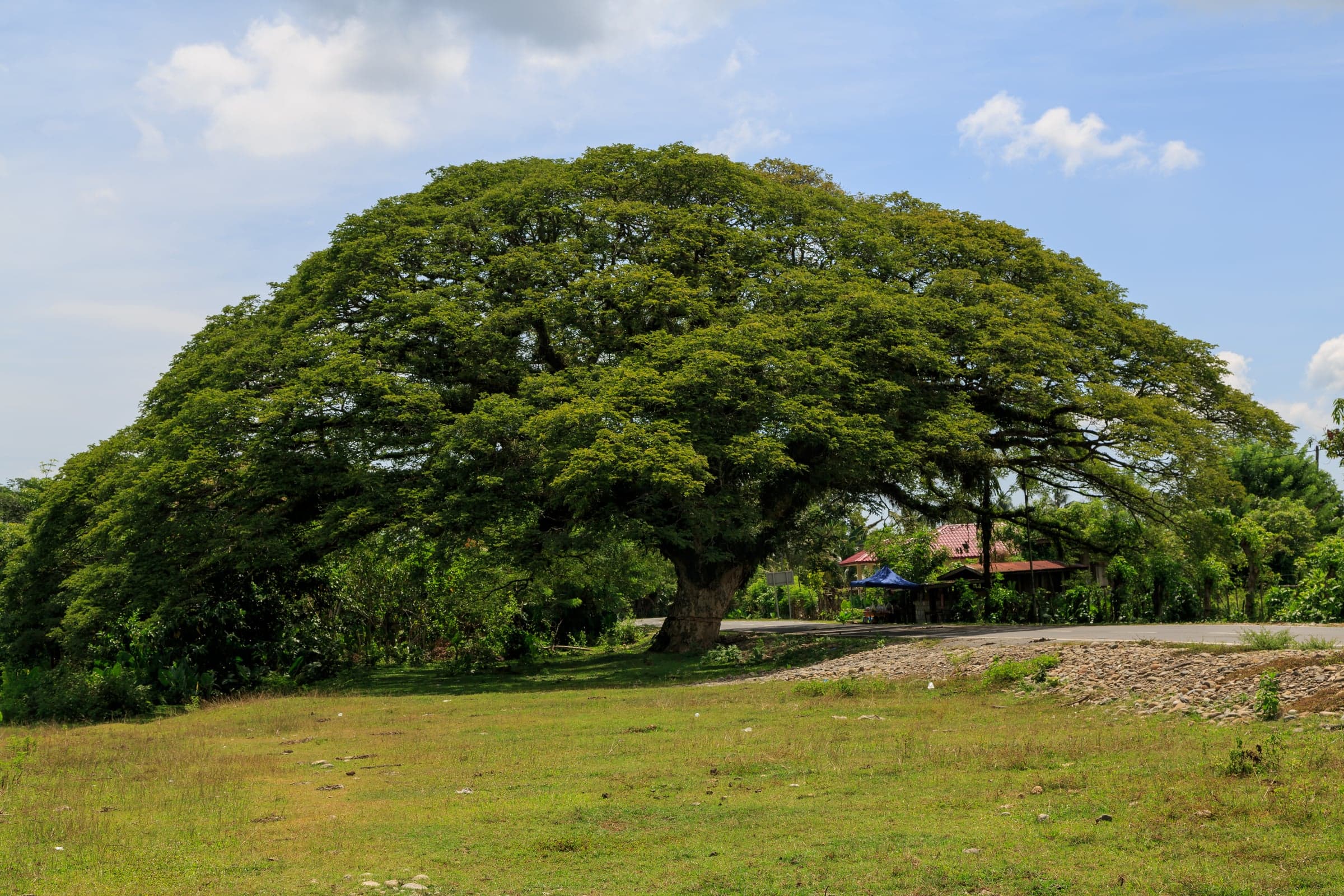
    Samanea saman

    4 Stücke

Benachrichtigung zu Europäische Eibe

Wir benachrichtigen Sie per E-Mail, wenn neue Europäische Eibe-Bohlen bei KORENA eintreffen. Jedes Stück ist ein Unikat, deshalb zählt eine frühe Nachricht.

Ein paar E-Mails pro Monat. Kein Spam, jederzeit abmeldbar.

Holzbild

So sieht es aus

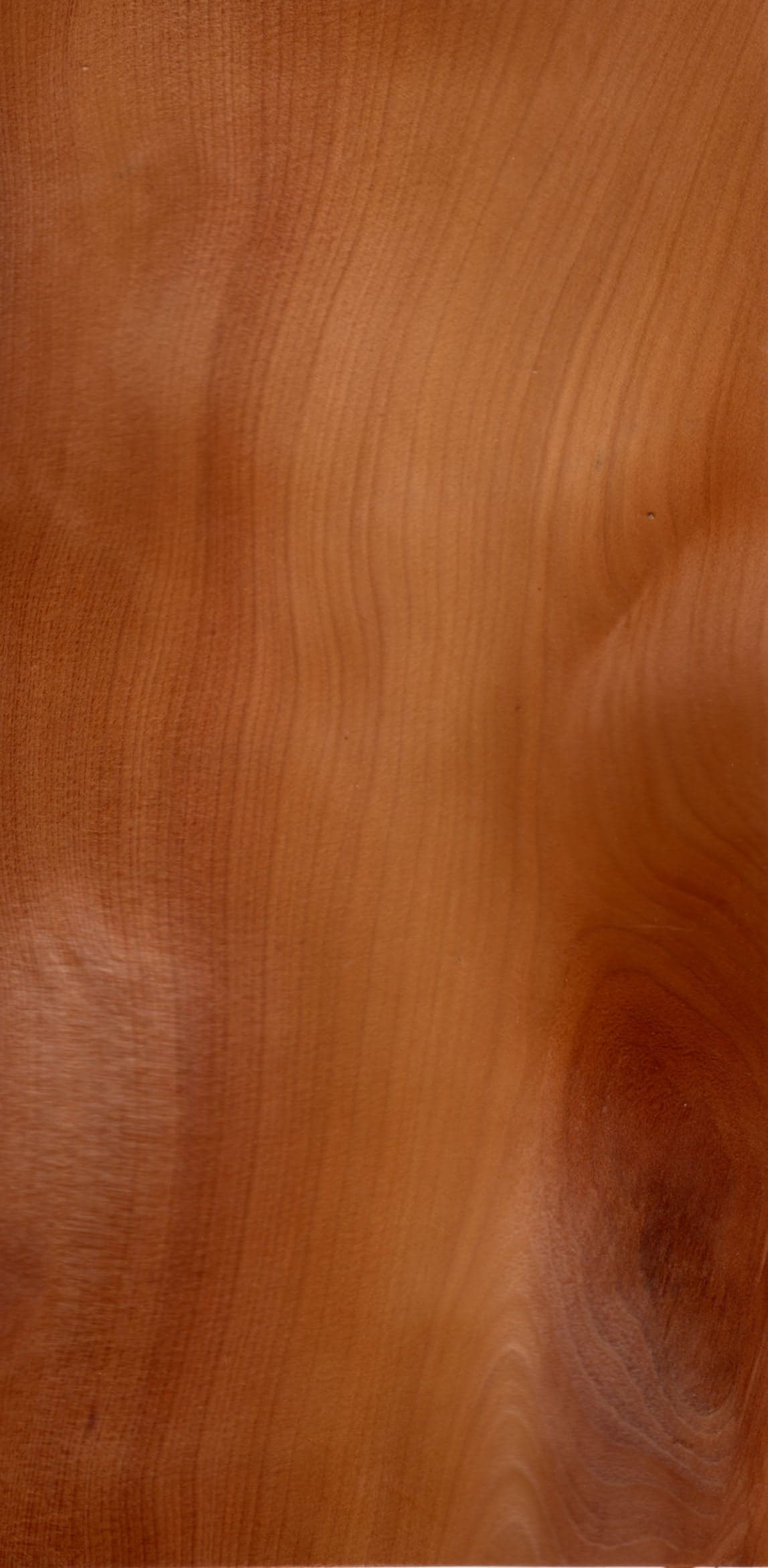
Sharp two-tone contrast: warm orange-red to honey-brown heartwood beside pale cream sapwood. Grain is generally straight but often irregular around frequent pin knots and burl figure. Texture is fine and even, with a natural lustre that deepens under oil. Boards are typically narrow and full of incident, sweeping sapwood lines, knot clusters, and occasional burl pockets are the norm, not the exception.

  • Heartwood: warm orange-red to honey-brown, ambering over time
  • Sapwood: pale cream to near-white, sharply defined against the heart
  • Frequent pin knots and burl figure, often clustered
  • Natural lustre that deepens under oil and wax
  • Strong two-tone contrast that softens but never disappears with age
  • Meist geradfaserig, oft unregelmäßig; feine, gleichmäßige Textur.

Arbeiten mit dieser Holzart

Verarbeitung

Turns superbly, one of the great turning woods, prized for centuries. Saws and sands cleanly. Planing is the catch: interlocked grain around knots tears easily, so take light passes with a sharp, high-angle iron or scrape. Holds detail well in carving. Glues and screws without fuss. Steam-bends well, which is why it became the longbow wood.

Finish

Takes oil and wax beautifully, a thin oil coat ignites the orange-red heartwood without muddying the cream sapwood. Sands to a near-polished surface straight off the belt. Watch for resin pockets that can bleed under film finishes; seal first with shellac if you plan to lacquer. The colour darkens and ambers over time; UV-stable topcoats slow the shift but won't stop it.

Trocknung

Dries slowly but with very little movement once stable, shrinkage is among the lowest of any European species. End-checks and surface checks are the main risks during initial drying; slabs from fallen trees often arrive with existing checks that should be stabilised before milling final thickness.

Wie stark arbeitet es?

Holz quillt und schwindet in der Breite, wenn die Luft feuchter und trockener wird. Schätzen Sie das saisonale Arbeiten einer Europäische Eibe-Platte, bevor Sie die Befestigung planen.

Einschnitt
Einsatzort

Erwartetes saisonales Arbeiten

etwa 6,1 mm

Platte mit Tischplattenhaltern oder Langlochwinkeln befestigen, nicht verleimen oder fest verschrauben.

Lineares Schwindmodell: Breite × (Schwindmaß ÷ 28 % Fasersättigung) × saisonale Feuchteschwankung. Verwendet 5,3 % Schwindmaß in Tangentialrichtung für Europäische Eibe. Eine Planungsschätzung, keine Garantie.

Was es kostet

Sicherheit und Herkunft

  • This species is recorded as commercially grown in Europe. This does not establish where an individual piece was harvested; check its origin details.
  • Status auf der Roten Liste der IUCN: die weltweite Schutzbewertung dieser Art.
  • Yew is toxic. Taxine alkaloids are present throughout the tree, needles, bark, and seeds are dangerous, and the wood itself is a documented sensitiser. Heavy dust exposure has been linked to cardiac and CNS effects. Wear a fitted respirator, run extraction, and keep offcuts away from animals and children. NOT food-safe. Do not use for cutting boards, chopping blocks, utensils, serving boards, or any surface in contact with food or drink. Treat it as a decorative and structural wood only.

Den vollständigen Leitfaden lesenAusführliche Hinweise zu Maserung, Farbveränderung, Verarbeitung und Formstabilität.+

What European Yew actually is#

Taxus baccata is a conifer that behaves like nothing else. At 6,760 N Janka it is harder than oak, ash or hard maple. At decay class 1 it is the most durable species in this catalogue alongside robinia. And it carries a colour that no other European timber approaches: vivid orange-red to purple-brown heartwood against narrow cream sapwood.

KORENA lists it as a hardwood on the basis of how it works and performs, though botanically it is a softwood. Treating it as a softwood at the bench would give you entirely the wrong expectations.

It is also poisonous, which governs a good deal of how it should be handled.

The toxicity, which is not a footnote#

Almost every part of the yew tree contains taxine alkaloids, which are cardiotoxic. The dust is a documented irritant and sensitiser, and the wood is recorded here as not food safe.

The practical rules are simple and worth following without exception. Run extraction and wear a mask when machining. Never use yew for chopping boards, food contact surfaces, drinking vessels or utensils. Keep shavings and offcuts away from animals, for which yew ingestion is frequently fatal, and never put them in bedding, mulch or compost.

None of this makes yew unsafe to own or to use in furniture. Finished, sealed yew is not a hazard. The risk is in the dust and the offcuts.

Käuferfragen

Häufige Fragen von Käufern

Is yew poisonous to work with?

+

Yes, and this needs taking seriously. Almost every part of the tree contains taxine alkaloids, which are cardiotoxic. The dust is a documented irritant and sensitiser, and yew is recorded here as not food safe. Run extraction, wear a mask, never use it for food contact or drinking vessels, and keep shavings away from animals, for which yew is often fatal.

Why is yew so expensive?

+

Slow growth, small sizes and high wastage. Yew grows very slowly, trunks are often hollow or fluted rather than round, and the proportion of clean usable timber from a log is low. Add high demand from turners and furniture makers for its colour and figure, and prices stay well above other European species.

How durable is it really?

+

Decay class 1, very durable, the highest rating in this catalogue alongside robinia. Yew heartwood is exceptionally resistant to rot and insect attack, which is why yew fence posts and structures survive for generations and why it was used for water pipes and boat parts.

Is it a softwood or a hardwood?

+

Botanically yew is a conifer and therefore a softwood, but it behaves nothing like one. At 6,760 N Janka it is harder than oak, ash or maple, and it is denser and more durable than most hardwoods here. KORENA classifies it as hardwood in the catalogue on the basis of how it works and performs rather than its botany.

Mechanische Eigenschaften

Technische Daten

Veröffentlichte Referenzwerte. Wo Quellen abweichen, steht die Spanne; der typische Wert wird für die Stufen oben verwendet.

Dichte (kg/m³)Masse pro Kubikmeter bei etwa 12 % Holzfeuchte. Schwereres Holz ist meist härter und fester.580–720 kg/m³typisch 675 kg/m³
Janka-Härte (N)Kraft, um eine Stahlkugel zur Hälfte ins Holz zu drücken. Das Standardmaß für Eindruckfestigkeit.6,300–7,100 Ntypisch 6.760 N
MOR: Biegebruchmodul (MPa)Biegefestigkeit: die Last, bei der ein Balken bricht.90–115 MPa
MOE: Elastizitätsmodul (GPa)Biegesteifigkeit: wie stark ein Regalboden oder eine Platte unter Last durchhängt.9.5–11.0 GPa
Radiales SchwindenSchwindmaß quer zu den Jahrringen, von frisch bis darrtrocken. Riftbretter arbeiten in diesem Maß.3.0–4.0 %
Tangentiales SchwindenSchwindmaß entlang der Jahrringe. Fladerbretter und die meisten Bohlen arbeiten in diesem Maß.
Europäische Eibe: Holzmaserung

Achim Raschka (talk), via Wikimedia Commons

  • Veneers and book-matched panels
  • Stärken

    • WetterfestEN 350 Klasse 1 von 5: widersteht Fäulnis im Freien ohne Behandlung.
    • Sehr formstabilGeringes saisonales Arbeiten. Gut für breite Platten und passgenaue Verbindungen.
  • Native across Europe, but standing yew is scarce. Ancient churchyard and estate yews are protected; commercial slabs come almost entirely from felled or fallen estate trees. Expect small, character-heavy boards rather than long clean stock.

  • IUCN Least Concern and not CITES-listed, but slow-grown and culturally protected across much of Europe. Most marketplace yew is salvage from estate fellings, storm-fall, or managed thinning of younger plantation stock. Ask about provenance, a clean DDS matters more here than with faster-growing species.

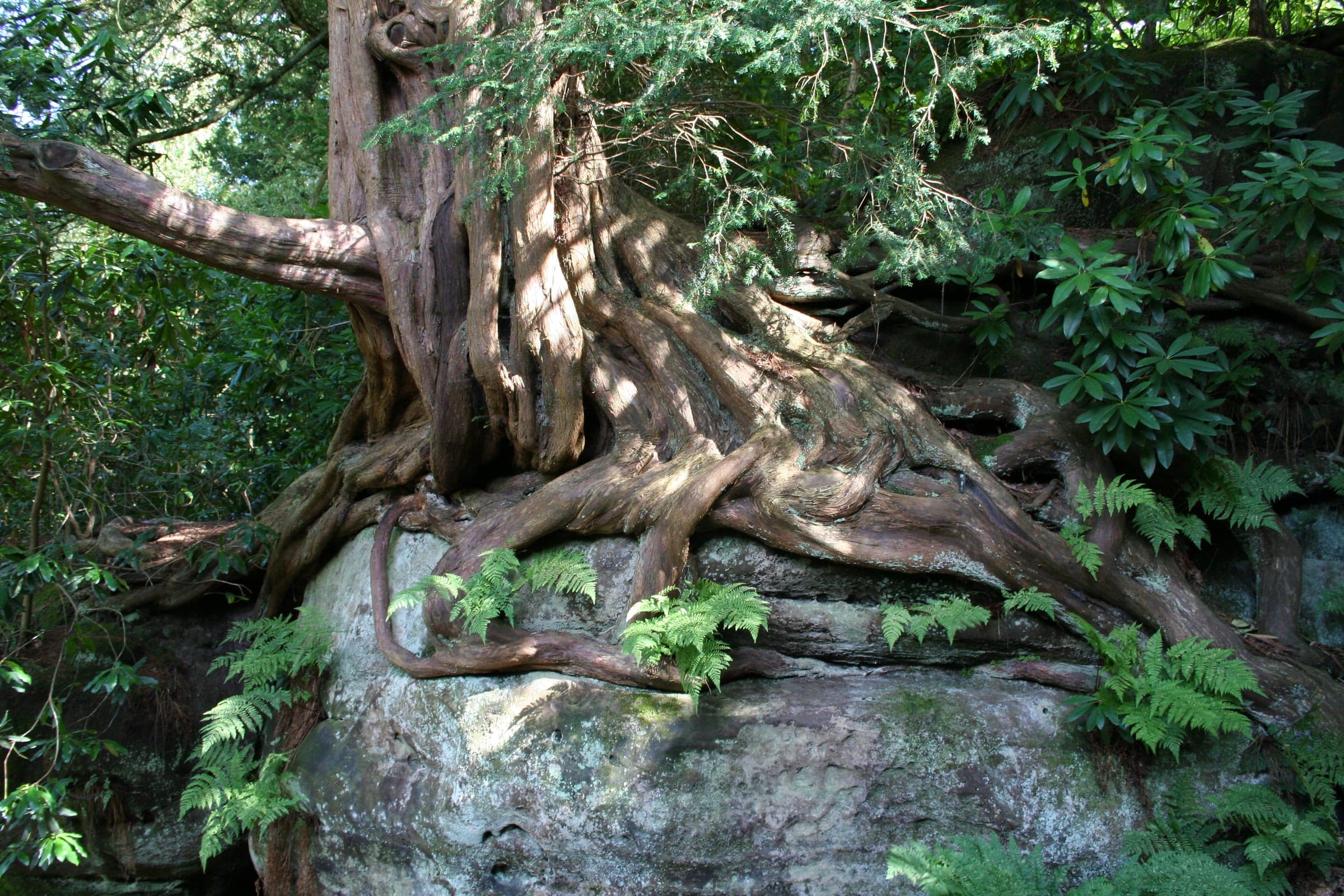
  • Europäische Eibe: Baum

    Marco Schmidt [1], via Wikimedia Commons

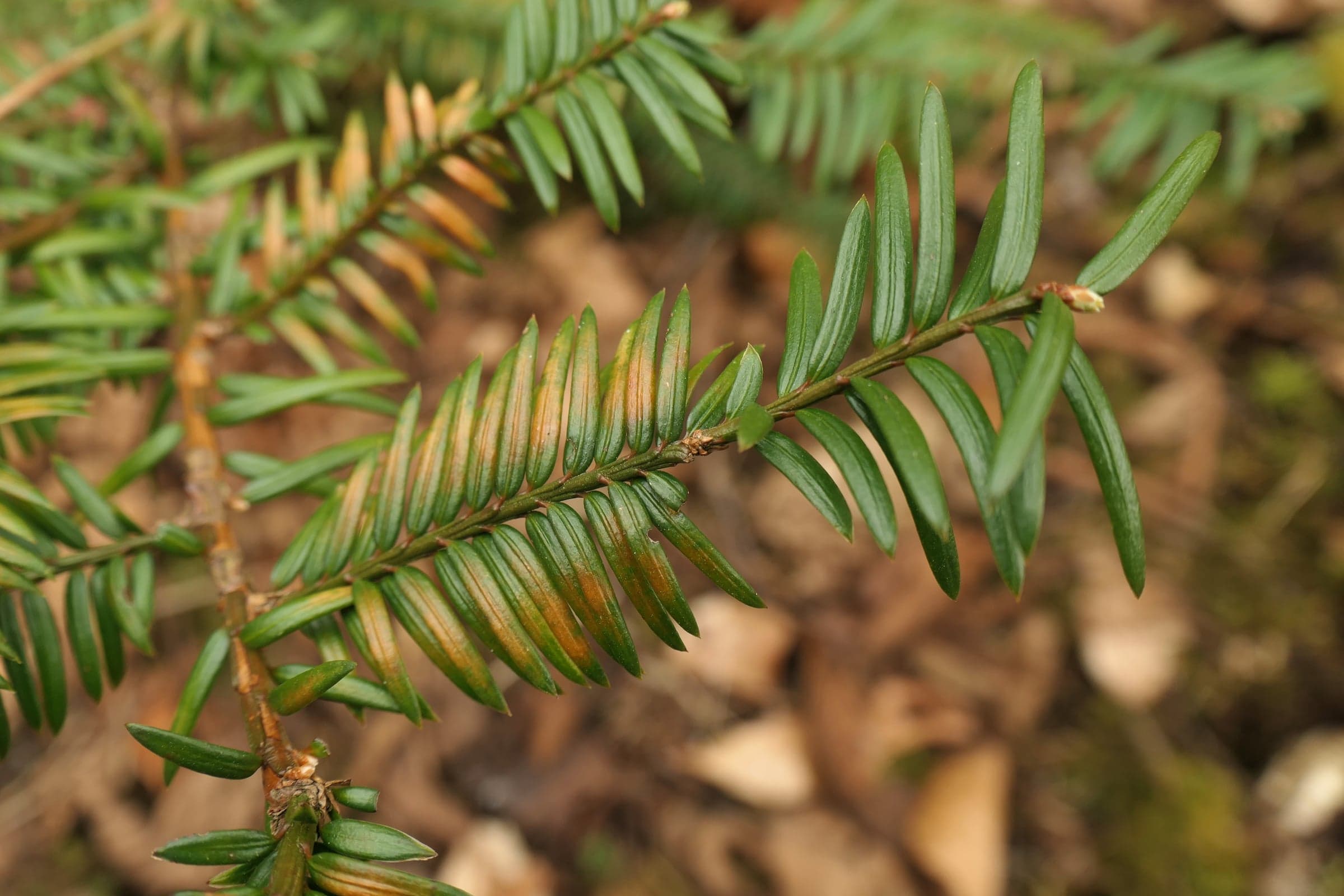
    Europäische Eibe: Blatt
    Blatt
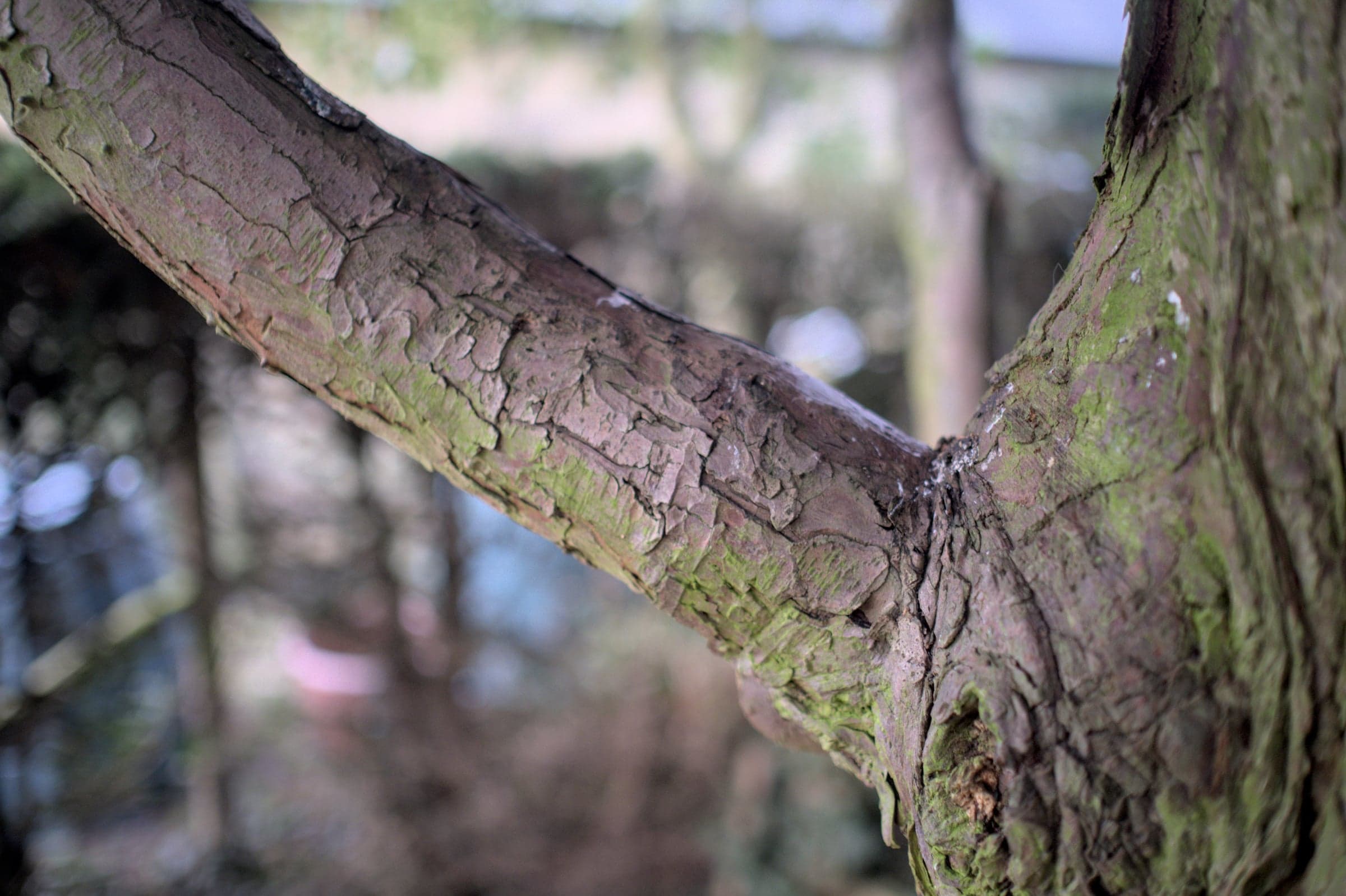
    Europäische Eibe: Rinde
    Rinde

    Reading a yew slab#

    The contrast is the point. Heartwood runs orange-red through to purple-brown, sometimes almost violet when freshly cut, against sapwood that is nearly white. On a live edge slab that pale band is usually left in place, and it is the defining feature.

    Yew is rarely plain. Expect frequent knots, wavy and interlocked grain, and pippy or burr sections. Trunks are often hollow or deeply fluted rather than round, so boards are irregular and wide clean lengths are genuinely scarce.

    That irregularity is most of the appeal and most of the price.

    At the bench#

    Yew works well for its hardness but the grain will fight you. Knots are frequent and hard, wavy grain reverses direction, and burr sections tear out readily.

    Light cuts, very sharp tooling, and a scraper or high angle plane for the final surface. On burr and pippy material, hand finishing is normal.

    It turns superbly, which is why yew is a favourite among bowl turners, and it takes a fine polished surface directly from the tool. It glues and finishes well, and oil finishes intensify the orange dramatically.

    The colour deepens and mellows with light exposure toward a richer red brown.

    Stability#

    Volumetric shrinkage of 7.8 percent is the second lowest in this catalogue after Saman, with tangential at 4.8 percent against radial at 3.0 percent. Both the total and the differential are low.

    That means yew is dimensionally very well behaved, which combined with its durability explains why it survives in structures and objects for centuries. Drying is slow given the density and irregular form, but the dried wood is stable.

    Where European Yew is the right answer#

    Turned work above all, plus fine furniture, decorative slabs, veneer and any piece where the colour carries the design. Its durability and stability also suit exterior work where the cost is justified, and it was historically used for gate posts, water pipes and boat parts.

    The longbow association is real: yew's combination of compressive strength in the heartwood and tensile strength in the sapwood is what made the English longbow work, with the two layers doing different jobs.

    It is the wrong answer for food contact, for large matched volumes, and for anyone unwilling to manage the dust properly.

    Sourcing and EUDR#

    Not CITES listed and assessed as Least Concern, though slow growth and small sizes mean supply is limited and much of it comes from garden, churchyard and estate felling rather than forestry. Provenance documentation deserves attention here, and KORENA records the yard and region on every listing.

    The sapwood, and why it stays#

    On almost every species in this catalogue, sapwood is the part you cut off. On yew it is usually the part you keep.

    Yew sapwood is narrow, near white, and sits in sharp contrast against orange-red heartwood. On a turned bowl or a slab edge that pale band is the single most striking feature the wood offers, and removing it removes most of the visual reason for choosing yew.

    It is also structurally interesting. Yew sapwood is elastic and strong in tension while the heartwood is strong in compression, and the English longbow exploited exactly that: the bow was cut so the sapwood formed the back and the heartwood the belly, giving a natural composite that no single layer could match.

    The one caution is durability. The decay class 1 rating applies to the heartwood. Yew sapwood is not durable, so on any exterior piece it is a sacrificial edge rather than a protected one.

    Hollow trunks and what they mean for slabs#

    Mature yew very commonly grows hollow, and old trees are often little more than a shell of living wood around an open centre.

    For the tree this is normal and not a sign of ill health. For the timber buyer it means yields are low, boards are irregular, and a wide clean yew slab is genuinely rare.

    It also means much yew comes to market in short, wide, irregular pieces rather than long boards, which suits turning, boxes and small slabs better than furniture in long lengths.

    What makes the figure so distinctive?

    +

    The sharp contrast between narrow cream sapwood and vivid orange-red to purple-brown heartwood, combined with frequent knots, wavy grain and pippy or burr sections. Yew is rarely plain. That irregularity is part of the appeal and part of why clean straight lengths are so scarce.

    4.8–5.8 %
    Volumetrisches SchwindenGesamte Volumenänderung von frisch bis darrtrocken. Niedriger heißt formstabiler.7.8–8.8 %
    Natürliche Dauerhaftigkeit (EN 350)Europäische Norm für natürliche Dauerhaftigkeit, von 1 (sehr dauerhaft) bis 5 (nicht dauerhaft).Class 1 — Very durable

    Quellen

    • The Wood Database(abgerufen am 2026-05-09)
    • USDA FPL Wood Handbook FPL-GTR-190 (2010)(abgerufen am 2026-05-09)
    • Meier, E. — WOOD! Identifying and Using Hundreds of Woods Worldwide (2015)(abgerufen am 2026-05-09)

    Auf einen Blick

    Die Stufen verwenden feste Grenzen für alle Holzarten bei KORENA und sind daher direkt vergleichbar. Der gemessene Wert steht unter jeder Stufe.
    HärteWiderstand gegen Dellen und AbnutzungHart

    Janka-Härte 6.760 N

    36 % härter als Europäische Eiche

    GewichtWie schwer eine Bohle zu heben istSchwer

    675 kg/m³

    StabilitätWie wenig es mit den Jahreszeiten arbeitetSehr stabil

    8,3 % Volumenschwindung

    BearbeitungSägen, Hobeln, Schleifen, LeimenLeicht

    4,0 / 5 Werkbank-Durchschnitt

    AußeneinsatzNatürliche Fäulnisresistenz, EN 350Außen, langlebig

    EN 350 Klasse 1

    • Sägen · Sehr gutWie sauber es schneidet und wie stark es Sägeblätter beansprucht.1 = schwierig · 5 = ausgezeichnet
    • Hobeln · GutWie glatt die Oberfläche wird und wie stark es ausreißt.1 = schwierig · 5 = ausgezeichnet
    • Schleifen · Sehr gutWie schnell es glatt schleift, ohne das Papier zuzusetzen.1 = schwierig · 5 = ausgezeichnet
    • Drechseln · AusgezeichnetWie es sich an der Drechselbank schneiden und finishen lässt.1 = schwierig · 5 = ausgezeichnet
    • Schnitzen · Sehr gutWie scharf es Details unter dem Hohleisen hält.1 = schwierig · 5 = ausgezeichnet
    • Verleimen · Sehr gutWie zuverlässig Leimverbindungen halten.1 = schwierig · 5 = ausgezeichnet
    • Schraub- / Nagelhalt · Sehr gutWie gut es Schrauben und Nägel hält, ohne zu spalten.1 = schwierig · 5 = ausgezeichnet
    • Dampfbiegen · Sehr gutWie gut es nach dem Dämpfen Rundungen annimmt.1 = schwierig · 5 = ausgezeichnet

    Für Europäische Eibe gibt es noch keine Marktreferenz. Jedes KORENA Stück wird einzeln vom Partner-Holzplatz bepreist.

    Gut biegbar
    Mit 4 von 5 fürs Dampfbiegen bewertet. Nimmt enge Radien an.
  • EinsteigerfreundlichLeicht zu bearbeiten und nicht so hart, dass es Werkzeuge strapaziert.
  • Achtung

    • Staub reiztBeim Schleifen und Maschinenarbeiten Absaugung und Maske verwenden.
    • Kein Holz für LebensmittelkontaktFür Schneidebretter und Servierware eine andere Holzart wählen.

    Für Details auf ein Etikett tippen.