EUDR
EUDR: which wood products are in scope
A reference to the EUDR wood product list, with CN codes, EUTR comparisons, examples, exclusions and application dates.
Audio by MediaThrive. Pressing the button loads their player, which saves your player settings in this browser.
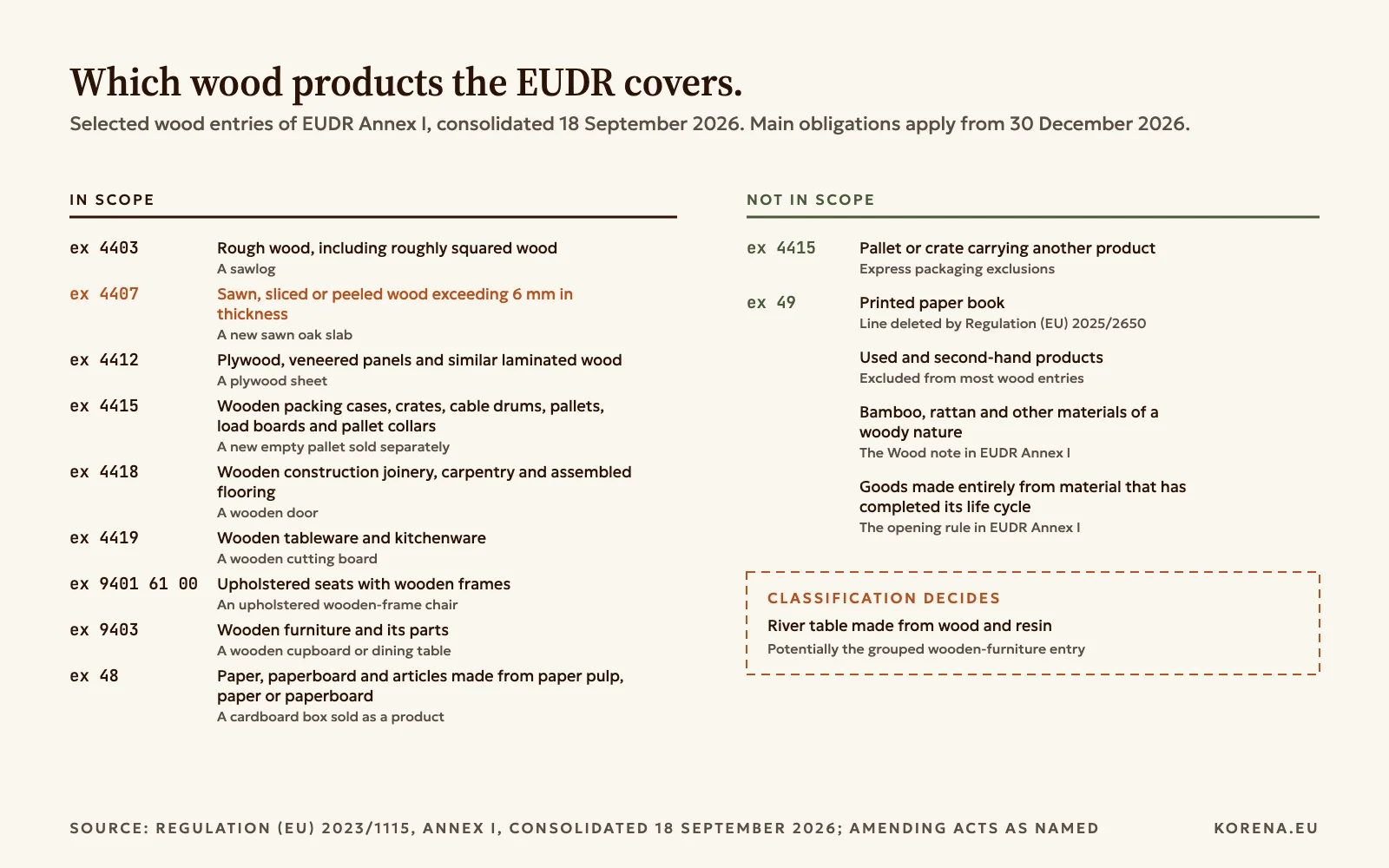
The EUDR wood products list has 31 entries in EUR-Lex's consolidated Annex I dated 18 September 2026. It covers sawn wood, panels, wooden furniture, seats, kitchenware such as cutting boards, pulp and paper. Under EUDR Article 38, the main obligations apply from 30 December 2026.
Key facts#
- EUDR Annex I contains 31 Wood entries in the consolidated text of 18 September 2026, counting the grouped furniture line as one entry.
- EUDR Annex I includes sawn wood over 6 mm thick under ex 4407, wooden furniture in the listed ex 9403 group, and wooden kitchenware such as cutting boards under ex 4419.
- Regulation (EU) 2025/2650 deleted the former ex 49 line, taking printed books and the other printed products in that line out of scope.
- Delegated Regulation (EU) 2026/2102 excludes used and second-hand products from most wood entries and clarifies exclusions for bamboo, rattan and packaging carrying another product.
- EUDR Article 38 sets the main application date at 30 December 2026.
- Under EUDR Article 38(3), products covered by the old Timber Regulation (EUTR) annex do not receive the extension to 30 June 2027, so most timber products apply from 30 December 2026 for small companies too.
- Commission Implementing Regulation (EU) 2025/1093 names 4 high-risk countries, Belarus, the Democratic People's Republic of Korea, Myanmar and the Russian Federation, and lists all EU Member States as low risk.
- EUDR Article 16 sets minimum yearly business check rates of 1 percent for low-risk production, 3 percent for standard-risk production and 9 percent for high-risk production.
Source: EUDR, Annex I and Articles 16 and 38, obligations amendment, scope amendment, country benchmarking regulation.
Last updated: 19 November 2026. This is legal information, not legal advice; the customs classification of a product decides.
 View full size
How to read the list#
EUDR Annex I uses the Combined Nomenclature, abbreviated CN. A product must match a listed entry and the relevant commodity requirement. Containing wood does not by itself bring an unlisted product into scope.
The prefix ex limits an entry to the part of the customs category described in the annex. Read the code, description and exclusions together. For example, a furniture code may be listed while its used and second-hand products are excluded.
The table below follows the order of the current Wood list. Its product descriptions use plain words. The EUTR column compares the product categories in the earlier annex with the current EUDR entries.
Source: EUDR, Article 1 and Annex I, Delegated Regulation (EU) 2026/2102, recital 7.
What changed in the list#
Many older lists on the web still show the 2023 version. These amendments explain why the current list looks different.
| Date | Act | What changed for wood |
|---|---|---|
| 19 December 2025 | Regulation (EU) 2025/2650 | Deleted the printed-products line, ex 49, through Article 1, point 26; changed the application dates; introduced the downstream operator and micro or small primary operator roles. |
| 13 July 2026, published 17 September 2026 | Delegated Regulation (EU) 2026/2102 | Added ex to wood entries; excluded used and second-hand products from most entries; rewrote packaging exclusions for single-use packaging and reusable packaging from first use; replaced the general ex 9401 seat entry with six specific codes, leaving out aircraft and motor vehicle seats as explained in recital 13; added notes on bamboo, rattan, samples and test products. |
Source: Regulation (EU) 2025/2650, Delegated Regulation (EU) 2026/2102, recitals and Annex.
Complete wood product list by CN code#
EUDR Annex I, consolidated on 18 September 2026, supplies every code in this table. The furniture codes remain grouped as printed in the annex. Read the summaries with the exclusions below.
| CN code | Product in plain words | Everyday example | In the EUTR annex? |
|---|---|---|---|
| ex 4401 | Fuelwood, chips, particles, sawdust and wood residues, including pellets and briquettes | Firewood or wood pellets | Yes |
| ex 4402 | Charcoal, including the shell or nut charcoal described in the entry | Charcoal made from wood | No |
| ex 4403 | Rough wood, including roughly squared wood | A sawlog | Yes |
| ex 4404 | Hoopwood, split poles, pointed stakes and roughly prepared wooden sticks | A pointed wooden fence stake | No |
| ex 4405 | Wood wool and wood flour | Wood wool supplied as a product | No |
| ex 4406 | Wooden railway or tramway sleepers | A new wooden railway sleeper | Yes |
| ex 4407 | Sawn, sliced or peeled wood exceeding 6 mm in thickness | A new sawn oak slab | Yes |
| ex 4408 | Veneer and similar thin wood not exceeding 6 mm in thickness | A veneer sheet | Yes |
| ex 4409 | Wood continuously shaped along an edge, end or face | A grooved flooring strip | Yes |
| ex 4410 | Particleboard, OSB and similar boards made using wood | An OSB panel | Yes |
| ex 4411 | Fibreboard made using wood | A fibreboard sheet | Yes |
| ex 4412 | Plywood, veneered panels and similar laminated wood | A plywood sheet | Yes |
| ex 4413 | Densified wood in blocks, sheets, strips or shaped sections | A compressed wood block | Yes |
| ex 4414 | Wooden frames for pictures, mirrors and similar objects | A wooden picture frame | Yes |
| ex 4415 | Wooden packing cases, crates, cable drums, pallets, load boards and pallet collars | A new empty pallet sold separately | Yes |
| ex 4416 | Wooden barrels, casks, vats, tubs, their parts and staves | A new wooden barrel | Yes |
| ex 4417 | Wooden tools, tool bodies, handles and shoe lasts or trees | A wooden tool handle | No |
| ex 4418 | Wooden construction joinery, carpentry and assembled flooring | A wooden door | Yes |
| ex 4419 | Wooden tableware and kitchenware | A wooden cutting board | No |
| ex 4420 | Inlaid woodwork, jewellery or cutlery cases, ornaments and the wooden furniture described in this entry | A wooden jewellery box | No |
| ex 4421 | Other wooden articles | A wooden clothes hanger | No |
| ex 47 | Wood pulp | Wood pulp supplied for papermaking | Yes |
| ex 48 | Paper, paperboard and articles made from paper pulp, paper or paperboard | A cardboard box sold as a product | Yes |
| ex 9401 31 00 | Wooden swivel seats with adjustable height | An adjustable wooden swivel chair | No |
| ex 9401 41 00 | Wooden seats convertible into beds, excluding garden seats and camping equipment | A wooden convertible sofa | No |
| ex 9401 61 00 | Upholstered seats with wooden frames | An upholstered wooden-frame chair | No |
| ex 9401 69 00 | Unupholstered seats with wooden frames | An unupholstered wooden-frame chair | No |
| ex 9401 80 00 | Other seats of wood | Another wooden seat classified in this entry | No |
| ex 9401 91 90 | Other wooden parts of seats | A wooden chair part classified in this entry | No |
| ex 9403 30 , ex 9403 40 , ex 9403 50 , ex 9403 60 and ex 9403 91 | Wooden furniture and its parts | A wooden cupboard or dining table | Yes (older code numbers) |
| ex 9406 10 00 | Wooden prefabricated buildings | A prefabricated wooden building | Yes (older code numbers) |
The examples illustrate the categories; they do not classify an individual shipment.
Under EUDR Article 38(3), the later date of 30 June 2027 for micro and small operators established by 31 December 2024 does not apply to products covered by the EUTR annex. So a small sawmill or slab seller handling ex 4407 starts on 30 December 2026. A small maker of cutting boards under ex 4419 or chairs under the listed ex 9401 entries can use 30 June 2027 if it qualifies.
The EUTR column is our comparison of the two annexes. Code numbering changed between them: the EUTR annex includes the older furniture code 9403 90 30 and building code 9406 00 20. The customs classification and the legal texts decide.
Source: EUDR, Annex I and Article 38(3), EUTR annex.
Worked examples: in or out?#
These examples assume commercial supply and new wood products unless stated otherwise. Each answer follows the named EUDR Annex I entry. The Commission's guidance explains the packaging distinction.
| Example | Code or Annex I basis | Scope answer |
|---|---|---|
| Sawn oak slab thicker than 6 mm | ex 4407, sawn wood | In, if classified as the sawn wood described in the entry. |
| Finished wooden dining table | The grouped wooden-furniture entry, including ex 9403 60 | In, if classified in the listed wooden-furniture category. |
| Wooden cutting board | ex 4419, wooden kitchenware | In, if classified as wooden kitchenware. |
| River table made from wood and resin | Potentially the grouped wooden-furniture entry | Classification decides. In if classified as listed wooden furniture; the annex does not classify every wood-and-resin design. |
| Wood charcoal | ex 4402, charcoal | In, subject to the relevant commodity requirement. |
| Wood pellets or firewood | ex 4401, fuelwood and agglomerated wood material | In, unless the applicable waste or packaging exclusion applies. |
| New wooden pallet sold as a product | ex 4415, wooden pallets | In when supplied as a product in its own right. |
| Pallet or crate carrying another product | ex 4415, express packaging exclusions | Out when used exclusively to support, protect or carry that product and presented with it. |
| Printed paper book | The former ex 49 printed-products line was deleted | Out as a printed book; Regulation (EU) 2025/2650 removed that entry. |
| Wooden picture frame | ex 4414, wooden frames | In; used and second-hand frames are excluded by the entry. |
| Plywood | ex 4412, plywood | In; used and second-hand products are excluded by the entry. |
For a river table, check the actual product and its customs classification before deciding scope. The Commission's guidance explains that listed products can contain other materials. It does not give every wood-and-resin table the same classification.
Source: EUDR, Annex I, Regulation (EU) 2025/2650, Article 1, point 26, Commission Guidance, sections 7 and 9.
What is outside scope?#
Packaging carrying another product#
EUDR Annex I excludes single-use packing material and containers used exclusively to support, protect or carry another product, when presented with that product. For the specified reusable packaging, the exclusion continues from its first use for that purpose.
An empty pallet sold as merchandise is different from a pallet carrying merchandise. The Commission's guidance also explains that some containers are classified separately because they give the product its essential character. Check the actual use and classification of the container.
Entirely recovered material#
The opening rule in EUDR Annex I excludes goods made entirely from material that has completed its life cycle and would otherwise have been discarded as waste. The rule has an exception for manufacturing by-products from a process involving material that was not waste.
The Commission's guidance explains that virgin material in a partly recycled product remains subject to the rules. Its examples include virgin paper pulp and new timber used to repair pallets. Ordinary sawmill chips and sawdust can also remain in scope as by-products.
Other exclusions#
The Wood note in EUDR Annex I excludes bamboo, rattan and other materials of a woody nature, to the extent that the product is made from those materials. The Commission's guidance confirms that a shared customs code does not bring a product made from a non-relevant commodity into scope.
Many entries expressly exclude used and second-hand goods. These include sawn wood, plywood, frames, kitchenware, seats and wooden furniture. Check the individual entry because the wording is not the same for every category.
The paper entry excludes specified correspondence and marketing or information material accompanying another product, or supplied free for marketing or information. The general annex notes also exclude narrowly defined order samples and products for examination, analysis or testing under their stated conditions. Calling an item a sample is not enough to meet those conditions.
EUDR Article 1(2) otherwise excludes relevant products produced before entry into force, subject to the timber exception in Article 37(3). The Commission separately confirms that non-commercial consumers have no EUDR responsibilities.
Source: EUDR, Article 1(2) and Annex I, Commission Guidance, section 7, Green Forum, Roles and responsibilities.
Application dates and the timber transition#
EUDR separates entry into force from the dates when its main obligations apply. Its deforestation cut-off is another date. The cut-off concerns the land and, for wood, harvesting that induces forest degradation.
The dates below follow the current consolidated text. The Commission confirms the calendar date of entry into force; Article 38(1) states it as the twentieth day after publication.
| Event or rule | Date and qualification | Legal source |
|---|---|---|
| Entry into force | 29 June 2023 | EUDR Article 38(1); Commission confirmation |
| Deforestation cut-off | 31 December 2020; wood must also have been harvested without inducing forest degradation after that date | EUDR Article 2(13) |
| Main application date, including large and medium businesses | 30 December 2026 for the provisions specified in the article | EUDR Article 38(2) |
| Extension for qualifying micro and small operators | 30 June 2027, for operators established as such by 31 December 2024, except for products covered by the EUTR annex | EUDR Article 38(3) |
| EUTR repeal | 30 December 2026, subject to the transitional provisions | EUDR Article 37(1) |
| Continued application of EUTR | Until 31 December 2029 for its defined timber products produced before 29 June 2023 and placed on the market from 30 December 2026 | EUDR Article 37(2) |
| EUDR requirement for that older timber | Products produced before 29 June 2023 and placed on the market from 31 December 2029 must comply with EUDR Article 3 | EUDR Article 37(3) |
Use the EUTR column in the full product table to check the product-category comparison. The small-operator extension and the transition for older timber are separate rules. A business must meet the conditions of the rule it uses.
Source: EUDR, Articles 2, 37 and 38, Commission EUDR page, Application dates.
Who must do what?#
The amended EUDR distinguishes operators, downstream operators and traders. A business should identify its role for the actual transaction. A smaller business does not automatically qualify for the primary-operator regime.
| Role | Main responsibility | EUDR article |
|---|---|---|
| Operator | Places relevant products on the market or exports them, excluding downstream operators. Exercises due diligence and normally submits a statement first, then passes the relevant reference to downstream buyers. | Articles 2(15), 4 and 8 |
| Downstream operator | Makes relevant products using relevant products already covered by statements or simplified declarations. Keeps the required supplier and business-customer information and applicable references for at least 5 years. | Articles 2(15b) and 5 |
| Trader | Makes relevant products available without being an operator or downstream operator. Keeps the required supplier and business-customer information and applicable references for at least 5 years. | Articles 2(17) and 5 |
| Micro or small primary operator | A qualifying primary producer established in a low-risk country. Keeps its due diligence responsibilities but uses a one-time simplified declaration instead of routine statements; the statutory database alternative can apply. | Articles 2(15a) and 4a |
Under EUDR Article 5, non-SME downstream operators and traders must register in the information system. Substantiated concerns trigger additional verification duties for those businesses. A buyer must collect statement references or declaration identifiers when its direct supplier is an operator. Every later buyer does not have to collect the original reference again.
For terms used here, see EUDR, due diligence statements and geolocation.
Source: EUDR, Articles 2, 4, 4a, 5 and 8, Green Forum, Roles and responsibilities.
Country risk classes and check rates#
EUDR Article 29 establishes low, standard and high risk. Commission Implementing Regulation (EU) 2025/1093 lists the low-risk and high-risk countries. Countries absent from those lists remain standard risk.
The complete high-risk list is Belarus, the Democratic People's Republic of Korea, Myanmar and the Russian Federation. All EU Member States appear on the low-risk list. Use the Commission's official country classification list to check a country.
| Risk class | What it changes for due diligence | Minimum yearly authority checks under EUDR Article 16 |
|---|---|---|
| Low | Article 13 permits simplified due diligence if its origin, supply-chain and mixing conditions are met. | 1 percent of operators, non-SME downstream operators and non-SME traders in the relevant population; Article 16(10). |
| Standard | Ordinary due diligence requirements apply. | 3 percent of those businesses in the relevant population; Article 16(8). |
| High | Ordinary due diligence requirements apply, with country risk included in the assessment. | 9 percent of those businesses and 9 percent of the quantity of each relevant product; Article 16(9). |
EUDR Article 16 calculates these minimums separately for each relevant commodity. It uses the statutory previous-year business population and quantities where applicable. The percentages are not fixed chances that an individual shipment will be inspected.
Low risk does not remove information collection. Under EUDR Article 13, eligible operators may omit the ordinary risk-assessment and mitigation stages after checking the specified supply-chain risks. Information pointing to non-compliance or circumvention restores those duties and must be reported to the competent authority. Processing higher-risk material in a low-risk country does not remove the circumvention issue.
Source: EUDR, Articles 13, 16 and 29, benchmarking regulation, Article 1 and Annex, Green Forum, Understand Due Diligence.
Frequently asked questions#
Is furniture covered by EUDR?#
Yes. EUDR Annex I covers the listed wooden furniture codes and selected wooden seats. Used and second-hand products are excluded from these entries. A product's customs classification decides whether it matches a listed entry.
Is a cutting board covered by EUDR?#
Yes, if a new wooden cutting board is classified as wooden kitchenware. EUDR Annex I lists ex 4419 for wooden tableware and kitchenware. The entry excludes used and second-hand products, and the wood-material exclusions also apply.
Which EUDR HS codes cover wood products?#
EUDR Annex I is a Combined Nomenclature list. Its Wood block includes ex 4401 to ex 4421, ex 47, ex 48, selected wooden seats, wooden furniture and wooden prefabricated buildings. Read each entry and exclusion; a code alone is insufficient.
When does EUDR apply to wood products?#
EUDR Article 38 sets 30 December 2026 as the main date. Most timber products apply from that date for small companies too because the EUTR exception removes their extension. Qualifying micro and small operators established by 31 December 2024 can use 30 June 2027 for products outside the EUTR annex.
Which countries are high risk under EUDR?#
Commission Implementing Regulation (EU) 2025/1093 lists Belarus, the Democratic People's Republic of Korea, Myanmar and the Russian Federation as high risk. The Commission's live country list showed the same countries when checked on 19 November 2026.
Is wooden packaging covered by EUDR?#
EUDR Annex I includes new wooden packaging sold as a product in its own right. Packaging used exclusively to support, protect or carry another product and presented with it is excluded. Reusable packaging remains excluded after it first serves that purpose.
Source: EUDR, Annex I and Article 38, benchmarking regulation, Commission country list.
How to cite this page#
KORENA Journal, "EUDR: which wood products are in scope", korena.eu/journal/eudr-wood-products-scope-cn-codes, checked against the consolidated text on 19 November 2026.
KORENA is a marketplace listing individually measured hardwood slabs with a per-piece wood passport. Related reading: EUDR for hardwood buyers, the buying checklist for furniture makers and what a wood passport records.
Sources#
- European Parliament and Council of the European Union, Regulation (EU) 2023/1115 on the making available on the Union market and the export from the Union of certain commodities and products associated with deforestation and forest degradation and repealing Regulation (EU) No 995/2010, consolidated text dated 18 September 2026, identifier 02023R1115-20260918, EUR-Lex consolidated text, accessed 19 November 2026.
- European Parliament and Council of the European Union, Regulation (EU) 2025/2650 amending Regulation (EU) 2023/1115 as regards certain obligations of operators and traders, identifier 32025R2650, Official Journal text, accessed 19 November 2026.
- European Commission, Commission Delegated Regulation (EU) 2026/2102 amending Regulation (EU) 2023/1115 as regards the list of relevant commodities and relevant products, identifier 32026R2102, Official Journal text, accessed 19 November 2026.
- European Commission, Commission Implementing Regulation (EU) 2025/1093 laying down rules for the application of Regulation (EU) 2023/1115 as regards a list of countries that present a low or high risk of producing relevant commodities for which the relevant products do not comply with Article 3, point (a), identifier 32025R1093, Official Journal text, accessed 19 November 2026.
- European Commission, Guidance document for Regulation (EU) 2023/1115 on deforestation-free products, Commission Notice C/2026/3896, Official Journal guidance, accessed 19 November 2026.
- European Parliament and Council of the European Union, Regulation (EU) No 995/2010 laying down the obligations of operators who place timber and timber products on the market, identifier 32010R0995, EUTR text and annex, accessed 19 November 2026.
- European Commission, Directorate-General for Environment, EU Deforestation Regulation (EUDR), identifier: EUDR policy webpage, policy and application dates, accessed 19 November 2026.
- European Commission, Green Forum, Country Classification List, identifier: country benchmarking webpage, official country classifications, accessed 19 November 2026.
- European Commission, Green Forum, Roles and responsibilities, identifier: EUDR implementation webpage, roles and responsibilities, accessed 19 November 2026.
- European Commission, Green Forum, Understand Due Diligence, identifier: EUDR implementation webpage, due diligence explanation and statutory extracts, accessed 19 November 2026.