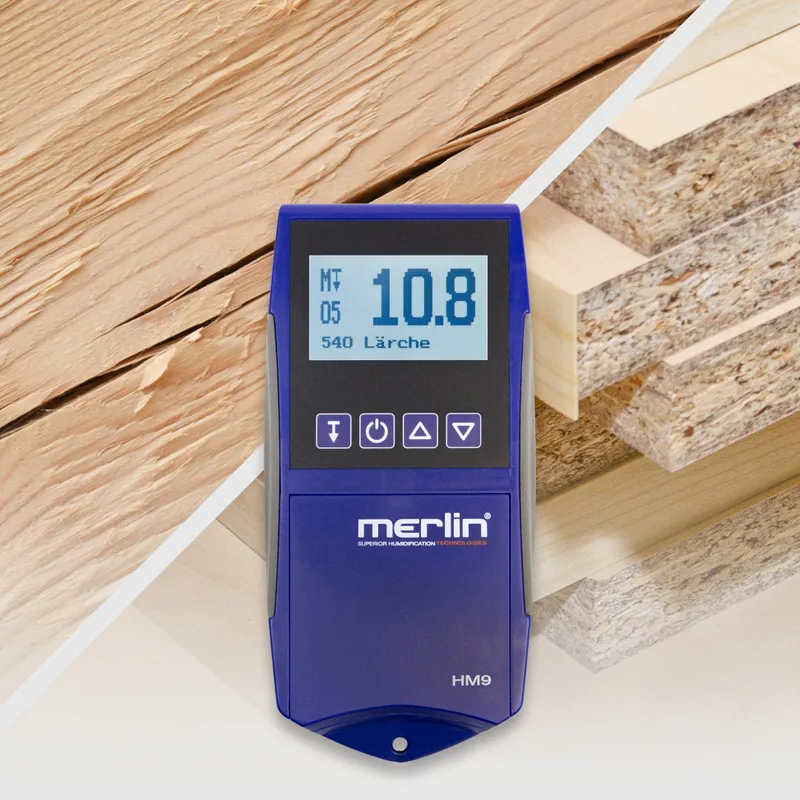
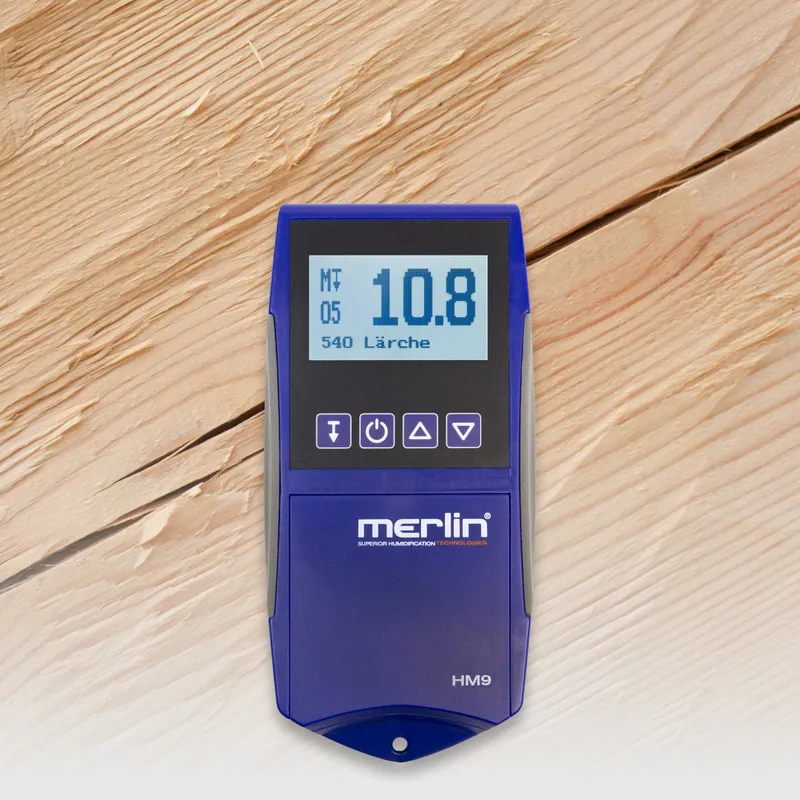
Pinless moisture meter for boards and furniture — MERLIN HM9 WS13
The MERLIN HM9 WS13 is a pinless wood moisture meter for furniture boards and joinery from 13 mm thick, with a published scanning depth of 20 mm.
€456.00
incl. €76.00 VATDelivery to Bulgaria from €5.03
The exact price for your address is confirmed at checkout.
Wood moisture checks for boards and furniture
The MERLIN HM9 WS13 is a pinless wood moisture meter for furniture boards and joinery from 13 mm thick, with a published scanning depth of 20 mm.
Check incoming furniture timber, compare boards before glue-up and follow moisture changes during storage without leaving pinholes in the surface. The WS13 suits cabinetmakers, furniture workshops and joiners working with flat boards and components that meet its thickness and sensor-coverage requirements. It is a practical choice when preserving the visible face matters as much as taking the reading.
Sensor depth and minimum wood thickness
The 13 mm minimum wood thickness and the 20 mm scanning depth describe different things: the first is the minimum suitable workpiece thickness; the second describes the sensor field. This model is intended for furniture stock rather than thin veneer or flooring below 13 mm. For thicker timber requiring the deeper HM9 sensor, compare the WS25.
Pinless measurement with 21 wood groups
The capacitive / dielectric sensor responds to the moisture-dependent electrical properties of wood. Choose from 21 calibration groups across a dry-density range of 175–1075 kg/m³. Automatic temperature compensation and a self-calibration function support routine checks; the illuminated display shows moisture, wood group, dry density and minimum wood thickness.
How to measure wood moisture
Select the wood group using the species and its actual dry density. Place the entire sensor surface against a clean, flat area of wood and keep the meter still while taking the reading. Check several positions on each piece and compare them before making a processing decision. The workpiece must cover the sensor and meet the minimum thickness for the selected model.
Rough surfaces, incomplete contact, unsuitable density settings and material beneath a thin workpiece can affect the reading. The stated scanning depth is not proof of moisture uniformity through a thicker board or beam. Follow the supplied instructions; near or above fibre saturation, treat high readings as an indication rather than a precise drying endpoint.
Technical specifications
- Minimum wood thickness: 13 mm
- Published scanning depth: 20 mm
- Supplier-stated minimum workpiece face: 80 × 48 mm
- Measurement principle: pinless, capacitive / dielectric
- Wood groups: 21 selectable calibration groups
- Dry-density setting range: 175–1075 kg/m³
- Published display range: 2–99% wood moisture
- Display resolution: 0.1%; resolution is not measurement accuracy
- Automatic temperature compensation and self-calibration function
- Backlit display, battery indication and automatic switch-off
- Power: 4 × 1.5 V AA alkaline batteries
- Operating temperature: 0 to +40 °C
- Storage temperature: −20 to +60 °C
- Instrument dimensions: 150 × 73 × 23 mm
- Manufacturer-stated weight with batteries: 215 g
- Manufacturer: MERLIN Technology, Austria
What is included
MERLIN HM9 WS13 meter, soft case, batteries and operating instructions. Bioevibul also lists a calibration certificate for this model.
Which MERLIN HM9 should you choose?
Choose HM9 WS13 for furniture stock from 13 mm thick, HM9 WS25 for timber from 25 mm thick, or HM9 DUO when your work includes both flooring from 5 mm and thicker boards or beams from 25 mm.
Specifications
- Brand
- MERLIN