Dining-Table Slab Size Guide
Work from room clearance, seat count, live-edge width and trimming allowance before choosing a dining-table slab online.
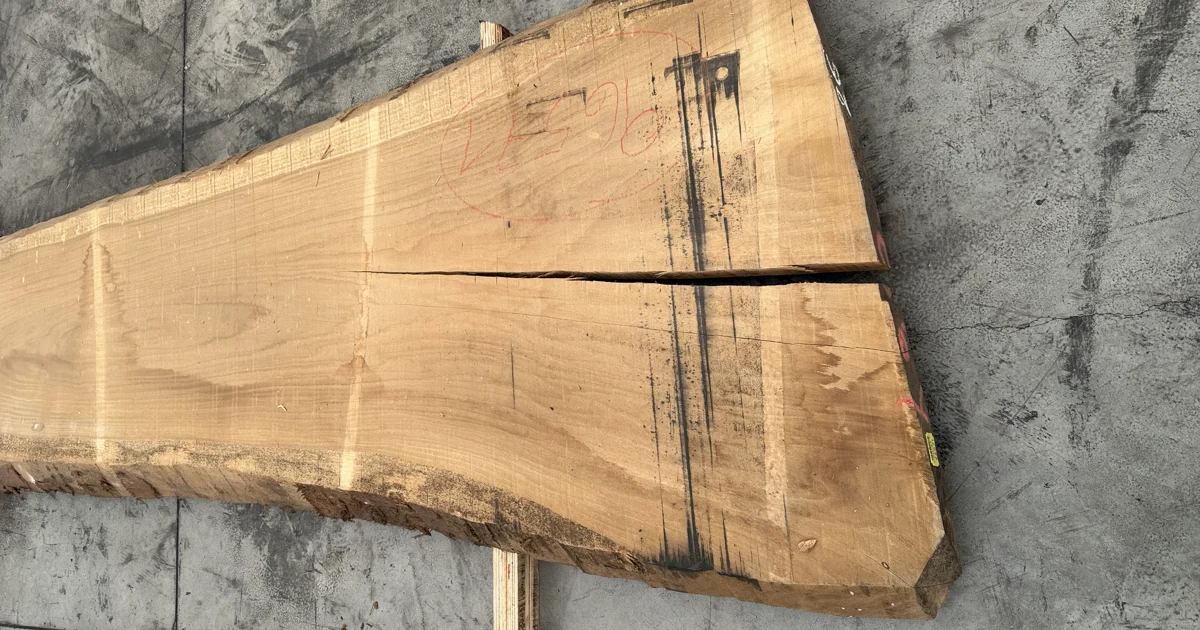
Start from the room, then the seats#
A dining-table slab should be sized from the room inward. The slab can be beautiful and still be wrong if chairs scrape the wall or if the end seats cannot be used. Start with the clear rectangle available for the finished table, then work back to the slab you need.
As a working rule, allow about 90 cm from the table edge to a wall, cabinet or fixed bench. That gives room to pull a chair back and pass behind it. In a tight flat, 75 cm may be workable for occasional use, but it feels tight and makes service awkward. If there is a doorway, a radiator, a sideboard or a walkway behind chairs, keep the 90 cm target.
For places along the long sides, allow 60 cm of width per person. That is a practical setting with plate, cutlery and elbows. Larger chairs or armchairs need more. End seating needs depth as well as width, so check the base position and leg clearance before counting it as a full place.
When you browse dining-table slabs, compare the listed length with the table you can actually use in the room, then check whether the live edge gives enough usable width at the narrow points.
Seat count to table length#
Once the room gives you a maximum length, use seat count as a sanity check.
For four seats, a finished table of about 1.2–1.6 m works. That covers two per side, or four around a compact rectangle. For six seats, plan about 1.8–2.2 m. For eight seats, 2.4–3.0 m is the usual zone. For ten seats, 3.0 m plus is where the table starts to feel natural rather than crowded.
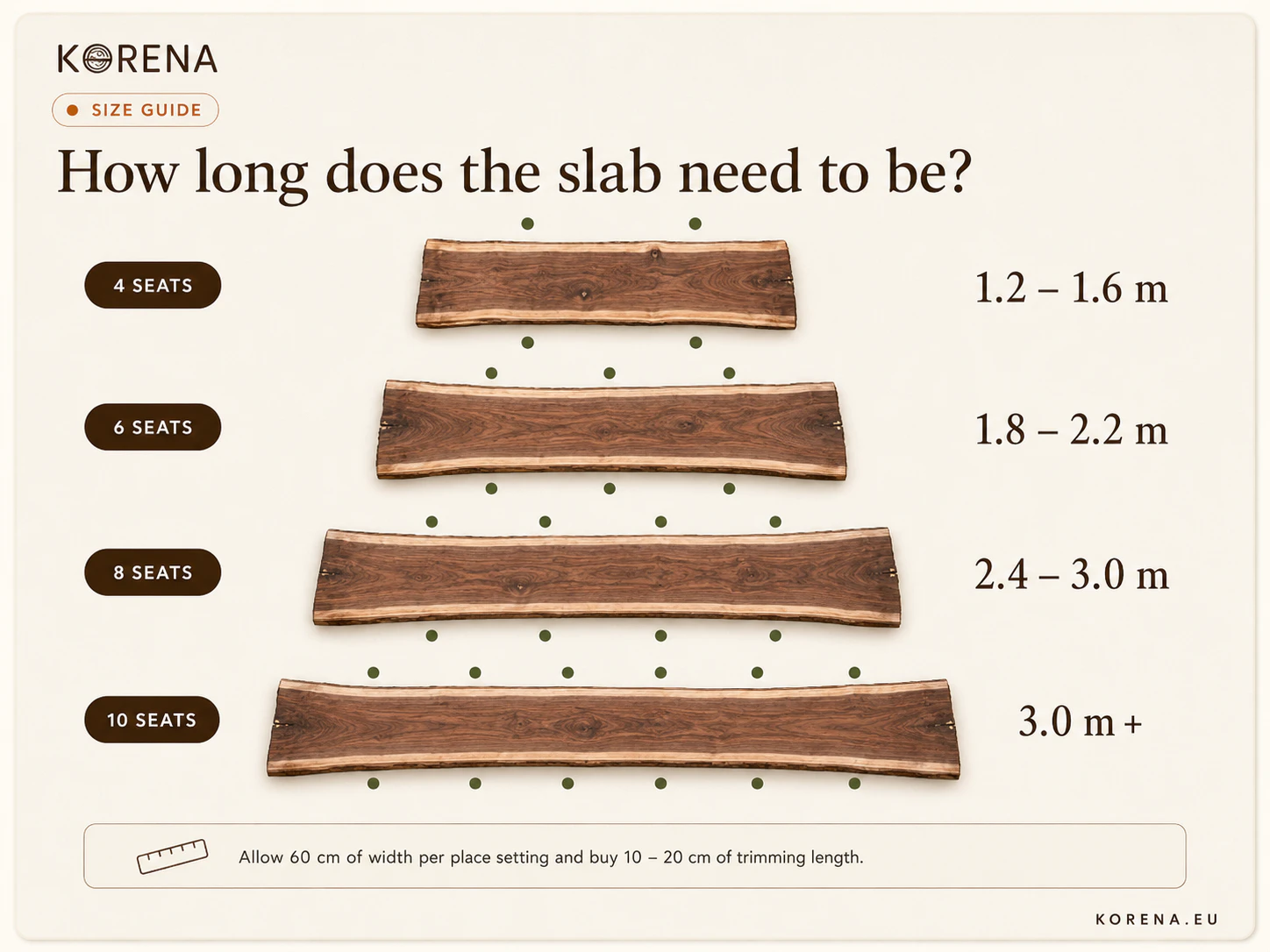
These numbers assume 60 cm per setting along the sides. A 2.4 m table can seat eight as three per long side plus one at each end. A 3.0 m table can seat eight with more elbow room, or ten when the ends are usable and the chairs are not bulky. In the current KORENA catalogue, a 3 m slab sits in that eight to ten seat band if the width and base design support it.
Do not count every centimetre of slab length as finished table length. Ends may need trimming, and a live edge may narrow near one end. The listing length is the raw piece measurement, not a promise that every part becomes the finished show face.
Width: what feels right#
The comfortable width for most dining tables is 75–100 cm. Below 75 cm, plates can work, but shared dishes and place mats start to compete. Around 80–90 cm is useful for smaller rooms. Around 95–100 cm feels more generous and gives a central strip for serving dishes, candles or a low arrangement.
Live-edge slabs are different from rectangular boards because width changes along the length. That is why a KORENA listing shows width stations at 25, 50 and 75 percent of length, with the measured outline. The headline width can be tempting, but the narrow waist decides how two diners opposite each other will actually fit. If the slab is 95 cm at one station and 72 cm at another, design around the 72 cm zone unless you plan to trim around it.
For online buying, look at the measured outline before the photograph. Photographs show figure, colour and edge character. The outline tells you where plates, chairs and the base will land. If you are planning a rectangular top from a live-edge piece, ask how much width is lost when the edge is straightened.
Thickness and overhang#
Thickness changes the visual weight and the engineering. A 50 mm slab reads lighter, especially in European walnut. It suits a dining table where the base is refined and the top should not dominate a smaller room. The current walnut stock is 50 mm thick, kiln-dried, around 3.0–3.4 m long and around 0.5–0.65 m wide, with recent moisture readings from about 6.5 to 11 percent and prices from about 180 EUR net. That can make an elegant narrow table, desk-table hybrid or wall-side dining piece.
Oak at 70–90 mm reads far heavier. It has the presence for a wider family table or a table with a simple trestle or metal base. Current European oak pieces are around 3.2–3.3 m long, up to about 1.0 m wide, 70–90 mm thick, with an example around 490 EUR net for a 3.3 m piece.
Listed thickness is before final surfacing unless the listing says otherwise. Flattening removes material. The finished thickness depends on cup, twist, machining and the maker's target. If a 50 mm listed slab must be flattened hard, the finished top may be thinner than expected. Ask the maker how much they expect to lose before committing to base proportions.
Overhang is a design and structural question, not a fixed number. Small overhangs keep the slab calm and reduce force on the base. Long end overhangs can look good, but they need a base with enough stance and, for some species or cuts, discreet reinforcement. For heavy 70–90 mm oak, moving the base is harder once built. Decide the chair positions and base footprint before ordering steel or timber legs.
Trimming allowance#
Buy longer than the finished table. A practical allowance is 10–20 cm beyond the desired finished length, and more if the ends have visible checks, splits, handling damage or a shape you want to remove. End checks can run farther than they first appear. Your maker may also want a clean square reference for flattening and routing.
Example: if the target table is 2.8 m, look for a slab around 2.9–3.0 m rather than exactly 2.8 m. For a 3.0 m finished table, a 3.2 m piece gives the maker more choice at both ends. On a live-edge slab, that allowance can also help position the best figure in the centre of the table rather than losing it to a cut line.
Trimming allowance is one reason slab buying works best as a conversation between buyer and maker. Send the listing, the room dimensions, the intended seat count and the base sketch. A good maker can tell you whether the raw length has enough margin before anyone spends money on transport.
Matching a real slab to the numbers#
KORENA is useful here because each slab is measured as an individual piece. Listings show the measured outline, length, width stations at 25, 50 and 75 percent, thickness, moisture reading, drying method and a precision badge, typically within 10 mm. I measure the pieces myself in the partner yards, so the listing is based on the slab in front of the capture system rather than a batch description.
If you want a narrow, elegant eight to ten seat table, the ten European walnut slabs are the first check. They are 3.0–3.4 m long, about 0.5–0.65 m wide, 50 mm thick and kiln-dried, with recent moisture readings from about 6.5 to 11 percent. The length works for eight to ten seats, but the width is narrow for a conventional family table. That can be the right choice in a long room, a studio dining area or a table intended to leave clear circulation. Read the European walnut slab buying guide for species-specific buying checks.
For a wider dining table, the six European oak slabs are more direct candidates. They are around 3.2–3.3 m long, up to about 1.0 m wide and 70–90 mm thick. At that width, opposite place settings and shared dishes are easier. The trade-off is weight and visual mass, so the room and base need to suit the thickness. The European oak slab buying guide covers the checks that matter for oak.
The four Saman slabs sit in a different scale, up to 4.76 m long and over 1.1 m wide. That is boardroom or very large dining room territory. Saman can solve a long-table brief, but transport, access, flattening and the base become serious constraints. Check stair turns, door openings and workshop capacity before treating the length as usable.
Use the species guides when colour, movement, edge shape and finishing behaviour matter as much as length. For process, the wider buying workflow is covered in How to buy a hardwood slab in Europe.
If a listing gives moisture around 7–8 percent, that is a useful sign for indoor furniture, but storage still matters. Let the maker confirm acclimatisation before final flattening.
Quick reference table#
Use this as a first filter, then confirm the measured outline and width stations.
| Seats | Finished table length | Finished table width | Slab buying note |
|---|---|---|---|
| 4 | 1.2–1.6 m | 75–85 cm | Compact dining, check chair pull-out in small rooms. |
| 6 | 1.8–2.2 m | 80–90 cm | Most flexible domestic size, still needs 90 cm clearance. |
| 8 | 2.4–3.0 m | 85–100 cm | A 3.0 m slab can seat eight with comfort, ten if ends work. |
| 10 | 3.0 m plus | 90–100 cm plus | Check base stance, end overhang and access before buying. |
Before checkout, write down four numbers: room width, room length, desired seats and maximum finished table size. Then compare them with the slab length, width stations, thickness and trimming allowance. If those numbers agree, the rest of the decision becomes species, figure, edge and budget rather than a sizing gamble.