Juglans hindsii
Claro Walnut
California's figured walnut, and the wildest figure in the walnut family. Graft unions between English walnut and Hinds rootstock produce violet, gold and marbled patterns no other walnut can match.
Premium import, sourced outside EuropeFamily: Juglandaceae
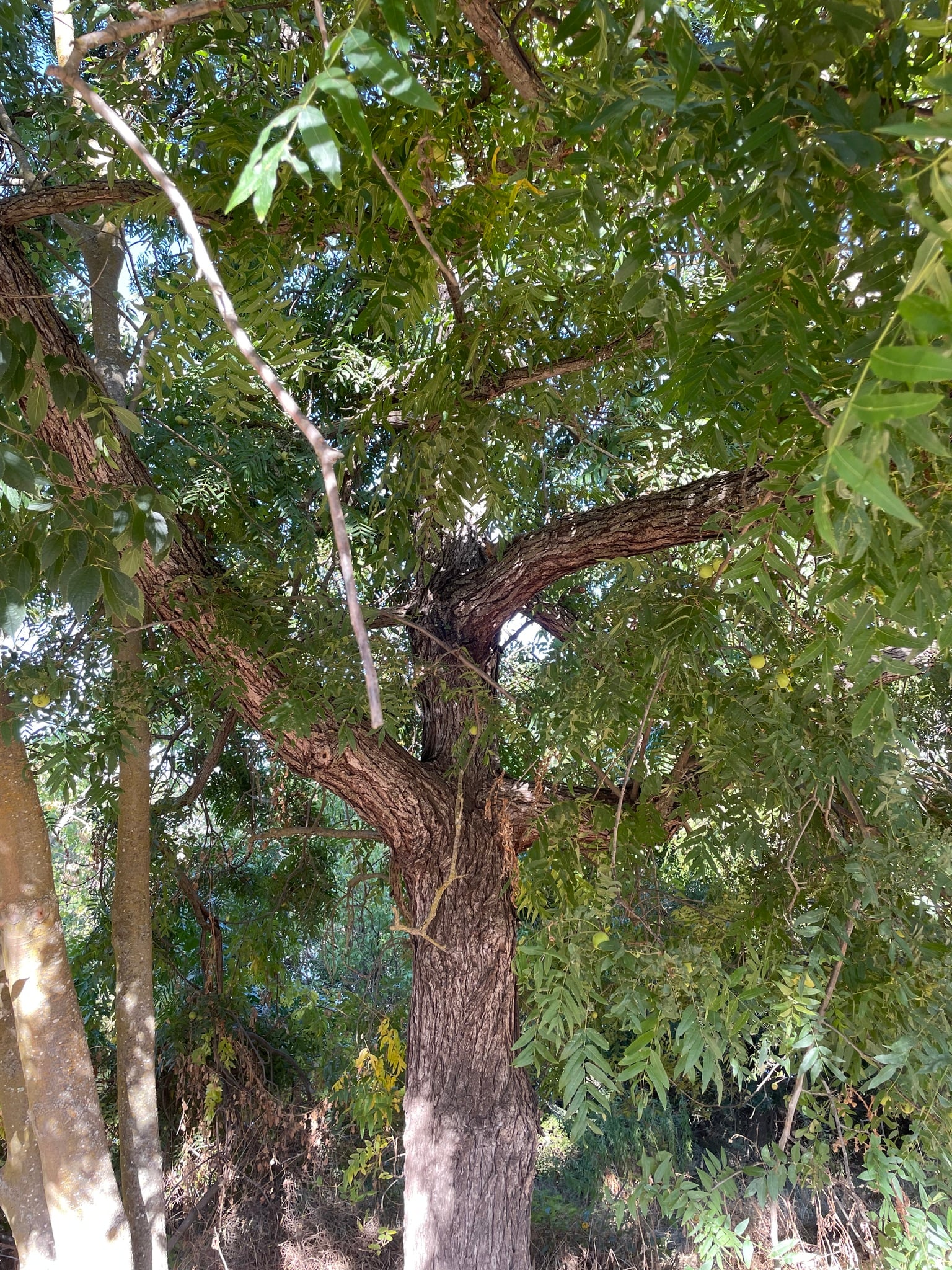
Tree
Native to Northern California, not Europe. Claro reaches EU yards as imported tablestock and slabs, usually cut from orchard trees where Juglans regia was grafted onto Juglans hindsii rootstock for nut production. The graft union, root crown and crotch sections carry the figure that makes this wood sought after. Stocks in Europe are limited and lot-driven, what arrives is what was milled.
Wood appearance
Heartwood ranges from chocolate brown to purple-grey, often streaked with violet, gold and reddish tones. Sapwood is pale cream and usually contrasts sharply. Figure is the headline: fiddleback, marbled, feathered crotch, and dense burl clusters are common in graft-figured boards. Grain is typically straight in clear sections but wild around figure. Medium texture, satin natural lustre.
- Chocolate-brown to purple-grey heartwood
- Violet, gold and reddish streaking
- Pale cream sapwood with sharp contrast
- Fiddleback, marbled and crotch figure common
- Often heavily figured; prized for slabs.
Mechanical properties
| Density (kg/m³) | 600–680 kg/m³ |
|---|---|
| Janka hardness (N) | 4,700–5,400 N |
| Radial shrinkage | 4.0–4.7 % |
| Tangential shrinkage | 6.0–7.0 % |
| Volumetric shrinkage | 10.2–11.2 % |
| Natural durability (EN 350) | Class 2 — Durable |
Working with it
1 = difficult · 5 = excellent
Works well by hand and machine across sawing, planing, sanding, turning and carving. Glues and screws without drama. Wild grain around figure and burl tears out easily, back off feed rates, use sharp tooling, and finish-sand rather than hand-plane figured zones. Steam-bending is moderate at best; not the wood for tight curves. Note: published laboratory data for Claro is limited. No reliable MOR or MOE figures exist. For structural calculations, treat mechanical properties as broadly comparable to Black Walnut (Juglans nigra) and design with that proxy in mind.
- Sawing
- Planing
- Sanding
- Turning
- Carving
- Gluing
- Screw / nail hold
- Steam bending
Drying
Dries at a moderate rate. Shrinkage is moderate (radial 4.0–4.7%, tangential 6.0–7.0%, volumetric 10.2–11.2%) with a tangential-to-radial ratio around 1.5, manageable, but figured and crotch sections can check or honeycomb if pushed. Slow kiln schedules and weighted stickering are standard for slab stock. Acclimatise indoors for several weeks before machining.
Finishing
Takes oil, hardwax and lacquer cleanly. Oil finishes deepen the violet and gold tones and lift the chatoyance in fiddleback areas, worth a sample board before committing. Sand to 180–220 grit; going finer can close the surface and dull the figure. Open pores will show under high-build finishes, so grain-fill if a glass-flat surface is required.
Durability and safety
- Class 2 — Durable
- Food contact safe
- Dust irritant: wear PPE
Walnut dust contains juglone and is a known respiratory and skin sensitiser. Use extraction at the source, wear an FFP3 mask when sanding, and keep offcuts away from horses and dogs, juglone is toxic to both. Cured finished surfaces are food-contact safe.
Best uses
- Heirloom dining tables
- Statement live-edge slabs
- Executive desks
- Gun stocks
- High-end cabinetry feature panels
Pairs and substitutes
Pairs well with
Often substituted for
Sourcing and sustainability
- Premium import, sourced outside Europe
- IUCN: LC — Least Concern
IUCN Least Concern, no CITES listing. EN 350 durability class 2 (durable) in heartwood; sapwood is not durable and is not rated for ground contact. Most Claro on the European market comes from Californian orchard culls and salvage rather than forest harvest, which suits the figured-tablestock trade. EUDR due diligence is in preparation and becomes mandatory for large operators from 30 December 2026, and KORENA is building each slab passport to carry origin, species, and supplier provenance.
What Claro Walnut actually is#
Juglans hindsii is the northern California black walnut, and it produces the most dramatic figure in the walnut family. Its reputation rests on something that is not really a property of the species at all.
Claro is widely used as rootstock for English walnut, Juglans regia, in Californian orchards. Where the two species are grafted together, the grain at the union becomes violently disrupted, producing marbled patterning in violet, gold, orange and near black that neither species shows on its own.
Slabs cut through or near that graft union carry figure no other walnut can match, and they are priced accordingly. Plain Claro away from the union is a good walnut; graft figured Claro is a different proposition entirely.
The missing numbers#
Density at 640 kg per cubic metre and Janka hardness at 5,030 N are sourced and displayed on the species record. Modulus of rupture and elastic modulus are not shown, and that is deliberate.
Published laboratory data for Claro is limited, and no reliable MOR or MOE figures appear in the references KORENA cites. Borrowing values from Juglans nigra or Juglans regia and presenting them as Claro would produce a page that looks complete and specifies a wood that was never tested.
The practical consequence: do not use Claro where a calculated load path depends on assumed stiffness or bending strength. For a tabletop, a cabinet or a decorative slab, which is what this species is actually for, the missing figures do not constrain the decision.
Reading a Claro slab#
Colour variation is the signature. A single slab can run from pale gold through orange and red brown to near black, often with sharp transitions rather than gradual ones.
Sapwood is pale cream and usually left in place on a live edge slab.
Look specifically for the graft line if the slab was cut from a grafted tree. It shows as a zone of chaotic, swirling grain, sometimes with a visible colour boundary, and it is the most valuable part of the board.
Because Claro is an orchard tree, expect irregular form, frequent inclusions and character. Clean straight plain material exists but is not what the species is sought for.
At the bench#
At 5,030 N it is harder than black walnut and moderately demanding on tooling, though nothing like robinia or hornbeam.
Figured and graft material tears out badly. The grain in a graft zone has no consistent direction at all, so no planing orientation works. Light cuts, very sharp tooling, and a scraper or high angle plane for the final surface. On material this valuable, hand finishing is the sensible default.
Voids, bark inclusions and checks are common in graft and crotch sections, and epoxy filling is a normal part of finishing this species rather than a repair.
It glues and finishes well, and oil finishes deepen the colour and lift the chatoyance in figured zones considerably.
The juglone issue#
Claro is a walnut and carries the same juglone content as its relatives. It is a documented sensitiser, with skin and respiratory irritation reported, and some woodworkers sensitise over repeated exposure.
Run extraction and wear a mask. Shavings are toxic to many plants, must not go into mulch or compost, and must never be used as animal bedding, particularly for horses.
Fading#
Claro lightens with light exposure, as all walnuts do.
The effect is more consequential here than in a uniform walnut, because Claro's appeal is its colour range. As the darkest zones lighten, the contrast across the slab softens. The figure remains; the drama moderates.
Plan for the piece the slab becomes.
Stability#
Volumetric shrinkage of 10.2 percent is low for this catalogue, with tangential at 6.0 percent against radial at 4.0 percent, a narrow differential. Claro is dimensionally well behaved, which matters because it is usually used in wide single slab form.
Decay class 2 makes it durable, though it is far too valuable to use outdoors.
Where Claro Walnut is the right answer#
Live edge tabletops, decorative slabs, cabinet fronts, turned work and any piece where figure and colour carry the design entirely.
It is the wrong answer where consistency across boards is needed, where a full engineering specification is required, and where the budget is not built around a feature timber.
Sourcing and EUDR#
Not CITES listed and assessed as Least Concern. Native to northern California, so European buyers are importing, with a longer documentation chain and higher transport carbon. Supply comes largely from orchard removal rather than forestry. Where a European alternative is acceptable, figured Juglans regia offers comparable drama with a much shorter chain.
Buyer questions
What makes Claro Walnut figure so dramatic?
Much of it comes from graft unions. Claro is widely used as rootstock for English walnut orchards, and where the two species join, the grain becomes violently disrupted, producing marbled violet, gold and dark brown patterning that neither species shows alone. Slabs cut through that union carry figure no other walnut can match.
Why are no MOR or MOE figures listed?
Published laboratory data for Claro is limited and no reliable modulus of rupture or elastic modulus values exist in the references KORENA cites. Rather than borrow figures from Juglans nigra or regia and label them Claro, those fields are left empty. Density at 640 kg per cubic metre and Janka at 5,030 N are sourced and shown.
How does it compare with Black Walnut?
Claro is harder at 5,030 N against 4,490 N and considerably more variable in colour, running from pale gold through orange brown to near black, often within a single slab. Black walnut is more uniformly chocolate. Claro is bought for figure and colour variation; black walnut for consistency.
Is walnut dust a hazard?
Yes. Walnut contains juglone and is a documented sensitiser, with skin and respiratory irritation reported. Run extraction and wear a mask. Shavings are toxic to many plants and must never be used as animal bedding, particularly for horses.
Does it fade like other walnuts?
Yes. Like Juglans regia and nigra it lightens with light exposure rather than darkening, mellowing toward a warmer, lighter brown and softening the contrast between the darkest and lightest zones. A UV inhibiting finish slows it without stopping it.
Current stock
No Claro Walnut in the current drop
This species is in the KORENA reference list, but there are no live pieces for the selected store right now. Check the journal or catalogue for nearby alternatives.
Get notified about Claro Walnut
We email you when fresh Claro Walnut slabs land at KORENA. Each piece is one of one, so early notice matters.
Sources
- The Wood Database(accessed 2026-05-09)
- USDA FPL Wood Handbook FPL-GTR-190 (2010)(accessed 2026-05-09)
- Meier, E. — WOOD! Identifying and Using Hundreds of Woods Worldwide (2015)(accessed 2026-05-09)