Finishing
Board butter vs oil: do you need both?
Oil dry wood first, then add a thin beeswax balm for a water-resistant satin surface, using the wood's appearance and water beads as your guide.
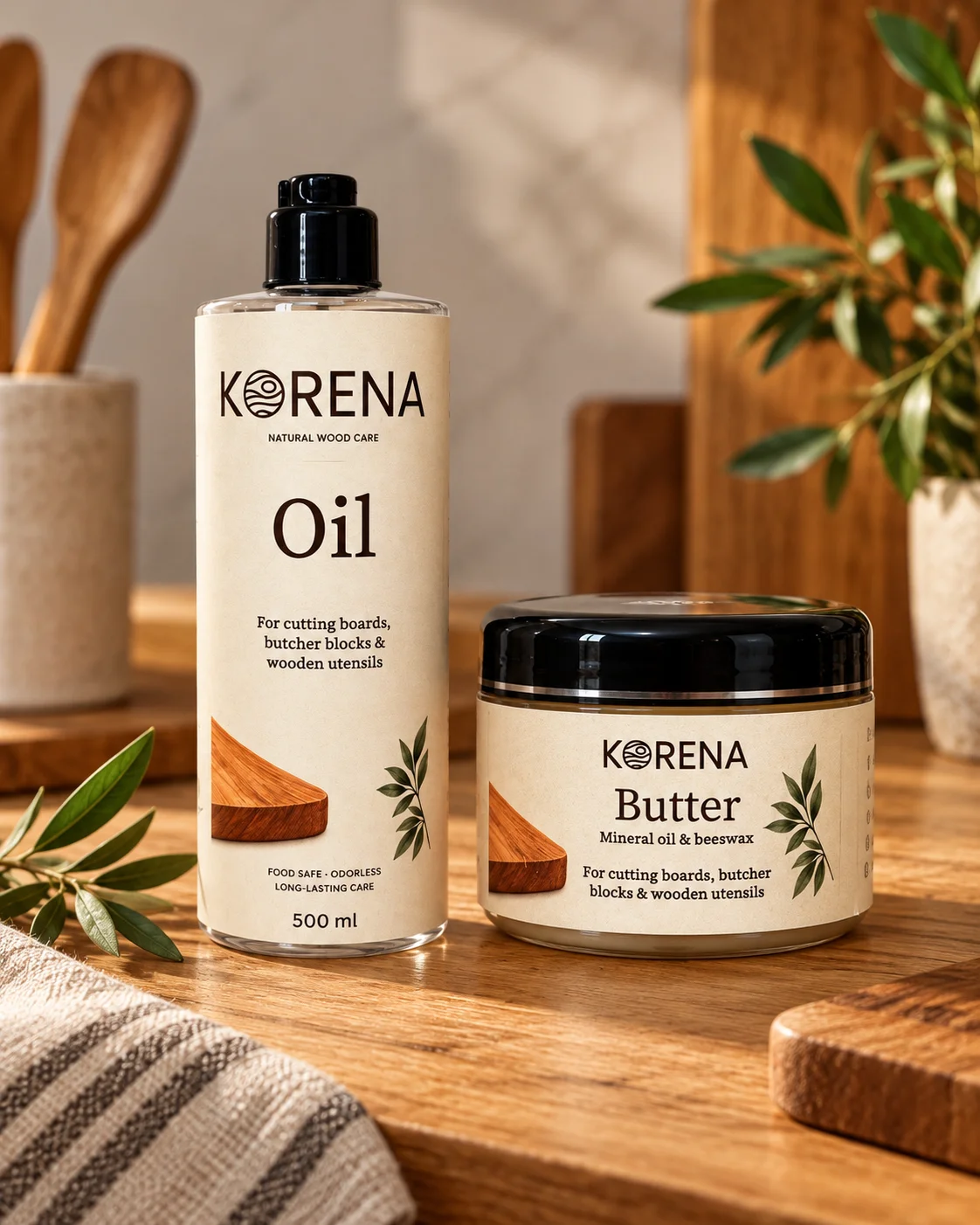
You do not need both for every treatment: oil dry wood first, then use board butter if you want a water-resistant satin finish on the surface. Butter is the follow-up step in the complete routine. A pale, thirsty board needs oil before its thin balm layer.
The two products are easy to confuse because a board butter also contains oil. Think about the condition you are treating. Dry-looking wood and a surface that no longer beads water are separate observations. They can occur together, but they do not always ask for the same next step.
What does oil do, and what does butter do?#
Mineral oil is spread over exposed wood and given time to absorb. A board balm combines oil with beeswax and is worked on thinly, then buffed for a water-resistant satin finish. The wax gives the second step its surface role. Water-resistant does not mean the board can be left soaking.
| Question | Board oil | Board butter |
|---|---|---|
| What is its place in the routine? | First on pale or dry wood | After oiling and wiping |
| How is it applied? | With a cloth on every face and end grain | In a thin layer, then buffed |
| What tells you to renew it? | Wood looks pale, grey or dry | Water stops beading on the surface |
| What is in the KORENA product? | 100% purified white mineral oil | 80% mineral oil and 20% beeswax by weight |
| What is the final step? | Wipe off all excess | Buff off all excess |
Neither product repairs a broken joint or fills a deep crack. If you find damage while inspecting the board, pause the finish routine and use the restoration guide to distinguish surface dryness from something needing repair.
What is inside a board butter?#
“Board butter” describes a balm, not a universal recipe. Check the ingredients rather than assuming every jar has the same blend. KORENA Butter is a 150 ml jar containing 80% pharmaceutical-grade white mineral oil and 20% yellow beeswax (E901), by weight. It has no added fragrance or colour.
The proportions are by weight, so do not read them as a volume recipe. You do not need to mix or dilute the finished balm. Take a little on a clean cloth, spread it thinly and work it over the wood. Finish by buffing. KORENA Butter is food safe once buffed; leaving a thick smear on top is not the intended finish.
Which should go on a pale or dry board first?#
Start with oil. Wash with mild soap and warm water, then let the board dry completely. Work oil along the grain on both broad faces, every edge and the end grain. Leave it at least 20 minutes, or overnight for a new or very dry board. Wipe off all excess before applying balm.
KORENA Oil is 500 ml of 100% purified white mineral oil of pharmaceutical grade (Ph. Eur.). It is clear, odourless and tasteless, with no added fragrance or colour. It does not go rancid. It is food safe once the excess is wiped off.
Do not try to solve very dry wood by laying on more butter. Follow the oiling guide first. For a new unfinished board, that means three or four oil treatments in its first week. Once oil has absorbed and the excess is removed, a thin balm layer can finish the sequence.
How does the water-bead test work?#
Put a few drops of water on the clean board and watch them briefly. Do they hold together as beads, or spread over the surface? Wipe the water away straight afterwards. Do not leave a puddle sitting while you attend to something else.
When water stops beading, renew the thin layer of butter. Before doing so, inspect the wood. If it also looks pale or feels dry, oil first, wipe and then apply balm. If it looks well cared for and only the beading has changed, a thin balm renewal can be the next step.
This is a practical maintenance cue. It does not prove anything about food-contact suitability or the condition inside a crack. Keep the test small, and do not turn it into a soaking test. Always check the board's own care instructions if it has a finish other than this oil-and-balm routine.
How much should you apply?#
Oil needs enough coverage to reach every face and the end grain. The balm needs a thin layer you can buff to a satin surface. Those are different application goals. Using a thick layer of balm does not compensate for missed edges or an unoiled underside.
There is no fixed number of applications per bottle or jar. A large butcher block, a small spoon and a very dry board take different amounts. Work steadily around the object rather than measuring the routine against a promised count. After buffing, check corners, handles and grooves for any visible build-up and remove it with the cloth.
How do you maintain the finished board?#
Oil about once a month, or when the wood looks pale or dry. Add butter after oiling when you want the surface finish, or renew it when water stops beading. Wash with mild soap and warm water, dry completely before care and keep the board out of the dishwasher. Never leave it soaking.
Use this sequence on unfinished or oiled cutting boards, butcher blocks, bowls, spoons and wooden utensils. It is not for varnished or lacquered wood. KORENA Set brings the 500 ml oil and 150 ml balm together in one box if you want both steps. The wood care range also lets you choose the product that matches the board's current condition.
Frequently asked questions#
Do I need board butter if I already use mineral oil?#
Board butter is optional if you want a water-resistant satin surface after oiling. Oil first when the wood looks pale or dry, wipe off the excess, then apply the balm thinly and buff with a clean cloth.
Can board butter replace oil on a dry cutting board?#
A very dry board needs the oiling step first. Wash and dry it completely, oil every face and the end grain, let it absorb and wipe off excess before adding a thin balm layer for the surface finish.
Do you put board butter on before or after oil?#
Put it on after oil has absorbed and you have wiped off the excess. Spread only a thin balm layer and buff it with a clean cloth; do not apply it over a wet pool of oil or leave thick patches in grooves.
How do I know when to use board butter again?#
Place a few drops of water on the board and wipe them away after checking. When water stops beading, renew the thin balm layer; if the wood also looks pale or dry, complete the oiling step first.
Is beeswax board butter food safe?#
KORENA Butter is food safe once buffed. Its blend is 80% pharmaceutical-grade white mineral oil and 20% yellow beeswax (E901), by weight, with no added fragrance or colour; check other balms separately.