Finishing
Best oil for cutting boards: how the main options compare
Purified mineral oil suits regular board care; compare it with cooking oils and curing finishes before choosing what goes on your kitchen wood.
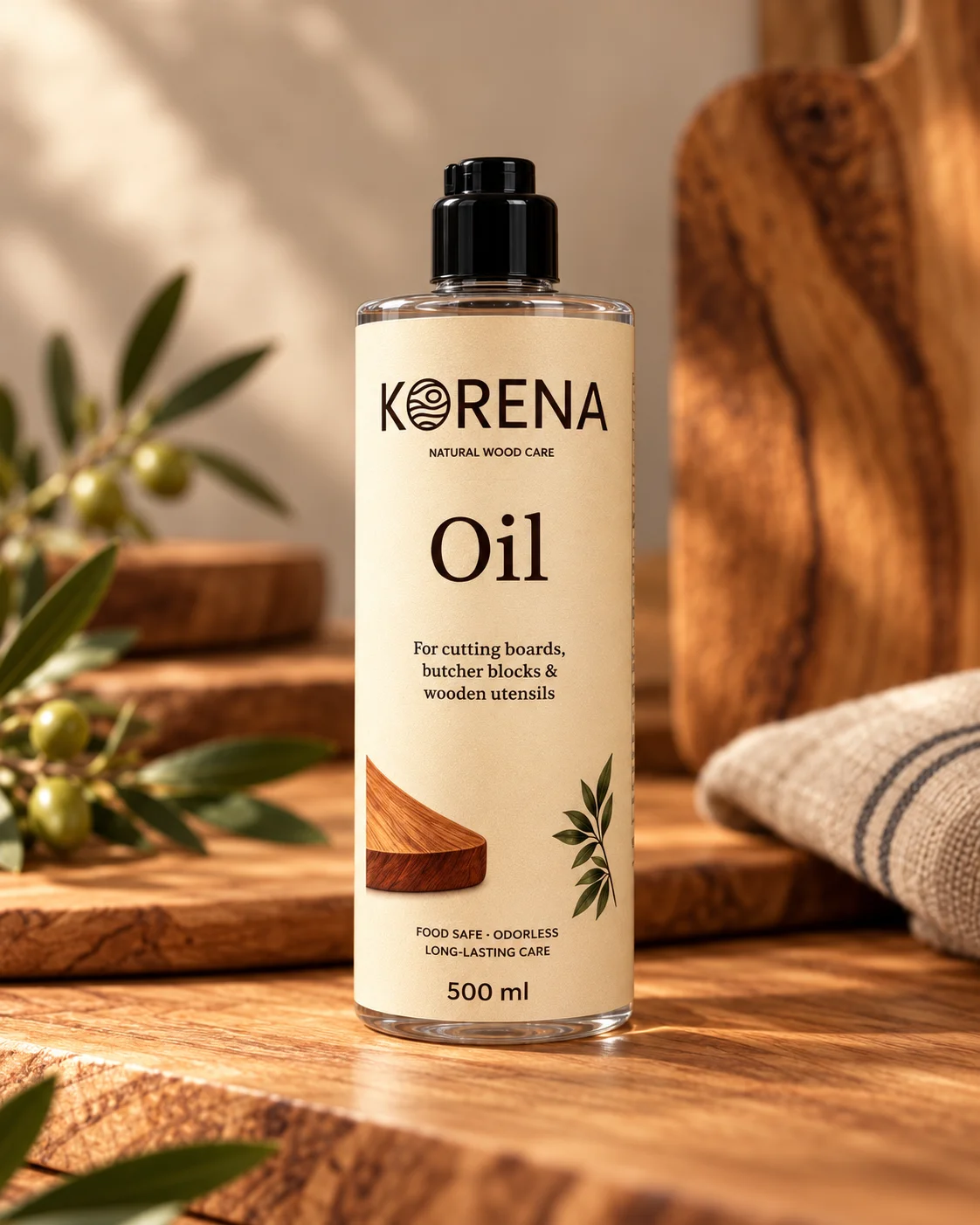
Purified white mineral oil intended for wooden kitchenware is a practical choice for unfinished or oiled cutting boards because it does not go rancid and is easy to renew when the wood looks pale or dry. Choose the product by its ingredients, grade and intended use. The word “oil” alone tells you very little about what is in the bottle.
Olive oil, sunflower oil, mineral oil, linseed oil and tung oil do different jobs. Some are kitchen ingredients. Some are used in curing wood finishes. Before comparing them, check the board's existing finish: a maintenance oil for exposed wood is not the same as a finish applied when making a board.
How do the main oils compare?#
The table separates routine board care from choosing a curing finish. “Food safe once wiped” applies to the specified board-care mineral oil, rather than every product sold under the same ingredient name.
| Oil | Rancidity and odour | Does it cure? | Food contact after application | How to renew |
|---|---|---|---|---|
| Purified board-care white mineral oil | Does not go rancid; KORENA Oil is odourless | Non-drying; does not cure into a hard finish | KORENA Oil is food safe once excess is wiped off | About monthly, or when pale or dry |
| Olive oil | Can go rancid; cooking aroma varies | Not a reliable curing board finish | Edible oil does not make it a suitable lasting wood treatment | Avoid for this routine |
| Sunflower oil | Can go rancid; aroma varies | Not a substitute for a specified curing finish | Edible oil does not make it a suitable lasting wood treatment | Avoid for this routine |
| Linseed oil | Depends on formulation and condition | A drying oil used in curing finishes | Check exact product, intended use and full cure instructions | Follow the finish maker's instructions |
| Tung oil | Depends on formulation and condition | A drying oil used in curing finishes | Check exact product, intended use and full cure instructions | Follow the finish maker's instructions |
The US Forest Products Laboratory's Wood handbook finishing chapter identifies linseed and tung as drying oils. That distinction explains why their treatment steps differ from mineral oil's soak-and-wipe routine.
Why does a non-drying oil suit everyday boards?#
A board that is used, washed and dried regularly needs care you can repeat without rebuilding a cured finish. Mineral oil is worked into clean, completely dry wood, left to absorb, then wiped. There is no hard film to aim for in this routine. A shiny wet patch is excess to remove, rather than evidence that you have finished well.
KORENA Oil contains 500 ml of 100% purified white mineral oil of pharmaceutical grade (Ph. Eur.). It is clear, odourless and tasteless, with no added fragrance or colour. Those are useful properties on boards, bowls and spoons: the product does not add a cooking aroma to your wood. The mineral oil and food-contact guide explains the grade and the final wiping step.
Use it on unfinished or oiled wood, covering every face and the end grain. Leave at least 20 minutes, or overnight for a new or very dry board, then wipe off the excess. The full oiling guide shows the sequence, including three or four treatments in a new board's first week.
Why avoid olive and sunflower oil for this job?#
Their availability in the cupboard makes them tempting. But an oil that belongs in a meal is not automatically the right treatment for wood that will be used and washed repeatedly. Olive and sunflower oil can go rancid. Purified mineral oil does not.
Choose the care product before starting rather than using whatever is beside the cooker. For a board already treated with cooking oil, wash it, let it dry completely and check for lingering odour or an uneven surface. Another oil will not necessarily remove old smells or stains. If the wood still looks dry, assess its condition with the restoration guide.
What should you check with linseed or tung oil?#
Look at the complete formulation and the maker's intended use. A product name can describe one ingredient without describing everything in the container. A finishing blend may include other components, so do not transfer a food-contact claim from one product to another.
For a curing finish, follow its preparation, application and full curing instructions. Wiping excess away is not the same as completing a cure. If your board already has such a finish, maintain it according to those instructions rather than assuming the monthly mineral-oil routine applies. Our food safe finish glossary explains why suitability belongs to a particular finish and its correct application.
When might hardwax oil make sense?#
A hardwax oil may make sense when you are choosing a specified curing finish for a wooden surface and have instructions that cover its intended use. Treat that as a finishing decision. Check what the surface is used for, how it will be cleaned and what maintenance the maker requires.
For an unfinished or mineral-oiled chopping board, the simpler repeatable routine is oil, absorption and wiping. If you want extra surface water resistance, follow with a thin board balm and buff it; our board butter comparison explains the extra step. Neither route makes soaking or dishwasher cleaning appropriate for the board.
How do you choose without overcomplicating it?#
Read three things: ingredients, grade and intended surface. Then check the instructions for the final usable condition. Avoid scented, coloured or technical oils whose intended use is unrelated to kitchen wood. Do not use mineral oil on varnished or lacquered boards.
For regular care, choose a clearly described board-care mineral oil and watch the wood rather than counting treatments from a bottle. There is no fixed number of applications: size and absorbency vary. KORENA Oil fits that routine; the wood care category puts it beside the balm for those who also want a satin finish.
Frequently asked questions#
What is the best oil for a wooden cutting board?#
Purified white mineral oil intended for wooden kitchenware is a practical choice for unfinished or oiled boards. It does not go rancid; KORENA Oil is odourless and food safe once the excess is wiped off.
Can I use olive oil on a cutting board?#
Avoid olive oil for regular board care because it can go rancid. Choose a mineral oil intended for wooden kitchenware, apply it to clean and completely dry wood, then let it absorb and wipe off the excess.
Is sunflower oil good for wooden cutting boards?#
Sunflower oil can go rancid, so it is not a good choice for this maintenance routine. A specified board-care mineral oil is easier to renew: cover all faces and the end grain, let it absorb and wipe away excess.
Can I use linseed or tung oil on a cutting board?#
Check the exact formulation and its stated use before choosing either as a finish. Both are drying oils, so follow the product's full curing instructions; the mineral-oil soak-and-wipe routine does not apply to them.
Is any mineral oil suitable for a cutting board?#
No. Read the grade, ingredients and intended use rather than choosing by the name alone. Use a product described for wooden kitchenware; do not substitute an industrial or technical oil with an unrelated purpose.