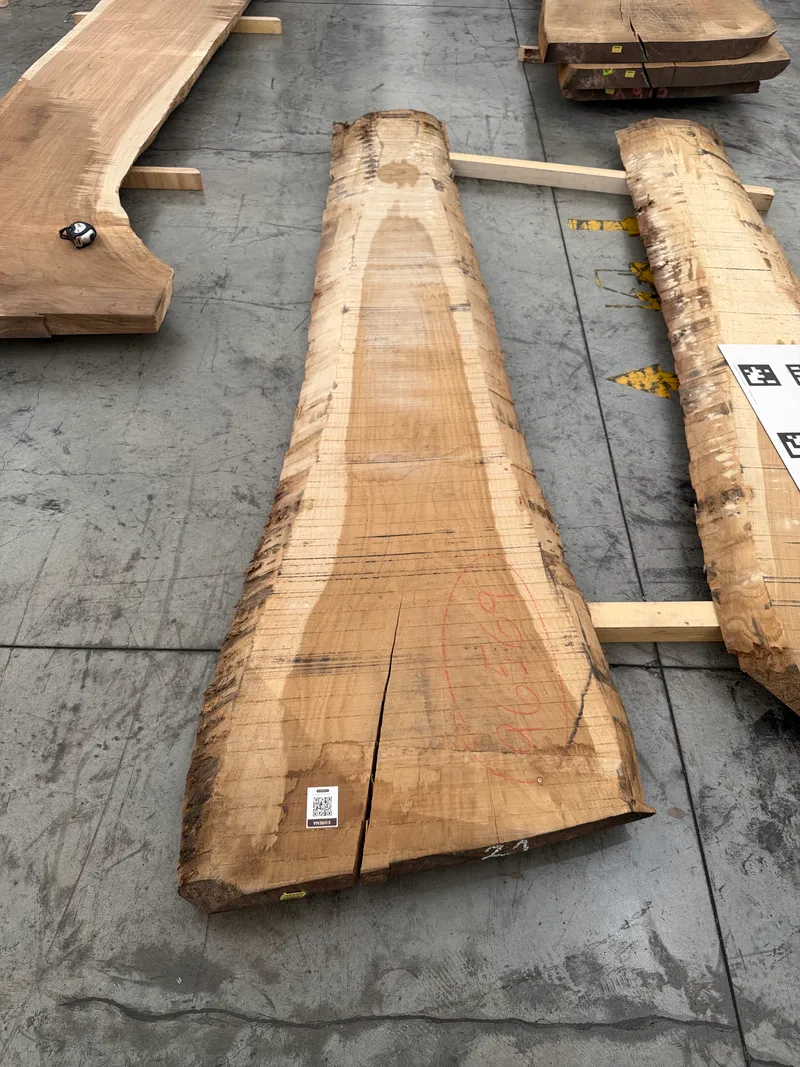
Quercus robur
The default European hardwood for furniture, joinery and architectural slabs. Open grain, calm colour, predictable behaviour at the bench.
Aspect du bois
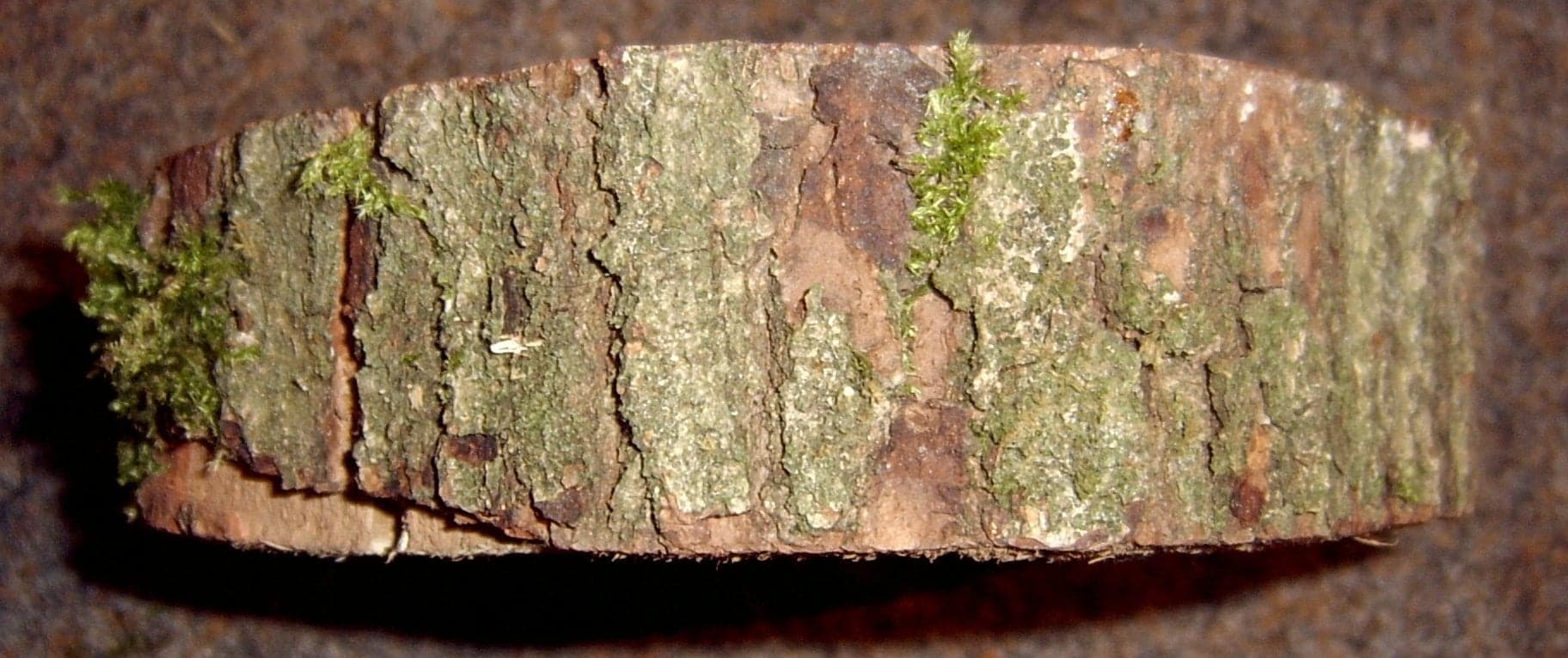
Pale tan to mid-brown heartwood, often with an olive cast, sitting against narrow cream sapwood. Grain is straight and the texture is coarse, with large open pores in the earlywood. Quartersawn faces show pronounced ray fleck, silvery, ribbon-like figure that is a signature of the species and of Mission and Arts and Crafts work.
Travail du bois
Works predictably with sharp tooling. Saws and sands well; planing can tear out around rays and interlocked patches, so take light cuts and back off the cutter angle on figured stock. Glues and screws hold reliably, though pre-drilling is sensible near ends. Steam-bends well, which is why it has been a chair and boat-frame timber for centuries.
Takes oil, wax, lacquer and water-based finishes cleanly. Hardwax oils sit particularly well on the open pores and keep the surface repairable. Oak reacts strongly to ammonia fuming, which drives tannins to deep chocolate browns without pigment, and to iron-vinegar ebonising for near-black tones. Fill the grain if you want a glass-flat film finish; leave it open for a tactile, matte surface.
Dries slowly and is prone to checking, honeycomb and ring shake if pushed. Tangential movement is roughly twice radial, so quartersawn boards stay flatter in service. Acclimatise slabs to workshop humidity for two to four weeks before flattening, and expect seasonal movement in wide tops. Design with breadboard ends, slotted fasteners or floating mounts.
Le bois gonfle et se rétracte en largeur selon que l’air devient plus humide ou plus sec. Estimez le mouvement saisonnier d’un plateau en European Oak avant de concevoir les fixations.
Mouvement saisonnier attendu
environ 10,6 mm
Fixez le plateau avec des taquets ou des équerres à trous oblongs, sans colle ni vis trop serrées.
Modèle de retrait linéaire : largeur × (retrait ÷ 28 % de point de saturation des fibres) × variation saisonnière d’humidité. Utilise un retrait tangentiel de 8,4 % pour le European Oak. Il s’agit d’une estimation de conception, pas d’une garantie.
Prix actuel du bois de European Oak en Europe, par mètre cube hors TVA. Touchez un prix pour en voir le détail.
Oak dust is classified by IARC as a Group 1 carcinogen (hardwood dust), so extraction at source, a P3 / FFP3 mask and good shop hygiene are non-negotiable. The high tannin content reacts with ferrous metals and water to leave blue-black stains. Use stainless or brass fixings on exterior or damp work, and keep steel wool away from raw oak.
Quercus robur grows across Europe, from Iberia to the Urals, and most slab-grade stock comes from managed FSC or PEFC forests in France, Germany, Poland and the Balkans. Supply is broad and EUDR documentation is well-established.
Native to Europe and harvested under EU forestry regulation, with FSC and PEFC chains widely available. EN 350 rates the heartwood Class 2, durable, thanks to tyloses that block the vessels and slow moisture ingress; sapwood is not durable and should be excluded from exterior work. IUCN Least Concern, no CITES listing. Food-contact safe and the classic stave-wood for wine, whisky and cognac casks.
Quercus robur is the wood most European furniture is measured against. It is hard enough at 4,980 N to survive daily use, durable enough at decay class 2 to go outside, predictable at the bench, available everywhere, and well documented. Nothing else in this catalogue does all five.
That reliability is why it became the default, and why deviating from it needs a reason.
Colour runs pale tan to mid brown, usually with an olive cast, against narrow cream sapwood. Texture is coarse with large open earlywood pores, which is what gives finished oak its characteristic grain texture.
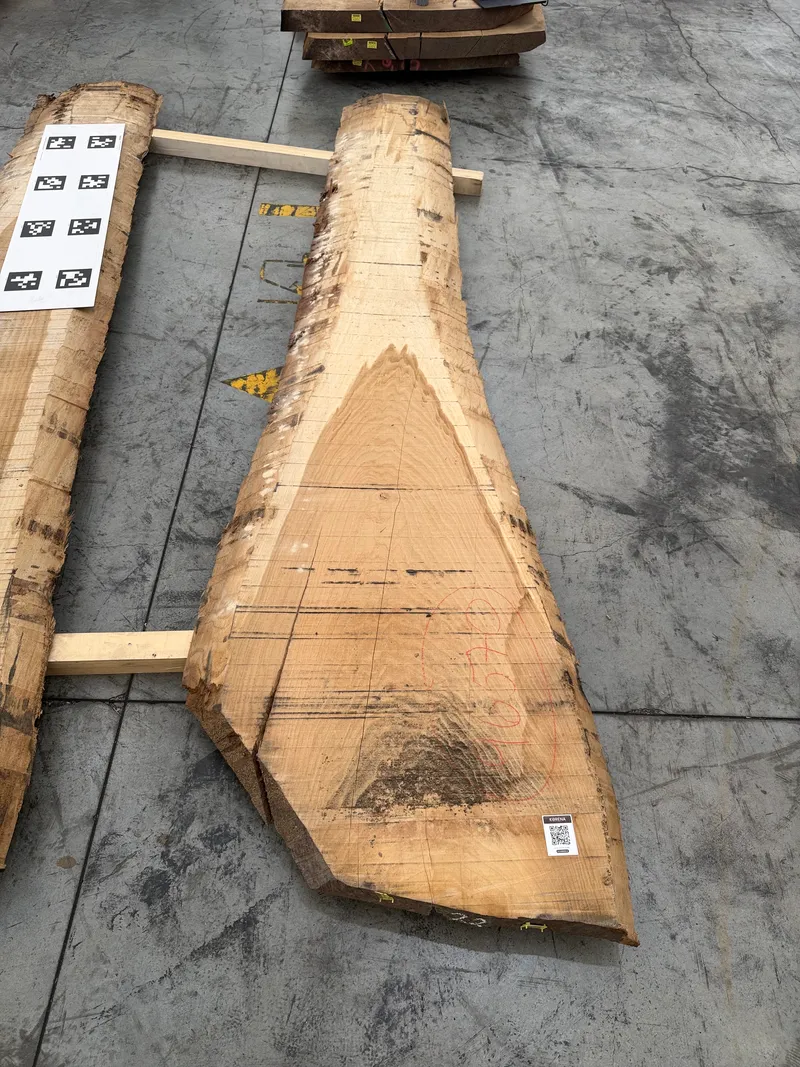
The single most consequential thing to read is the cut. A flatsawn face gives the bold cathedral pattern. A quartersawn face gives ray fleck, the silvery ribbon figure that is the species signature, and a considerably more stable board.
Look for checks radiating from the pith end, honeycomb on an end grain face, and cupping along the length. All three are drying faults, and oak that was pushed shows them.
Oak is full of tannins, and tannins react with iron to form a blue black stain. This is a same day problem, not a maintenance one.
Steel screws bleed black rings. A damp steel clamp bar prints a stripe across a glue-up. Steel wool leaves fragments that bloom into spots weeks later. Use brass or stainless throughout, keep steel wool away entirely, and pull clamps promptly.
The same chemistry run deliberately is how Arts and Crafts oak got its colour. Fuming with ammonia reacts with the tannins and darkens the wood evenly right through the surface, rather than sitting on it as a stain does.
Oak dries slowly and must be allowed to. Roughly a year per 25 mm for air drying remains a fair guide, and slab stock at 50 mm and above needs real patience.
In service, the ratio governs behaviour. Tangential shrinkage of 7.8 percent against radial at 4.4 percent is a wide differential, and it is what makes a flatsawn top cup between a humid summer and a heated winter. Quartersawn stock moves about half as much across its width. On a top that must stay flat, that is where the money goes.
Let a slab acclimatise in its final room for a couple of weeks before final flattening.
Oak is a pleasure with sharp tools and a fight with dull ones. It blunts cutters moderately. It glues reliably, takes stain and finish better than most timbers, holds fastenings well, and steam bends excellently, which is why it was the traditional choice for boat frames and chair backs.
The open pores need a grain filler if you want a glass smooth surface. Most makers do not fill them, because the texture is a large part of why oak reads as oak.
Right for tabletops, architectural joinery, flooring, cabinetry, cooperage and exterior joinery. Right whenever durability, availability and predictability matter more than novelty.
Wrong when you want a pale quiet surface, when weight is a constraint, or when a very wide single piece top has to stay dead flat, where Saman moves less than half as much.
Not CITES listed and assessed by the IUCN as Least Concern. Supply across France, Germany, central Europe and the Balkans is broad, certification is mature, and oak is among the most straightforward species in this catalogue to document to EUDR standard.
European oak is graded on the amount of clear face you get, and the grade names differ by country, which makes quotes hard to compare.
The broad tiers are consistent even where the labels are not. Top grade is largely clear, straight grained and knot free, and it is what goes into architectural joinery and veneer. Middle grades carry sound tight knots and some colour variation, and this is where most furniture oak sits. Rustic grades carry large knots, sapwood, and often some shake, and they are priced for character rather than clarity.
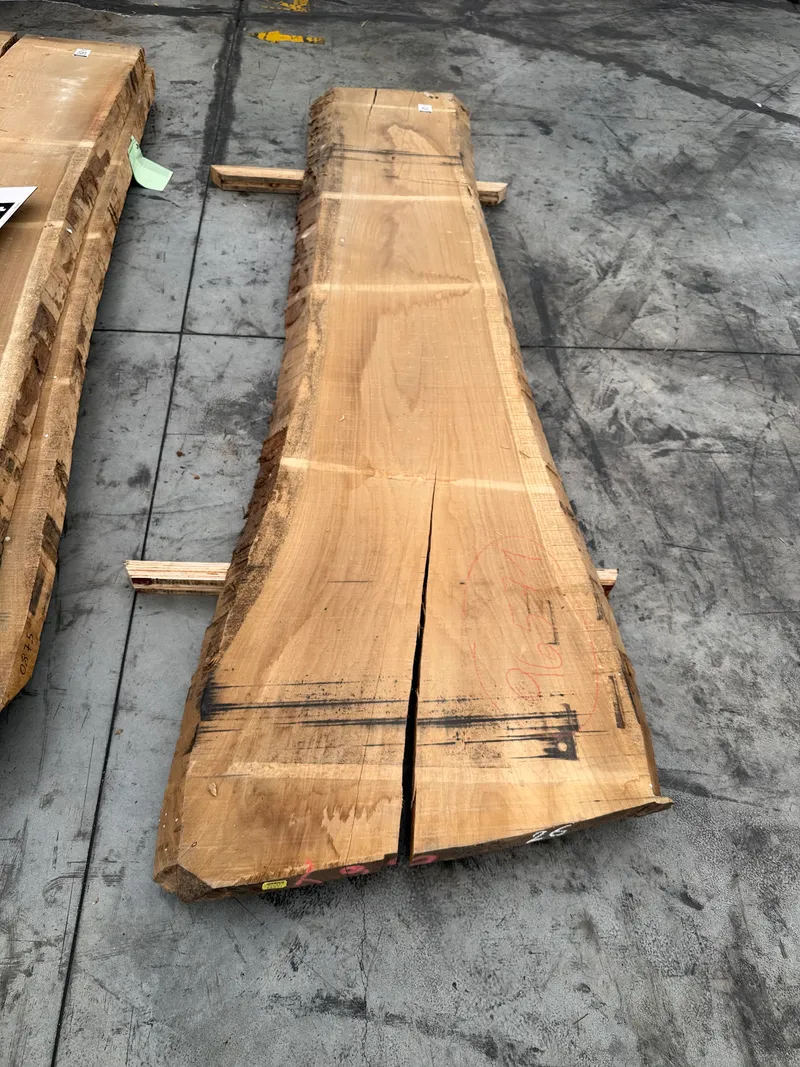
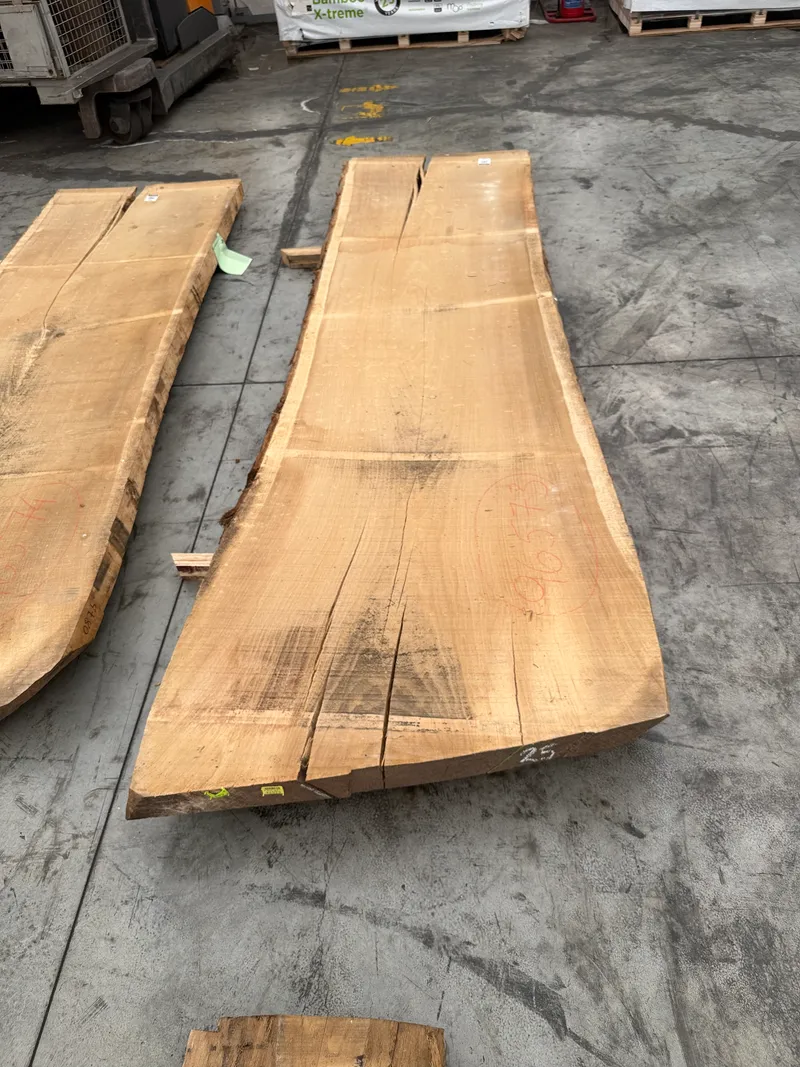
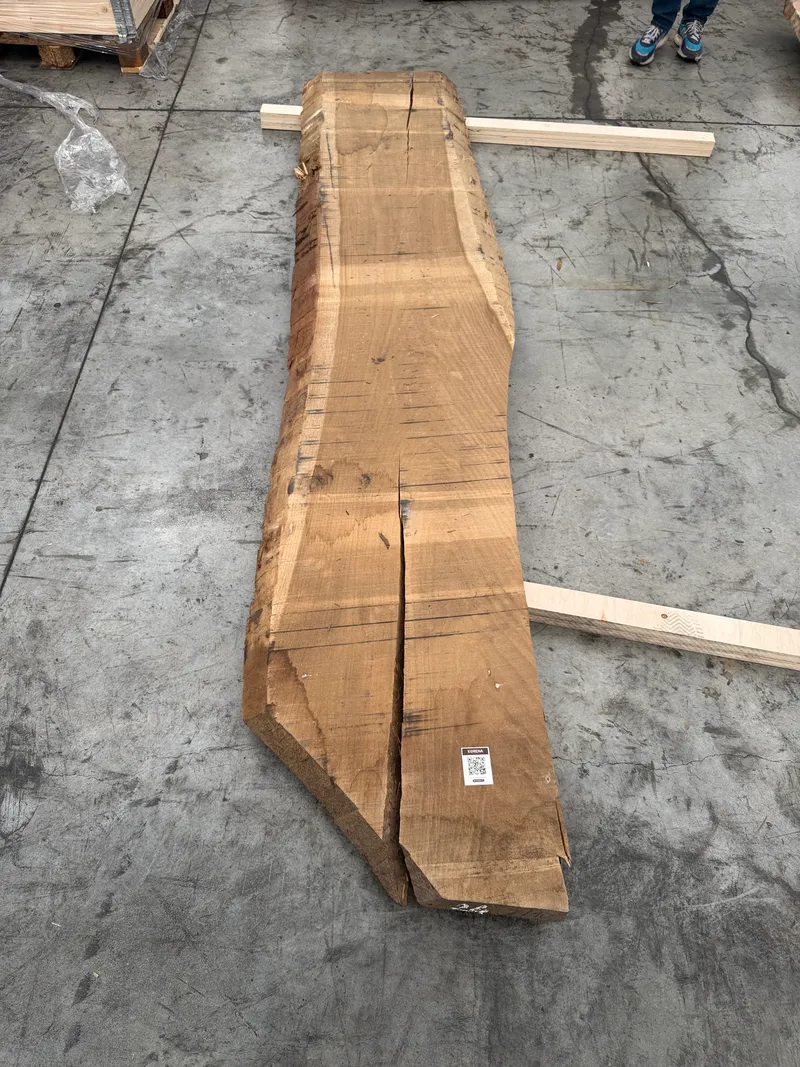
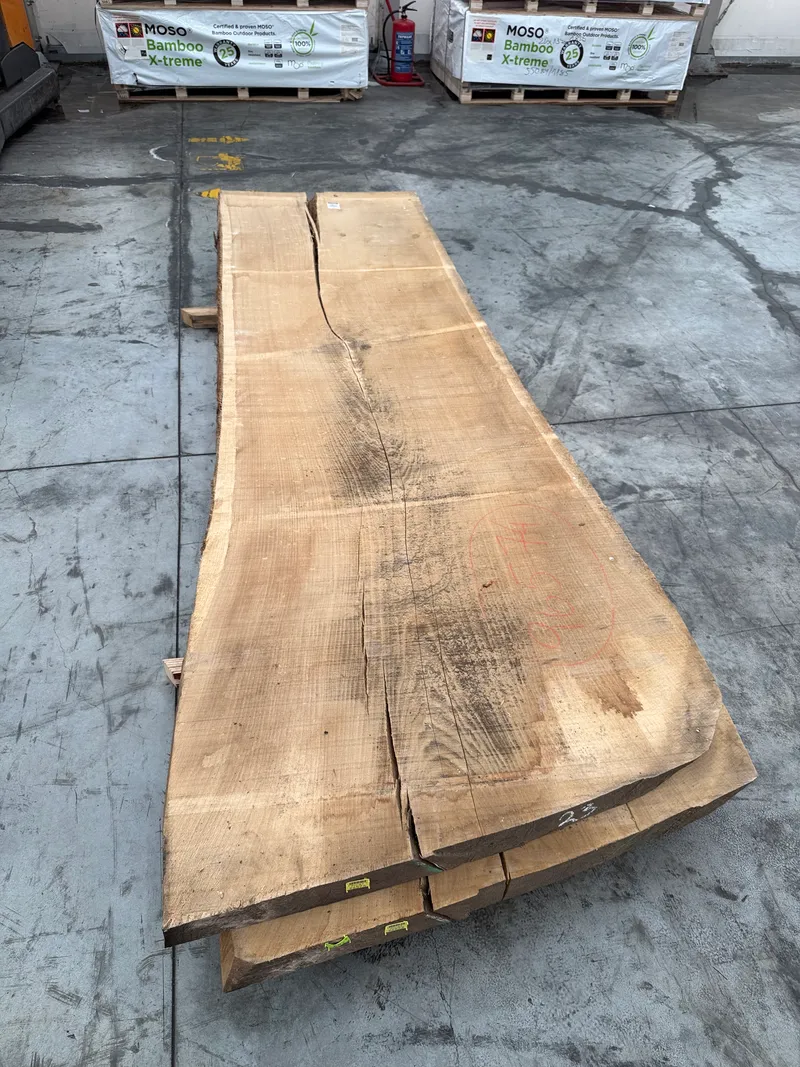
For slab work the grading system matters less than it does for boards, because a slab is bought as an individual object with its own defects visible. What does carry over is the vocabulary: a yard describing a slab as rustic is telling you it has knots and sapwood, not that it is defective.
The other thing worth asking is whether a slab is through and through sawn from the log or cut from a boule. A boule keeps the boards in sequence, so consecutive slabs mirror each other and can be bookmatched. Once a boule is broken up, that opportunity is gone permanently.
Oak makes a heavier slab than most people expect. At 675 kg per cubic metre, a 2.4 metre top at 50 mm thick and 900 mm wide weighs around 70 kg before a base goes under it. Plan the lift and the fixings accordingly.
The sapwood band on an oak slab is narrow, pale and much less durable than the heartwood. Left in place on an interior piece it is purely cosmetic and perfectly sound. On anything that will see moisture it is the part that fails first.
Questions des acheteurs
They are two species, Quercus robur and Quercus petraea, sold together as European oak and rarely separated. Robur is the pedunculate or English oak and favours heavy valley soils; petraea takes higher ground and grows straighter with more regular rings. At 675 kg per cubic metre and 4,980 N Janka, robur is fractionally lighter and softer than petraea at 710 and 4,990. For most work they are interchangeable.
Tannins in oak react with iron to form iron tannate, a blue black stain. Steel screws, damp steel clamp bars, steel wool and even nails in a bench top all cause it. Use brass or stainless fittings, never use steel wool on oak, and remove clamps promptly. Oxalic acid sometimes lifts an established stain, but prevention is far easier.
Usually yes. Tangential shrinkage of 7.8 percent against 4.4 percent radial means a flatsawn top cups noticeably across a humidity swing while a quartersawn one moves roughly half as much. Quartersawing also exposes the silvery ray fleck that is the signature figure of the species.
Longer than almost anything else. The traditional guide of roughly a year per 25 mm of thickness for air drying still holds. Rushed oak surface checks, honeycombs internally where you cannot see it, and case hardens so a flat looking slab springs the moment it is ripped. Every KORENA listing records the drying method and a measured moisture value.
Yes, within reason. At decay class 2 it is durable, and it has been the traditional European timber for exterior joinery, boatbuilding and framing for centuries. Ground contact still shortens its life considerably. Use stainless or brass fixings throughout, because the iron reaction is worse in wet conditions.
Propriétés mécaniques
Valeurs de référence publiées. Lorsque les sources divergent, la plage est indiquée et la valeur courante sert aux échelles ci-dessus.
| Densité (kg/m³)Masse par mètre cube à environ 12 % d’humidité. Un bois plus lourd est généralement plus dur et plus résistant. | 600–720 kg/m³valeur courante 675 kg/m³ |
|---|---|
| Dureté Janka (N)Force nécessaire pour enfoncer à moitié une bille d’acier dans le bois. Mesure standard de la résistance à l’enfoncement. | 4,500–5,500 Nvaleur courante 4 980 N |
| MOR : module de rupture (MPa)Résistance à la flexion : charge à laquelle une poutre casse. | 95–110 MPa |
| MOE : module d’élasticité (GPa)Rigidité en flexion : fléchissement d’une étagère ou d’un plateau sous une charge. | 10.5–12.5 GPa |
| Retrait radialRetrait perpendiculaire aux cernes, du bois vert au bois anhydre. Les planches sur quartier travaillent dans ce sens. | 4.4–5.0 % |
| Retrait tangentielRetrait dans le sens des cernes. Les planches sur dosse et la plupart des plateaux travaillent dans ce sens. | 7.8–9.0 % |
| Retrait volumiqueVariation totale de volume du bois vert au bois anhydre. Une valeur basse indique une meilleure stabilité. | 12.5–13.5 % |
| Durabilité naturelle (EN 350)Norme européenne de résistance naturelle à la pourriture, de 1 (très durable) à 5 (périssable). | Class 2 — Durable |
Nous vous envoyons un e-mail lorsque de nouveaux plateaux en European Oak arrivent chez KORENA. Chaque plateau est unique, mieux vaut donc être prévenu rapidement.
Dureté Janka : 4 980 N
Référence à laquelle les autres essences sont comparées
675 kg/m³
13,0 % de retrait volumique
3,7 / 5 de moyenne à l’atelier
EN 350 classe 2
Pourquoi un plateau coûte-t-il plus cher ?
Ces prix concernent le bois brut. Un plateau est la meilleure tranche d’une grume, séchée pendant au moins un an, puis contrôlée et mesurée individuellement. Seule une petite partie de chaque grume devient un plateau.
Source : KORENA Timber Index · Dernières données : 24 sept. 2026
Voir tous les prix régionauxTouchez une étiquette pour afficher les détails.