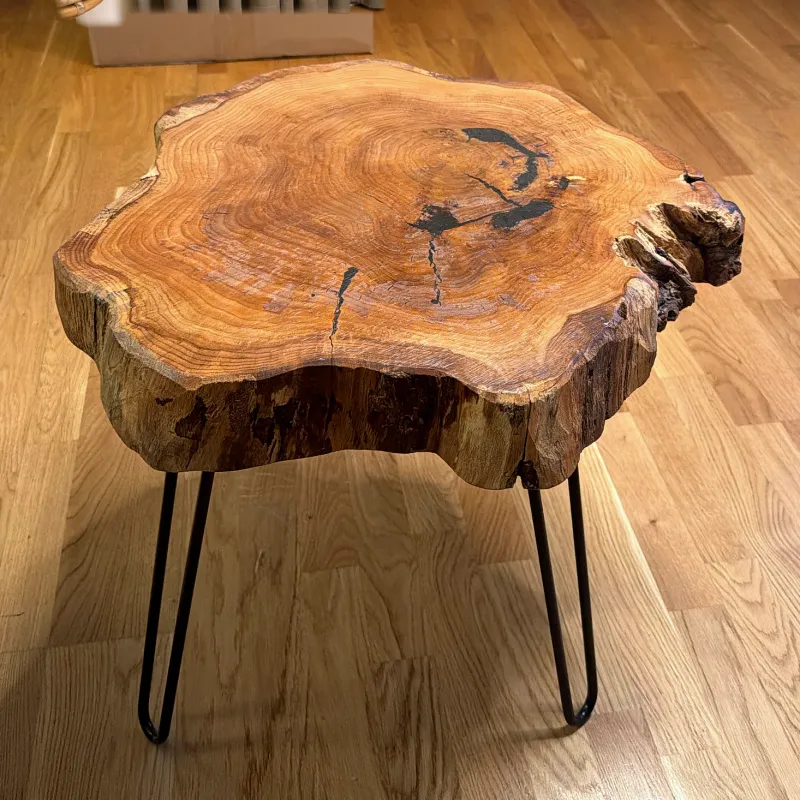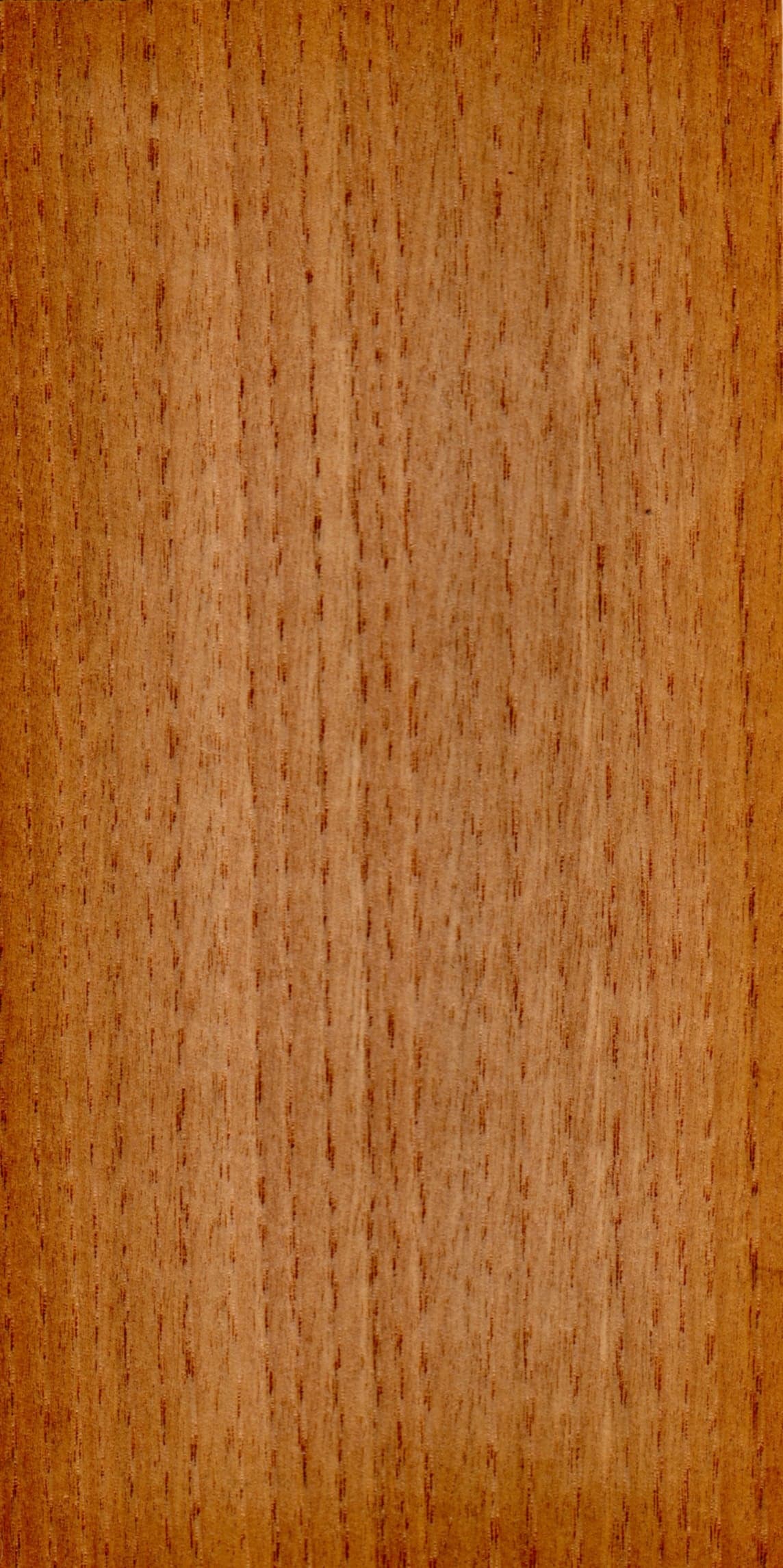
Castanea sativa
A lighter, softer cousin of oak. Tannin-rich heartwood gives it real durability outdoors, but those same tannins react with iron, so fixings need to be stainless or brass.
Medienos išvaizda
Straight-grained and coarse-textured, with prominent ring-porous figure that reads as oak at a glance. Heartwood is a warm honey-brown that ambers with age; sapwood is a narrow pale band. Lacks oak's strong medullary rays, so quartersawn faces are calmer and less flecked.
Apdirbimas
Saws and planes well with sharp tooling. Softer than oak, so it dents more easily but is also kinder on edges. Splits readily when screwed near ends or edges, pre-drill and countersink. Glues and steam-bends predictably. Turning is workable but the coarse grain can tear on end-grain cuts.
Takes oil, hardwax, and water-based finishes cleanly. Open pores benefit from a grain filler if you want a glass-flat surface, or leave them open for a tactile, oak-like read. Fuming with ammonia darkens it deeply thanks to the high tannin content. Test stains on offcuts, tannins can pull cool tones grey.
Dries slowly and is prone to ring shake and honeycomb if pushed. Air-dry to around 25–30% MC before kilning, then run a gentle schedule. Movement in service is moderate, tangential shrinkage near 7% means wide boards want room to move in panels and tabletops.
Kintant oro drėgnumui, mediena skersai pločio brinksta ir traukiasi. Prieš projektuodami tvirtinimus apskaičiuokite numatomą sezoninį Valgomasis kaštainis stalviršio pokytį.
Numatomas medienos brinkimas ir traukimasis per sezoną
apie 7,7 mm
Stalviršį tvirtinkite laikikliais arba gembėmis su pailgomis angomis, ne klijais ar stipriai suveržtais varžtais.
Linijinio nuodžiūvio modelis: plotis × (nuodžiūvis ÷ 28 % plaušo soties riba) × sezoninis drėgnio pokytis. Valgomasis kaštainis skaičiuojamas taikant 6,75 % tangentialinis nuodžiūvį. Tai planavimo įvertis, ne garantija.
Kiek šiuo metu Europoje kainuoja Valgomasis kaštainis mediena už kubinį metrą be PVM. Palieskite kainą, kad pamatytumėte išsamiau.
Dust is a reported skin and respiratory sensitiser, extract at source and wear a fitted mask when sanding or routing. Heartwood is rated food-contact safe once finished. Critical detail: chestnut tannins react with iron and produce black staining wherever the two meet in the presence of moisture. Use stainless steel or brass fixings, and keep iron tooling off damp stock.
Native across southern and Mediterranean Europe, with long-managed coppice woodlands in France, Italy, and the Iberian peninsula. Also grown in the UK and parts of central Europe. KORENA sources mainly from European coppice and standard-tree harvests.
Native European species, IUCN Least Concern, no CITES restrictions. Much of the European supply comes from coppice systems, short-rotation, low-input, and a working part of rural land management in France and Italy. Ask for FSC or PEFC chain-of-custody where it matters to your client. KORENA records the certification it holds on the slab passport.
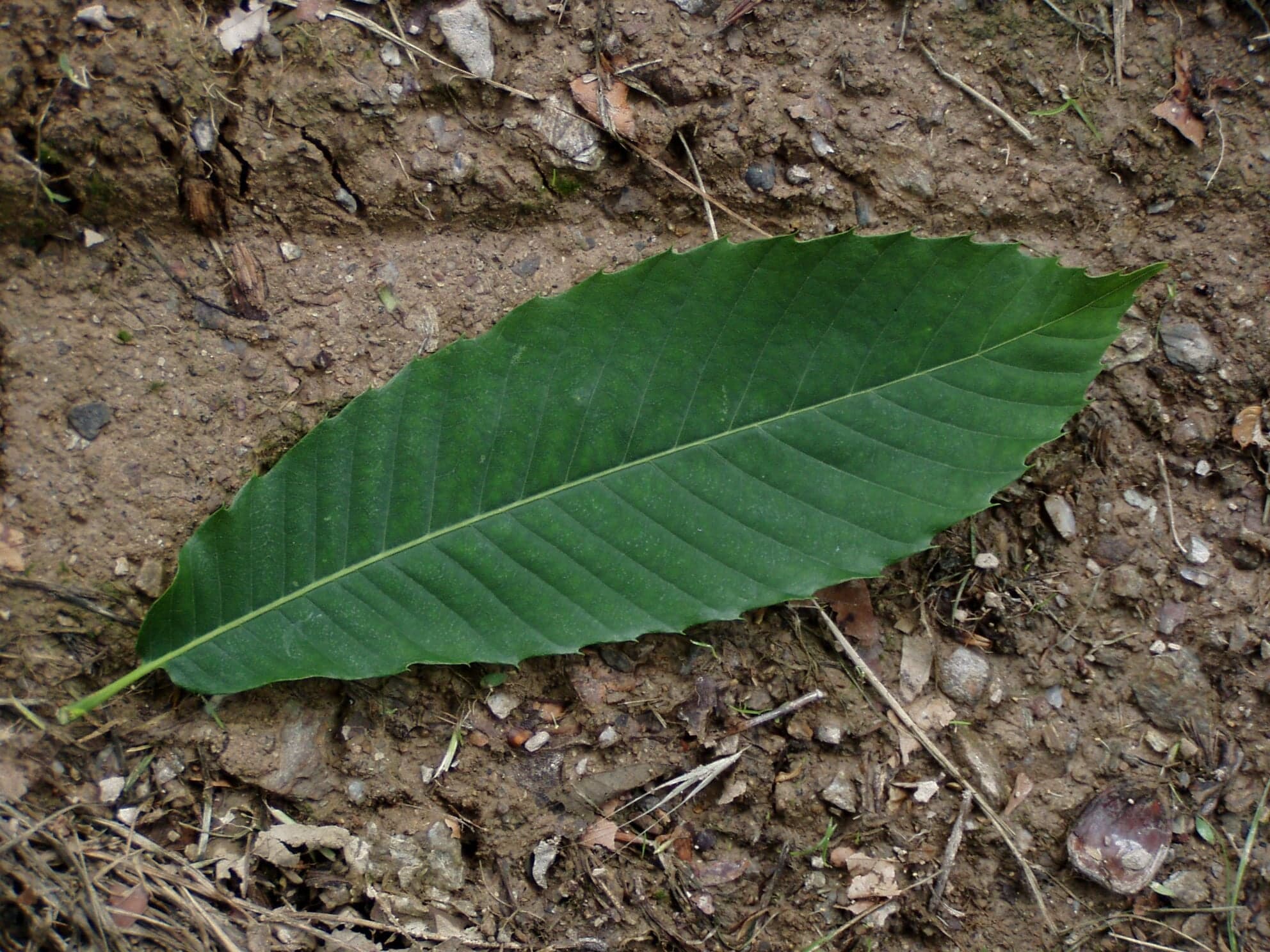
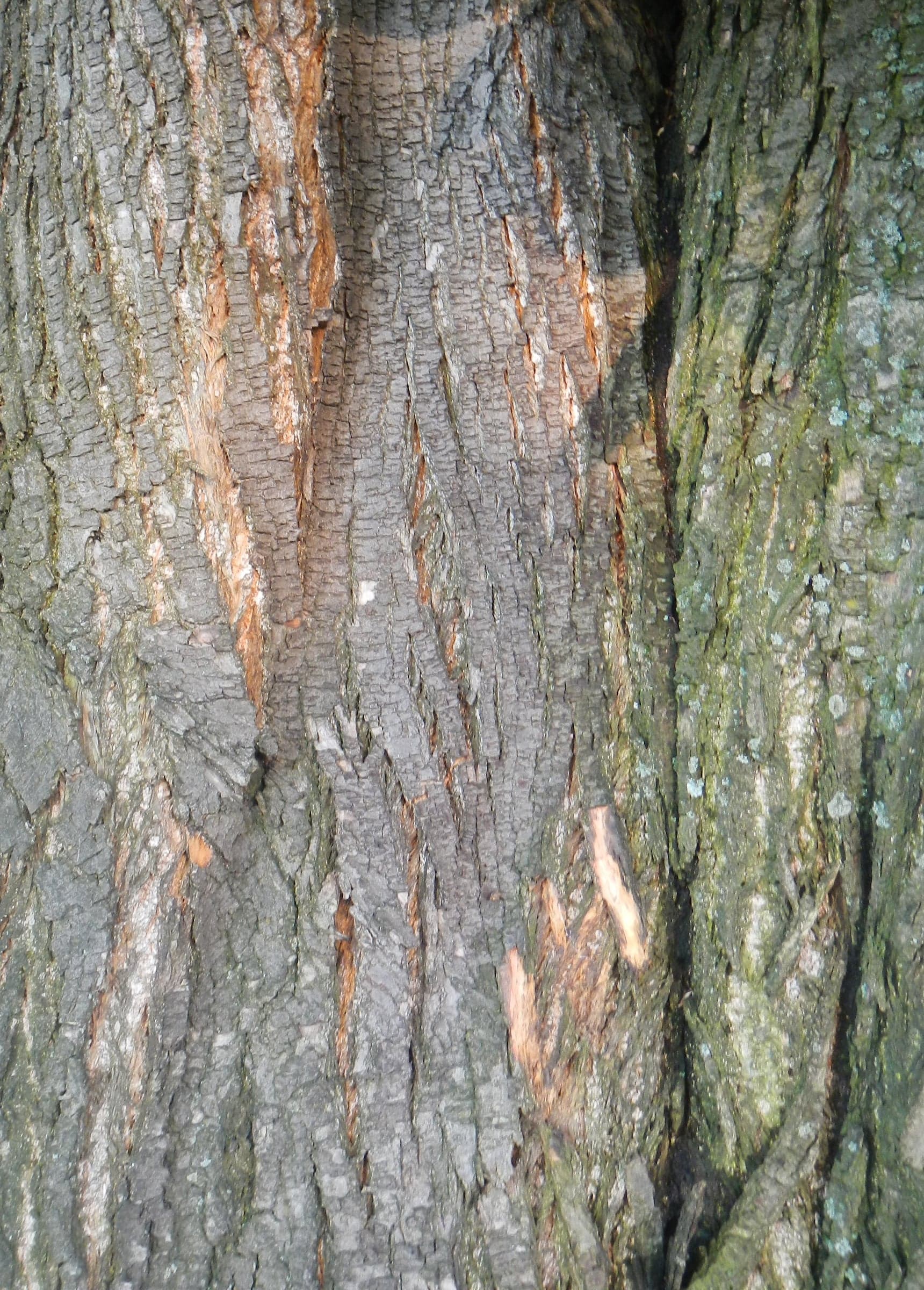
Castanea sativa is often sold as the light alternative to oak, and for appearance and durability that description holds. It is ring porous with a similar grain pattern, it carries a similar warm brown colour, and at decay class 2 it is genuinely durable outdoors.
Where the comparison breaks down is hardness. At 3,010 N Janka chestnut is the softest hardwood in this catalogue apart from black poplar, softer than Scots Pine and less than two thirds as hard as oak. Anyone expecting oak-like wear resistance from an oak-like appearance will be disappointed.
The other difference is visible: chestnut lacks oak's prominent rays, so a quartersawn chestnut board shows no ray fleck.
Chestnut is notably prone to ring shake, a separation along a growth ring inside the log.
The problem is that it frequently does not show on a rough sawn face. A board looks sound, gets machined, and the shake opens into a crescent shaped split that follows the ring and effectively ruins it.
This is the main reason chestnut yields far less usable timber than the abundance of the tree suggests, and it is the main reason to look carefully rather than quickly at a chestnut slab. Check end grain for any ring separation, and look along the length in raking light for a crescent line.
On a measured KORENA slab, a shake large enough to matter appears in the defect outline rather than being discovered at the bench.
Chestnut is very high in tannins, and that is where its durability comes from. At decay class 2 it is a genuine exterior timber and has been used across Europe for fencing, cladding, shingles, gates and outdoor structures for centuries. Coppiced chestnut fence posts remain a standard product precisely because they last without treatment.
The same tannins make the iron reaction worse than in oak. Contact with steel produces blue black staining quickly, particularly when damp. Use stainless or brass fixings on any chestnut and treat it as non-negotiable on exterior work.
Chestnut is easy to work, considerably easier than oak. It cuts cleanly, blunts tooling only moderately, glues well and takes finish readily.
Its softness is the working consideration. Arrises bruise, edges dent, and clamps mark the surface if you do not pad them.
The open pores need filling for a smooth surface, as in oak.
Volumetric shrinkage of 12.0 percent is moderate, with tangential at 6.0 percent against radial at 3.5 percent. That differential is narrower than oak's, so chestnut behaves reasonably well in a wide flatsawn board.
It dries readily, though drying is where existing ring shake tends to open up.
Exterior cladding, fencing, gates, garden structures, shingles and outdoor furniture, where its durability and light weight both count. Indoors it suits panelling, light furniture and any piece where an oak look is wanted at a fraction of the weight.
It is the wrong answer for a hard wearing work surface, and wrong wherever ring shake risk cannot be inspected for before committing.
Not CITES listed and assessed as Least Concern. Abundant across southern and western Europe with long established coppice management in France, Italy and the Iberian peninsula. Supply is straightforward and documentation simple.
Sweet chestnut has been coppiced across Europe for centuries. The tree is cut close to the ground and allowed to regrow multiple stems, which are harvested on a cycle of roughly fifteen to twenty years for poles, fencing and stakes.
That management history shapes what reaches the market. A great deal of chestnut is small diameter coppice material, excellent for its traditional uses and useless for slabs. Timber sized chestnut comes from maiden trees grown on a longer rotation, and it is much less common.
The practical effect is that wide chestnut slabs are scarcer than the abundance of the species suggests, and they command a premium relative to how cheap chestnut fencing is. If a quote for chestnut slabs looks similar to a quote for chestnut posts, something is wrong with the description.
Side by side, the two are easy to confuse at a glance and easy to separate on a second look.
Chestnut has no visible rays. Oak has prominent rays that show as fleck on the quarter and as fine lines on the face. That is the reliable test, and it works on a rough sawn surface.
Chestnut is also noticeably lighter in the hand at 590 kg per cubic metre against 675, and softer under a thumbnail at 3,010 N against 4,980. If a board looks like oak and feels light, check the rays.
Vartotojų klausimai
It looks similar and is durable like oak, but it is much lighter and softer at 590 kg per cubic metre and 3,010 N Janka against 675 and 4,980 for European oak. Chestnut also lacks the prominent rays, so it has no ray fleck on quartersawn faces. It is often described as oak without the weight, which is fair for appearance and durability but not for hardness.
A separation along a growth ring inside the log, which chestnut is particularly prone to. It may be invisible on a rough sawn surface and open up after machining, effectively ruining a board. It is the main reason chestnut yields less usable timber than its abundance suggests, and the main thing to inspect for when buying.
Yes. At decay class 2 it is durable, and its high tannin content gives real resistance to rot. Chestnut has been the traditional European timber for fencing, cladding, shingles and outdoor structures for centuries, and coppiced chestnut fence posts are still a standard product.
Yes, and more readily. Chestnut is very high in tannins, so contact with iron produces blue black staining quickly, particularly in damp conditions. Use stainless or brass fixings on any chestnut, and especially on exterior work.
At 3,010 N it is the softest hardwood in this catalogue apart from black poplar, softer than Scots Pine. A chestnut tabletop will dent. It suits a piece where that patina is acceptable, and where the light weight and oak-like appearance are the attraction.
Mechaninės savybės
Paskelbtos orientacinės vertės. Jei šaltiniai nesutampa, nurodomas intervalas, o pirmiau pateiktoms skalėms naudojama tipinė vertė.
| Tankis (kg/m³)Vieno kubinio metro svoris esant maždaug 12 % drėgniui. Sunkesnė mediena paprastai yra kietesnė ir stipresnė. | 540–650 kg/m³tipinė vertė 590 kg/m³ |
|---|---|
| Kietumas pagal Janka (N)Jėga, kurios reikia plieniniam rutuliukui įspausti į medieną iki pusės. Standartinis atsparumo įspaudams matas. | 2,700–3,300 Ntipinė vertė 3 010 N |
| MOR: stipris lenkiant (MPa)Stipris lenkiant: apkrova, kuriai veikiant sija lūžta. | 70–85 MPa |
| MOE: tamprumo modulis (GPa)Standumas lenkiant: kiek lentyna ar stalviršis įlinksta nuo apkrovos. | 8.0–10.0 GPa |
| Radialinis nuodžiūvisNuodžiūvis skersai rievių nuo žalios iki visiškai sausos būklės. Taip keičiasi radialinio pjūvio lentos. | 3.5–4.5 % |
| Tangentialinis nuodžiūvisNuodžiūvis išilgai rievių. Taip keičiasi tangentinio pjūvio lentos ir dauguma storlenčių. | 6.0–7.5 % |
| Tūrinis nuodžiūvisBendras tūrio pokytis nuo žalios iki visiškai sausos būklės. Mažesnė vertė reiškia didesnį stabilumą. | 12.0–13.5 % |
| Natūralus patvarumas (EN 350)Europos natūralaus atsparumo puviniui standartas nuo 1 (labai patvari) iki 5 (nepatvari). | Class 2 — Durable |
Parašysime jums, kai KORENA pasirodys naujų Valgomasis kaštainis storlenčių. Kiekvienas vienetas yra vienetinis, todėl verta sužinoti iš anksto.
Kietumas pagal Janka 3 010 N
40 % minkštesnė už ąžuolą
590 kg/m³
12,8 % tūrinis nuodžiūvis
3,9 / 5 apdirbimo vidurkis
EN 350 klasė 2
Kodėl storlentė kainuoja daugiau?
Tai žaliavinės medienos kainos. Storlentė yra geriausias rąsto pjūvis, džiovintas metus ar ilgiau, tada kiekvienas vienetas atskirai patikrintas ir išmatuotas. Storlente tampa tik nedidelė kiekvieno rąsto dalis.
Šaltinis: KORENA medienos indeksas · Naujausi duomenys: 2026-11-02
Žiūrėti visas regionines kainasPalieskite žymą ir peržiūrėkite išsamiau.