KORENA
DrewnoFinished piecesMateriałySkładyMagazyn

Otrzymuj powiadomienia

Każda deska jest niepowtarzalna. Gdy się sprzeda, znika. Piszemy, gdy pojawiają się nowe sztuki: świeże dostawy, nowe gatunki i deski dopasowane do projektu.

Kilka wiadomości miesięcznie. Bez spamu, możesz zrezygnować w każdej chwili.

KORENA, wysokiej jakości drewno liściaste

Jedna sztuka naraz.

Zweryfikowane drewno liściaste wysokiej jakości, sprzedawane sztuka po sztuce. Każda deska jest fotografowana, mierzona i wysyłana ze składu partnerskiego z paszportem drewna.

Sklep

  • Przeglądaj produkty
  • Archiwum sprzedanych
  • Śledź zamówienie

Wiedza

  • Magazyn
  • Przewodniki po gatunkach
  • Słownik
  • Porównaj
  • Autorzy

Pomoc

  • O nas
  • Jak to działa
  • Zostań składem partnerskim
  • Znajdź deskę
  • Pomoc
  • Wzory dokumentów
  • Dla mediów

Zakupy

  • Warunki sprzedaży
  • Prawo odstąpienia
  • Zwroty i gwarancja
  • Wysyłka i dostawa

Zaufanie

  • Polityka prywatności
  • Polityka plików cookie
  • Pochodzenie drewna i EUDR
  • Dostępność

Informacje prawne

  • Nota prawna / informacje o firmie
  • Dopuszczalne użytkowanie
  • Własność intelektualna i treści

© 2026 KORENA. Wszelkie prawa zastrzeżone.

Operatorem jest Martial Labs Ltd. (BG, EIK 207453941). KORENA jest nazwą handlową Martial Labs Ltd.

Szanujemy Twoją prywatność

Używamy niezbędnych plików cookie, aby witryna działała. Za Twoją zgodą użyjemy również plików cookie do analityki, spersonalizowanych treści i reklam. W każdej chwili możesz zmienić decyzję na stronie ustawień zgody. Zobacz naszą politykę plików cookie i politykę prywatności.

  1. Strona główna
  2. /
  3. Gatunki
  4. /
  5. Maritime Pine

Pinus pinaster

Maritime Pine

The pine of the Atlantic coast and the Landes. The most resinous and least stable wood KORENA lists, with a bold coarse figure that suits rustic work.

  • Uprawiane i pozyskiwane w Europie.
  • Grupa botaniczna. Drewno iglaste pochodzi z drzew iglastych, a liściaste z drzew liściastych.
  • Rodzina botaniczna, do której należy gatunek.
Powiadom mnie, gdy się pojawiGatunek referencyjny. Obecnie brak dostępnych sztuk.
  • Dopasowanie do projektu
  • Dostępne
  • Wygląd
  • Obróbka
  • Praca drewna
  • Cena
  • Bezpieczeństwo i pozyskiwanie
  • Pytania
  • Dane techniczne

Czy pasuje do Twojego projektu?

Świetne do

  • Rustic tabletops
  • Panelling
  • Carcass work
  • Painted furniture
  • Shelving

Brak drewna Maritime Pine w bieżącej dostawie

Dostępne podobne gatunki

Obecnie nie ma drewna Maritime Pine. Te gatunki nadają się do podobnych projektów i są dostępne.

  • Usłojenie Saman

    Saman

    Samanea saman

    4 sztuki

  • Usłojenie European Oak

    European Oak

    Quercus robur

    6 sztuk

  • Usłojenie European Walnut

    European Walnut

    Juglans regia

    9 sztuk

Otrzymuj powiadomienia o drewnie Maritime Pine

Wyślemy Ci wiadomość, gdy w KORENA pojawią się nowe deski Maritime Pine. Każda sztuka jest niepowtarzalna, więc warto wiedzieć wcześniej.

Kilka wiadomości miesięcznie. Bez spamu, możesz zrezygnować w każdej chwili.

Wygląd drewna

Jak wygląda

Pale yellow to reddish brown heartwood against wide pale sapwood, with very wide growth rings reflecting fast coastal growth. The ring contrast is strong, giving a bold and slightly coarse figure. It is the most resinous species KORENA lists, which is both its historical value, as the tree was tapped for turpentine for centuries, and its main working difficulty.

  • Pale yellow to reddish brown heartwood
  • Wide pale sapwood band
  • Wide growth rings with strong earlywood to latewood contrast
  • Straight grain with very wide rings and extreme earlywood to latewood contrast, giving a bold coarse figure. Pale yellow to reddish brown, highly resinous.

Obróbka

Obróbka

Works fairly well with most tools, but the resin gums up tools and clogs sandpaper more than in any other species here. Abrasives should be treated as consumable. The wide, soft earlywood bands between hard latewood bands mean the surface can wash out under sanding, leaving a rippled face, so scraping is preferable to heavy abrasive work. Sharp cutters are essential.

Wykończenie

Wipe down with denatured alcohol or acetone before finishing to lift surface resin, otherwise oil finishes may stay tacky in patches. Once clean it takes oil and wax well. Pigment stains blotch severely because of the extreme density contrast between earlywood and latewood, so a dye or a clear finish is much safer. Seal knots with shellac before any painted finish.

Suszenie

Dries reasonably quickly but is prone to distortion given the wide rings and often spiral grain of fast grown coastal stock. A hot kiln schedule drives resin to the surface where it sets sticky and interferes with finishing later. Air drying followed by a low temperature kiln finish is the sensible route. Volumetric shrinkage at around 14.4 percent is the highest of any species KORENA lists, so movement in service is substantial.

Jak bardzo będzie pracować?

Drewno pęcznieje i kurczy się w poprzek szerokości, gdy powietrze staje się wilgotniejsze lub suchsze. Przed zaprojektowaniem mocowań oszacuj sezonową pracę blatu z drewna Maritime Pine.

Sposób przetarcia
Miejsce użytkowania

Przewidywana sezonowa praca

około 10,3 mm

Przymocuj blat łącznikami lub wspornikami w podłużnych otworach, bez kleju i mocno dokręconych wkrętów.

Liniowy model skurczu: szerokość × (skurcz ÷ 28 % punktu nasycenia włókien) × sezonowa zmiana wilgotności. Dla gatunku Maritime Pine używa skurczu stycznego wynoszącego 9 %. To wartość do planowania, a nie gwarancja.

Ile kosztuje

Bezpieczeństwo i pozyskiwanie

  • Uprawiane i pozyskiwane w Europie.
  • Status na Czerwonej liście IUCN: globalna ocena zagrożenia tego gatunku.
  • Working with pine has been reported to cause allergic skin reactions and asthma-like symptoms in some people. Because this species carries more resin than the others here, skin contact sensitisation is a more realistic risk over repeated exposure. Gloves when handling and good extraction while machining are worth the habit.

Przeczytaj pełny przewodnikSzczegółowe informacje o rysunku drewna, zmianie barwy, obróbce i stabilności.+

What Maritime Pine actually is#

Pinus pinaster is the pine of the western Mediterranean and the Atlantic seaboard of Iberia and France. The Landes forest in southwest France, planted on former dunes and marsh from the nineteenth century onward, is the largest planted pine forest in western Europe and the principal commercial source of this timber.

For centuries the tree was more valuable standing than felled, because it was tapped for resin to produce turpentine and rosin. That history is the single most useful fact about the wood, because the resin that made it commercially important is also what makes it the most demanding species in this catalogue to machine and finish.

Reading a Maritime Pine slab#

Fast coastal growth produces very wide growth rings, and the contrast between the soft pale earlywood and the hard dark latewood is extreme. The result is a bold, coarse figure with a lot of visual movement, quite different from the fine even texture of spruce or fir.

That coarseness is the honest character of the wood and suits rustic work well. It does not suit a design asking for a quiet, uniform surface.

Colour runs pale yellow to reddish brown in the heartwood against a wide pale sapwood band. Spiral grain is common in fast grown coastal stock and is worth checking for, because it is the main cause of the distortion this species is prone to.

Pytania kupujących

Pytania kupujących

Why is Maritime Pine so much stickier to work than other pines?

+

It carries more resin than any other species KORENA lists, which is why it was tapped commercially for turpentine and rosin for centuries. The resin softens with cutting heat and deposits on blades, in saw gullets and across abrasives. Clean blades with a resin solvent between operations and expect sandpaper to load quickly.

How much will it move?

+

More than anything else in this catalogue. Volumetric shrinkage is around 14.4 percent, the highest figure KORENA lists, with tangential movement at 9.0 percent against 4.5 percent radial. A wide flatsawn top will change noticeably between seasons, so it must float on slotted fasteners and should acclimatise in its final room before flattening.

Why does the surface look rippled after sanding?

+

The earlywood bands are much softer than the latewood bands and abrasives cut them away faster, leaving a washboard surface. This is worse in Maritime Pine than other pines because the rings are wide and the contrast extreme. Use a card scraper or a sharp plane for the final surface rather than sanding it flat.

Is it strong enough for a table?

Właściwości mechaniczne

Dane techniczne

Opublikowane wartości referencyjne. Gdy źródła się różnią, podajemy zakres, a w powyższych skalach stosujemy wartość typową.

Gęstość (kg/m³)Masa metra sześciennego przy wilgotności około 12 %. Cięższe drewno jest zwykle twardsze i mocniejsze.500 kg/m³
Twardość Janki (N)Siła potrzebna do wciśnięcia stalowej kulki do połowy w drewno. Standardowa miara odporności na wgniecenia.1,740 N
MOR: wytrzymałość na zginanie (MPa)Wytrzymałość na zginanie: obciążenie, przy którym belka pęka.73 MPa
MOE: moduł sprężystości (GPa)Sztywność przy zginaniu: stopień ugięcia półki lub blatu pod obciążeniem.8.5 GPa
Skurcz promieniowySkurcz w poprzek słojów, od drewna mokrego do całkowicie suchego. W tym kierunku pracują deski przetarte promieniowo.4.5 %
Skurcz stycznySkurcz wzdłuż słojów. W tym kierunku pracują deski przetarte stycznie i większość desek KORENA.
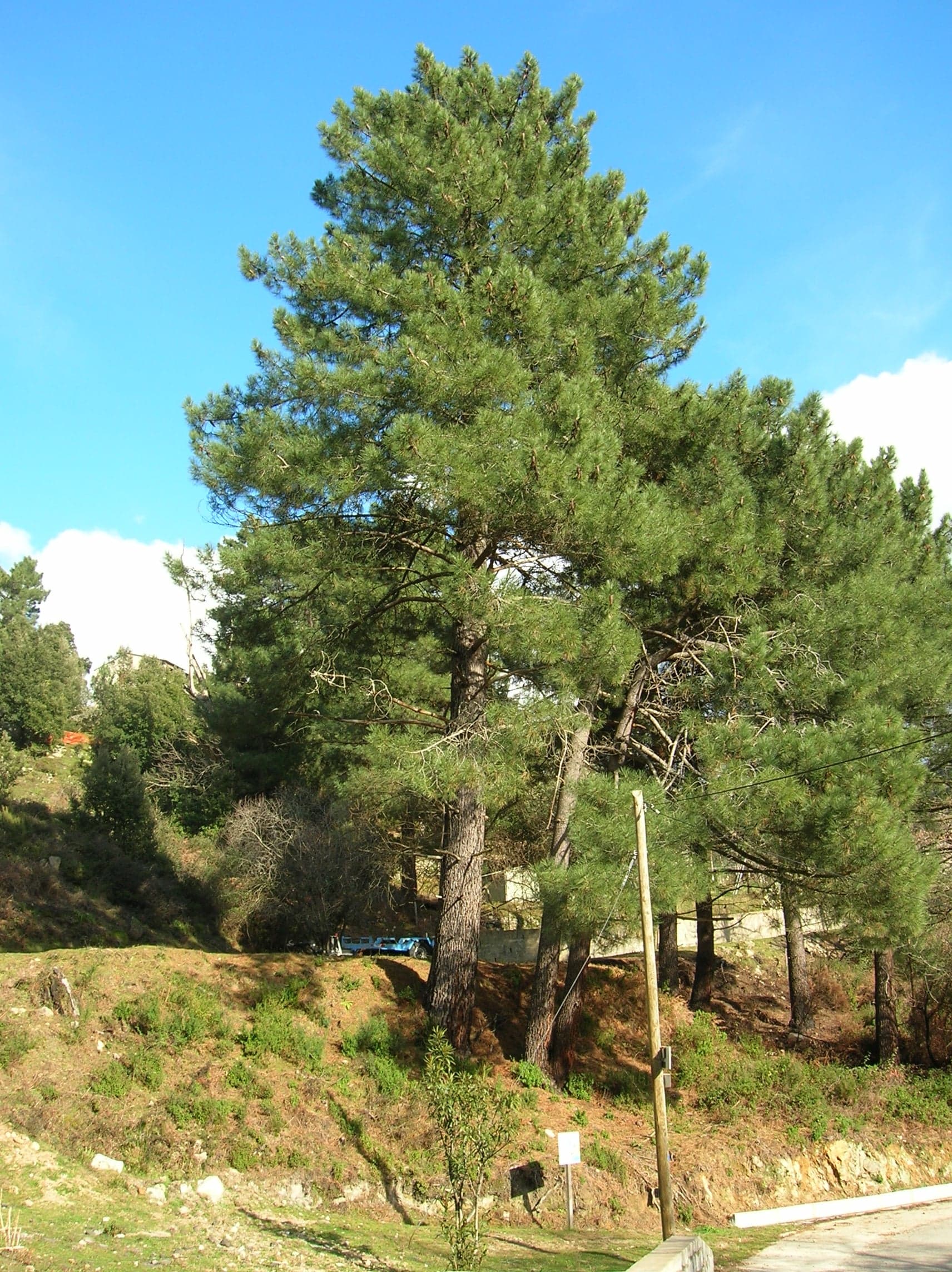
Drzewo Maritime Pine

Laurent Gallet, via Wikimedia Commons

Pinus pinaster is the pine of the western Mediterranean and the Atlantic coast of Iberia and France. The Landes forest in southwest France is the largest planted pine forest in western Europe and the main commercial source. Portuguese and Spanish material is also common in the EU market.

  • Not listed in the CITES Appendices and assessed by the IUCN as Least Concern. The Landes plantations are intensively managed and certified supply is readily available, which makes documentation straightforward. Fire is the significant risk to supply in this species range, and large burn events periodically push salvage volumes into the market.

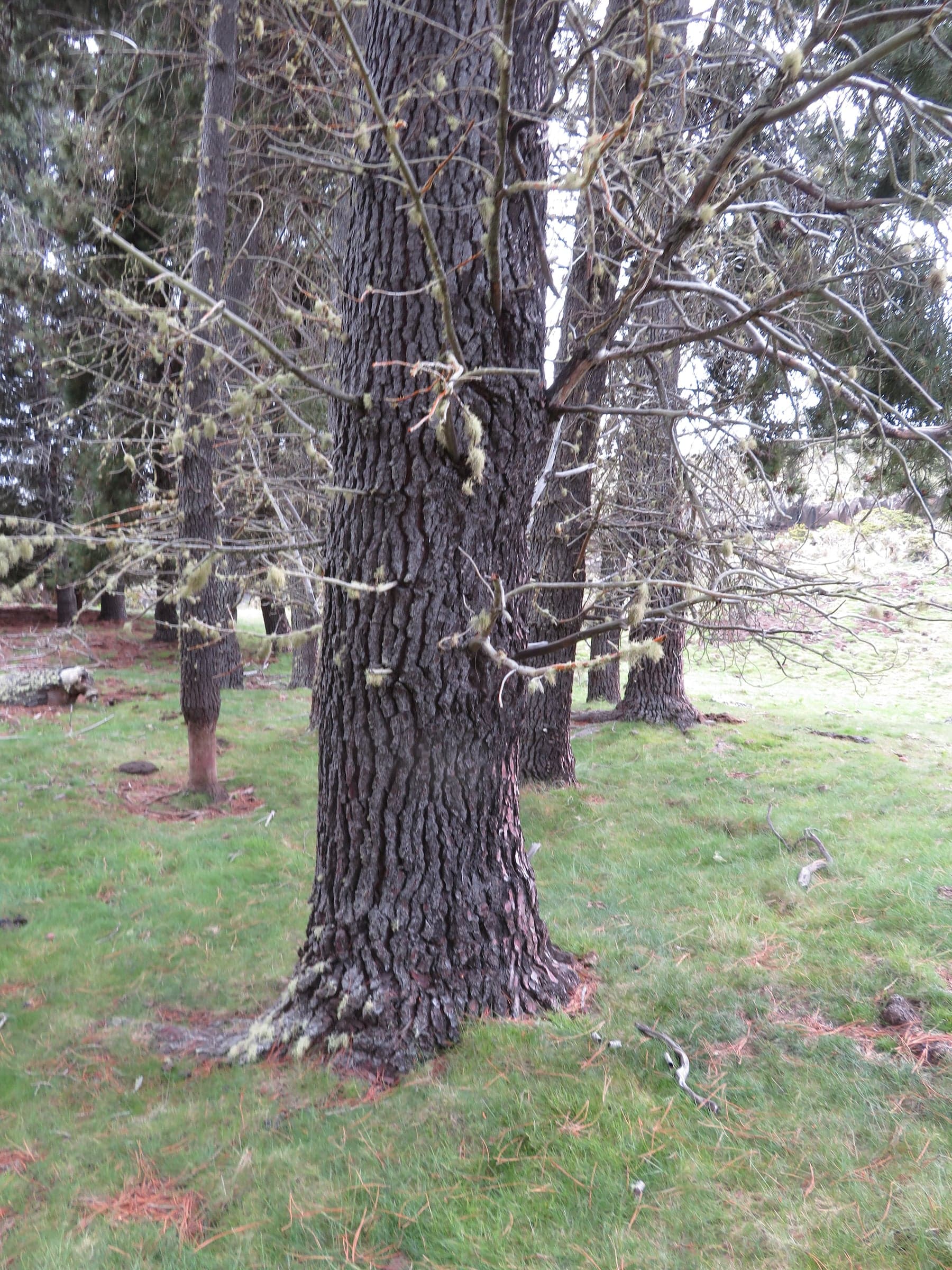
  • Maritime Pine: Kora
    Kora

    At the bench, and the resin problem#

    Maritime Pine works fairly well with most tools, and then the resin asserts itself.

    It gums blades faster than larch, which is saying something. It loads abrasives so quickly that sandpaper should be budgeted as a consumable rather than a tool. Saw gullets pack. Plane soles need clearing. None of this is difficult, but all of it is constant, and a schedule built on pine machining speeds will run over.

    There is a second, subtler machining problem. Because the earlywood bands are wide and much softer than the latewood, abrasives cut the soft bands away faster than the hard ones. Sand a Maritime Pine face flat and you get a washboard: a rippled surface that catches light unevenly. The fix is to produce the final surface with a sharp plane or a card scraper and use abrasives only lightly, if at all.

    Drying and movement#

    This species moves more than anything else KORENA lists. Volumetric shrinkage is around 14.4 percent, with tangential movement at 9.0 percent against 4.5 percent radial, a ratio of two to one that guarantees flatsawn boards will want to cup.

    It also dries with a tendency to distort, driven by the wide rings and frequent spiral grain of fast grown stock. A hot kiln schedule compounds the problem by drawing resin to the surface, where it sets sticky and sabotages the finish months later.

    Air drying under cover followed by a low temperature kiln finish is the route that works. Ask the yard what schedule was used, and let any slab acclimatise in its final room for a couple of weeks before final flattening. On a KORENA listing the drying method and measured moisture are recorded, so this is checkable rather than a matter of trust.

    Finishing#

    Start with a solvent wipe. Denatured alcohol or acetone across the surface, allowed to flash off, lifts the mobile surface resin. Skip this and an oil finish will cure unevenly and stay tacky in patches, which is a fault that only appears after the work is otherwise done.

    Once clean it takes oil and wax well. Pigment stains blotch severely here, worse than on any other pine, because the density contrast is so extreme. Use a dye or leave it clear. Seal knots with shellac before any painted finish.

    Where Maritime Pine is the right answer#

    Rustic tabletops, panelling, carcass work and shelving where the bold coarse figure is wanted and the movement can be designed around. It is inexpensive, widely available and honest about what it is.

    It is the wrong answer for fine work, for anything requiring dimensional precision across a wide panel, for a surface that must stay unmarked at 1,740 N Janka, and for any project where the finishing schedule cannot absorb the extra solvent and cleaning steps.

    Sourcing and EUDR#

    Not CITES listed and assessed as Least Concern. The Landes plantations are intensively managed with good certification coverage, so documentation is straightforward and supply is reliable. The one thing to be aware of is fire. Large burn events in southwest France and Iberia periodically push significant salvage volumes into the market, and salvage material is legitimate but should be identified as such rather than discovered on arrival.

    +

    At 1,740 N Janka it is soft, close to Norway Spruce and well below Scots Pine at 2,420 N. It makes a rustic tabletop that will dent and record use. For a surface expected to stay unmarked, choose a hardwood.

    Is my oil finish going to stay tacky?

    +

    It will if you skip the solvent wipe. Clean the surface with denatured alcohol or acetone and let it flash off before applying any oil, and be more thorough about it than you would with Scots Pine. Kiln dried stock that was pushed hot carries the most surface resin.

    9.0 %
    Skurcz objętościowyCałkowita zmiana objętości od drewna mokrego do całkowicie suchego. Niższa wartość oznacza większą stabilność.14.4 %
    Naturalna trwałość (EN 350)Europejska norma naturalnej odporności na rozkład, od 1 (bardzo trwałe) do 5 (nietrwałe).Class 4 — Slightly durable

    Źródła

    • The Wood Database — Maritime Pine (Pinus pinaster)(dostęp: 2026-08-12)
    • USDA FPL Wood Handbook FPL-GTR-190 (2010)(dostęp: 2026-08-12)
    • Meier, E. — WOOD! Identifying and Using Hundreds of Woods Worldwide (2015)(dostęp: 2026-08-12)

    Uwaga

    • Nie nadaje się na zewnątrz bez zabezpieczeniaNaturalna trwałość to klasa 4 z 5 według EN 350. Stosuj we wnętrzach albo pod regularnie odnawianą powłoką.
    • Pracuje bardziej niż większość gatunkówSzerokie blaty wymagają łączników lub mocowań w podłużnych otworach oraz miejsca na ruch. Skorzystaj z kalkulatora poniżej.
    • Pył działa drażniącoWłącz odciąg i noś maskę podczas szlifowania lub obróbki.

    Dotknij etykiety, aby zobaczyć szczegóły.

    W skrócie

    Poziomy mają stałe przedziały dla wszystkich gatunków prezentowanych przez KORENA, dzięki czemu można je bezpośrednio porównywać. Pod każdym widnieje zmierzona wartość.
    TwardośćOdporność na wgniecenia i zużycieMiękkie

    Twardość Janki: 1740 N

    O 65 % miększe od dębu europejskiego

    MasaJak ciężka jest deska przy podnoszeniuLekkie

    500 kg/m³

    StabilnośćJak niewiele pracuje wraz ze zmianą pór rokuŻywe

    14,4 % skurczu objętościowego

    ObróbkaPiłowanie, struganie, szlifowanie i klejenieWymagające

    3,1 / 5, średnia ocena obróbki

    Zastosowanie na zewnątrzNaturalna odporność na rozkład, EN 350Tylko do wnętrz

    Klasa 4 według EN 350

    • Piłowanie · DobraJak czyste daje cięcie i jak szybko tępi brzeszczoty.1 = trudna · 5 = doskonała
    • Struganie · DobraJak gładką pozostawia powierzchnię i jak często wyrywa włókna.1 = trudna · 5 = doskonała
    • Szlifowanie · DostatecznaJak szybko można je wyszlifować na gładko bez zapychania papieru.1 = trudna · 5 = doskonała
    • Toczenie · DobraJak zachowuje się podczas toczenia i wykańczania na tokarce.1 = trudna · 5 = doskonała
    • Rzeźbienie · DobraJak wyraźnie zachowuje detale wykonywane dłutem.1 = trudna · 5 = doskonała
    • Klejenie · Bardzo dobraJak niezawodnie trzymają połączenia klejone.1 = trudna · 5 = doskonała
    • Trzymanie wkrętów / gwoździ · Bardzo dobraJak dobrze trzyma wkręty i gwoździe bez pękania.1 = trudna · 5 = doskonała
    • Gięcie parowe · DobraJak dobrze przyjmuje krzywizny po parowaniu.1 = trudna · 5 = doskonała

    Bieżące ceny drewna Maritime Pine w całej Europie za metr sześcienny bez VAT. Dotknij dowolnej ceny, aby zobaczyć szczegóły.

    • Standardowe kłodyDuże ilości standardowego drewna okrągłego sprzedawanego przez właścicieli lasów i lasy państwowe, głównie dla budownictwa i przemysłu.Większość cen mieści się między 90 € a 90 €.Na podstawie 4 cen z 1 regionu.Najnowsze dane: 31 gru 2025

    Dlaczego deska kosztuje więcej?

    To ceny surowego drewna. Deska jest najlepszym wycinkiem kłody, suszonym przez co najmniej rok, a następnie sprawdzanym i mierzonym sztuka po sztuce. Tylko niewielka część każdej kłody staje się deską.

    Źródło: KORENA Timber Index · Najnowsze dane: 31 gru 2025

    Zobacz wszystkie ceny regionalne