How to Buy a Hardwood Slab in Europe
A practical checklist for choosing, comparing and receiving an individually measured hardwood slab from a European seller.
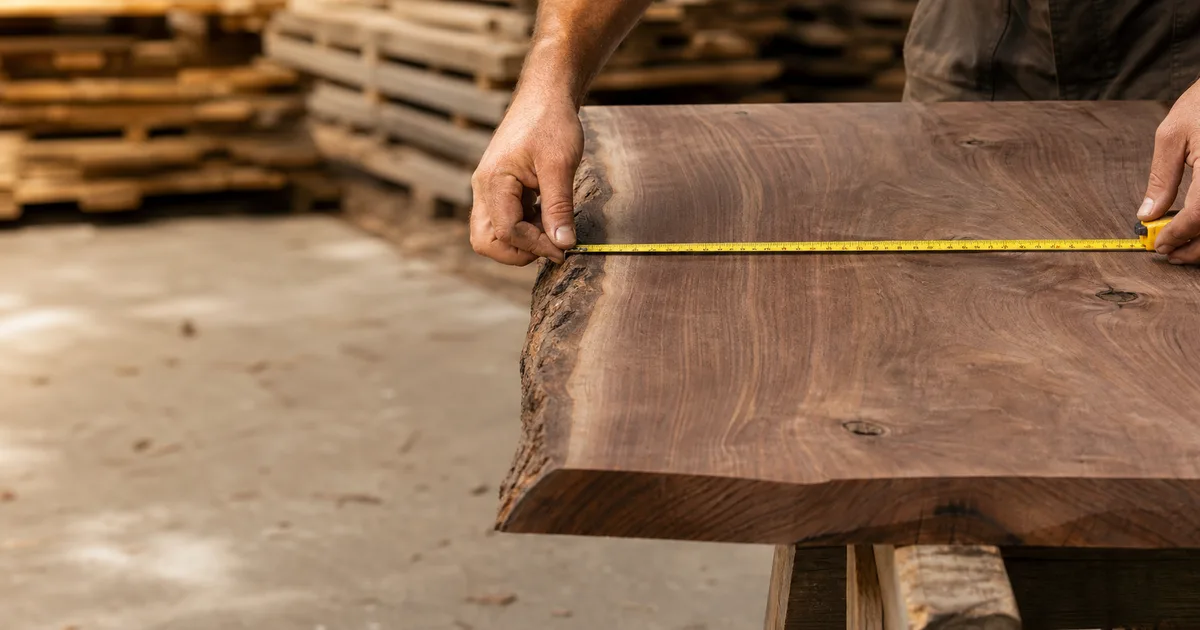
What you are actually buying#
A hardwood slab is a one-of-one piece of a tree. Its outline, grain, colour and defects cannot be reordered to a standard specification. Even consecutive cuts from the same log may differ in width, curvature, sapwood and checking.
That makes a slab different from dimensioned timber. A board sold as 50 × 200 mm is expected to be reasonably consistent. A slab described as 3.2 m long and 650 mm wide may reach that width only at certain points. Its natural edges may curve inwards, and one end may contain a split that must be removed.
Three variables establish the basic character of a slab:
- Species affects colour, hardness, grain and expected movement.
- Drying affects stability and the amount of work required before machining.
- Shape determines whether the piece contains your intended finished outline.
The shape is often the deciding factor. A beautiful slab that narrows across the planned leg position may be unsuitable for a table, while a less dramatic piece with consistent usable width may fit perfectly.
Online buying therefore depends on measurements and photographs that describe the individual piece. Start by looking through the slab catalogue, but treat each listing as a technical record rather than a product variant.
Decide the project before choosing the slab#
Write down the finished length, minimum width and finished thickness before comparing pieces. Include the positions of legs, joints, cable ports, sinks or other features that restrict where defects can remain.
For a dining table, distinguish between the overall width you would like and the minimum acceptable width at every critical point. The dining-table slab size guide helps translate room size and seating into practical dimensions. You can then compare those requirements with current dining-table slabs.
A rough slab must be larger than the finished part. You may need to trim split ends, remove an irregular corner, straighten an edge or shift the complete tabletop outline away from a defect. There is no universal allowance. A clean, flat slab needs less than a twisted slab with deep checks.
Thickness also disappears during flattening. A slab listed at 50 mm will not produce a 50 mm finished top once both faces are machined. The loss depends on cup, twist, local thickness variation and the flattening method. Ask the seller whether the stated thickness is nominal, minimum or measured at several points. If your design requires a specific finished thickness, ask how much sound material is likely to remain after flattening.
Draw the intended component to scale over the measured slab outline where possible. This simple check is much more useful than judging the largest quoted width.
Choose a species for the work#
Species choice should follow the use, appearance and machining plan. The species guides provide a useful starting point, but the individual slab still needs inspection.
European walnut is usually selected for its darker brown heartwood and the contrast that can occur between heartwood and lighter sapwood. Its colour changes with finish and light, so ask for photographs in neutral daylight if colour matching matters. Current KORENA stock includes ten kiln-dried European Walnut slabs, 3.0–3.4 m long, around 0.5–0.65 m wide and 50 mm thick. Recent moisture readings run from about 6.5 to 11%, with prices from about €180 net. See the European walnut page and the detailed European walnut slab buying guide.
European oak is generally paler and harder than walnut, with a strong grain that suits large tables and benches. Current stock includes six slabs around 3.2–3.3 m long, up to about 1.0 m wide and 70–90 mm thick. A 3.3 m piece is around €490 net. Thick oak can be heavy and may require substantial flattening capacity, so include handling and machining in the decision. The European oak slab buying guide covers the species-specific checks.
Less familiar species require extra research. KORENA currently has four Saman slabs, including pieces up to 4.76 m long and over 1.1 m wide. Before choosing saman or another less common species, confirm the botanical name, origin, density, expected movement and how the colour looks under your intended finish. Check whether your tooling, workshop access and delivery route can handle the size.
All solid wood moves as humidity changes. Species influences movement, but grain orientation, drying quality and the final environment matter too. Do not choose on a hardness label alone.
Read the listing as a measurement record#
A trustworthy listing lets you test whether the finished component fits inside the actual slab. It should show the outline, overall length, useful widths at stated positions, thickness, moisture, drying method and clear photographs of both faces and important defects.
KORENA listings show the measured outline and width stations at 25%, 50% and 75% of the slab length. I measure each slab myself in the partner yard with the capture system, so those numbers come from the physical piece rather than a stock description. Those stations reveal taper and waist that a single maximum width conceals. Compare every station with your minimum requirement, then inspect the outline between them. A deep inward curve can still fall between measurement stations.
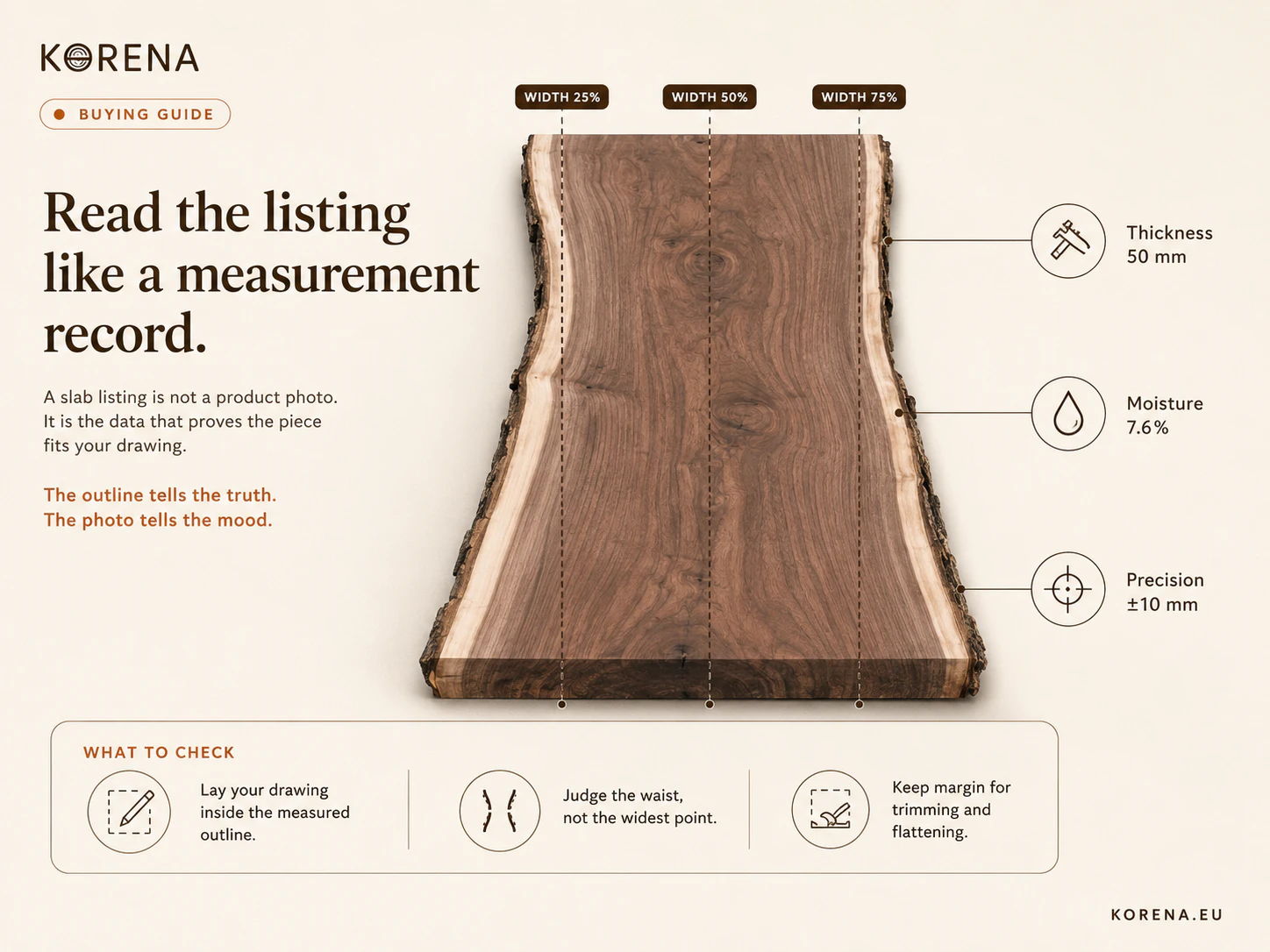
The precision badge states the expected measurement tolerance, typically within 10 mm. It is not a promise that the natural edge is straight or that every point has been sampled. Use the tolerance when planning margins. If your component fits by only a few millimetres, the slab is too close to the limit.
Thickness needs context. Look for local thin areas, saw marks, cup and twist. Ask whether bark is included in width figures and whether the ends are square. For a bookmatched pair, confirm that measurements identify each piece separately and that the photographs make the intended joint clear.
Photographs should include scale and detail. Look for end grain, both faces, edge condition, checks, knots, inclusions and any filled or stabilised areas. A single polished or wet glamour photograph cannot answer these questions. If an important area is hidden, request a close-up before paying.
Save the listing, outline and defect photographs with your order documents. They provide a clear reference when the slab arrives.
Check moisture and drying#
Drying method and current moisture reading answer different questions. Kiln drying controls the drying process and can prepare timber for interior work, but the slab can still gain or lose moisture later. Air-dried timber may also be usable, depending on its history, thickness and destination.
There is no single correct moisture percentage for every European workshop. The suitable level depends on the climate in the workshop and the room where the finished piece will live. Around 7–8% can be appropriate for many heated interiors, but a slab will begin adjusting when moved to a wetter or drier environment.
Ask where the reading was taken, when it was taken and whether it represents the surface or deeper material. Meter type and species settings affect interpretation. A reading from the day of measurement is useful evidence, but it does not freeze the slab at that value.
Transport can change the surface reading. Packaging, rain, cold storage and a heated workshop all affect the result. This is why a small difference on arrival does not by itself prove poor drying. Read why moisture changes in transit before comparing seller and arrival readings.
If the project is sensitive, measure the slab after arrival with a suitable calibrated meter and record the location, depth, date and workshop conditions. Delay final machining until readings and dimensions have settled for the intended environment.
Decide which defects fit the design#
Defects are not automatically disqualifying. A knot, check or band of sapwood may be central to the design, harmless outside the finished outline or expensive to stabilise. The correct judgement depends on location and depth.
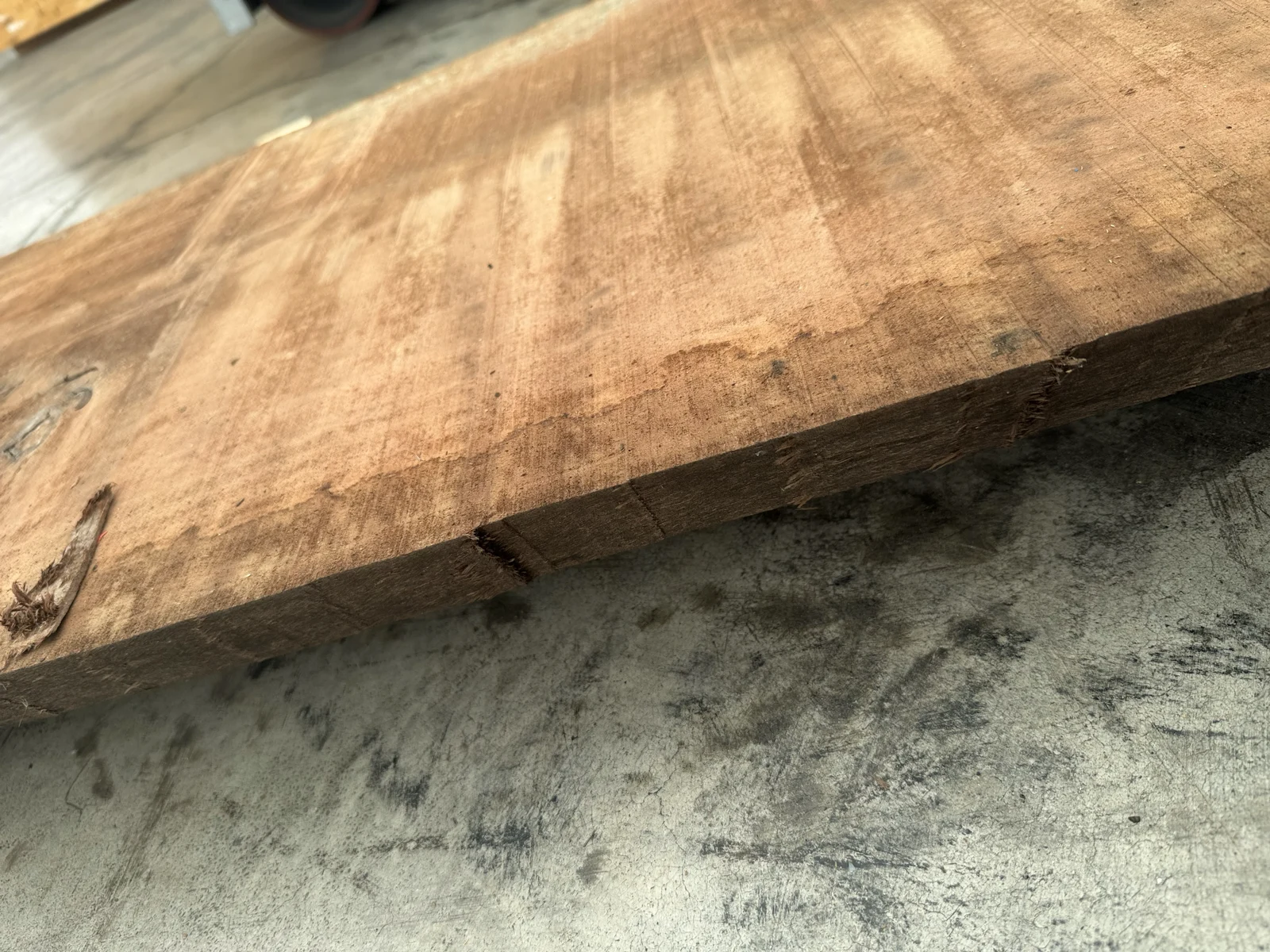
Inspect these areas closely:
- End checks: establish how far they extend beyond the visible opening and how much length must be trimmed.
- Pith: timber containing the centre of the tree can be less predictable as it dries. Ask for an end-grain photograph if its position is unclear.
- Bark inclusions: determine whether bark separates two sound areas and whether the inclusion crosses a planned joint or fixing point.
- Knots and voids: inspect both faces to understand whether they pass through the slab.
- Sapwood: decide whether the colour contrast suits the design and whether the outer material is sound.
- Insect holes or soft areas: ask whether activity is historical, whether the timber has been treated and what evidence supports the answer.
- Cup and twist: request straightedge photographs or measured deviation when flatness will affect yield.
Walk away when the seller cannot show a critical defect clearly, when sound finished dimensions cannot be established, or when the required repair exceeds your equipment and experience. A large resin fill can work, but it changes the schedule, cost and appearance. Removing the affected area may be the safer plan.
Do not assume bark can remain as a durable finished edge. Loose bark and cambium often need removal. Confirm what lies underneath before treating the live edge as finished material.
Compare the full price, not one headline figure#
Slabs can be priced per piece, by volume or through an area-based comparison. None of these methods captures usable yield by itself. A low price per square metre can hide deep checks, severe taper or hours of flattening.
Compare the cost of reaching a finished component:
- Net slab price and any applicable VAT.
- Packing, crating and delivery.
- Usable length, minimum width and likely finished thickness.
- Flattening, trimming, filling and sanding.
- Handling equipment or outsourced machining.
- Waste and offcuts that have a real use in the project.
Thickness usually carries value because the tree, drying time and handling burden are greater, but extra thickness is useful only if the design needs it. A 90 mm oak slab may be poor value for a light 35 mm top if most material becomes waste. It may be appropriate for a thick table, sculpted base or project requiring substantial correction.
Current catalogue examples show why headline comparison needs context. Walnut starts at about €180 net for 3.0–3.4 m pieces around 50 mm thick. A 3.3 m oak piece is around €490 net, with current oak thicknesses of 70–90 mm and widths reaching about 1.0 m. These are individual pieces, not a general market average.
Use the daily-refreshed KORENA Timber Index as a European hardwood price reference, then read what a hardwood slab costs in Europe for the factors behind the invoice.
Verify provenance and paperwork#
Wood provenance is becoming a practical purchasing criterion. EUDR is Regulation (EU) 2023/1115, amended by Regulation (EU) 2025/2650, and wood is a covered commodity. Due-diligence obligations apply to large and medium operators from 30 December 2026, and to micro and small operators from 30 June 2027.
Operators file a Due Diligence Statement through the EU Information System and receive a DDS reference number. Harvest plot geolocation is required, including polygons for plots over 4 hectares. The exact documentation relevant to a buyer depends on where the wood enters the supply chain and the buyer's commercial role.
KORENA assigns each slab a per-piece wood passport, accessed by QR at p.korena.eu. It records provenance information for that individual piece towards EUDR due diligence. Piece-level records matter because slabs can otherwise become separated from yard paperwork during storage, resale or fabrication.
Ask what the passport contains, how the slab identifier matches the physical piece, and which records will accompany the invoice. A passport supports traceability, but buyers with their own legal obligations must still check what information and DDS references they need to retain or pass on.
Buying documented pieces now reduces later reconstruction work. It also gives a studio a repeatable filing practice before the relevant application date. Keep the invoice, listing, passport link or export, supplier identity and any DDS reference supplied. See EUDR for hardwood buyers for a fuller explanation of roles and records.
Plan shipping and inspect the arrival#
A slab over 3 m long is a freight item. Thick oak and very wide pieces can require several people or mechanical handling. Before ordering, check vehicle access, unloading responsibility, doorway dimensions, stairs and the route to storage. Confirm whether delivery is kerbside and whether the driver provides unloading equipment.
Ask how the slab will be protected against impact, bending and rain. Crating adds cost and weight, but may be sensible for a valuable piece or a route involving several depots. Edge protection and firm support matter because natural edges and checked ends are vulnerable.
On delivery day, inspect the package before signing where the carrier process permits. Photograph crushed corners, punctures, wet areas and broken restraints. After opening, match the slab to the listing outline, identifier and defect photographs. Check both faces and ends. Record any transport damage promptly and retain the packaging until the issue is resolved.
Measure moisture as a dated arrival reading, not as an instant verdict on the seller's measurement. Store the slab flat with even support and airflow. Avoid placing it directly beside a heater or on a damp floor.
Acclimatisation time varies with thickness, moisture difference and workshop conditions. Use repeated readings and dimensional checks rather than a fixed number of days. Rough machining in stages can reduce risk on demanding work, provided enough material remains for final flattening.
Buyer's checklist#
Before ordering a wood slab listed for sale online, confirm:
- The finished length, minimum width and finished thickness.
- Enough allowance for trimming, flattening and measurement tolerance.
- The measured outline and widths at 25%, 50% and 75%.
- Whether width includes bark or unstable edge material.
- Thickness variation, cup, twist and likely machining loss.
- Drying method, moisture reading, reading date and measurement location.
- Photographs of both faces, end grain and every significant defect.
- How checks, pith, knots, inclusions and sapwood affect the design.
- The total cost including VAT, packing, delivery and remaining work.
- Provenance records, slab identifier, wood passport and relevant DDS information.
- Crating, delivery access, unloading responsibility and handling equipment.
- The process and deadline for reporting transport damage.
- A supported storage position and a plan for acclimatisation.
If any answer changes the usable dimensions, update the drawing before paying. The safest online purchase is the piece whose measured shape, condition and records can be checked against a defined project.